Project 1: SARS-CoV-2 genome assembly from Illumina reads
Project 1: SARS-CoV-2 genome assembly from Illumina reads Course: SARS-2 Bioinform tics & D t Science Abhin v Mishr 29th September 2023 a a a a a
Background

Background (perspective is import nt !) a
What’s it good for ?
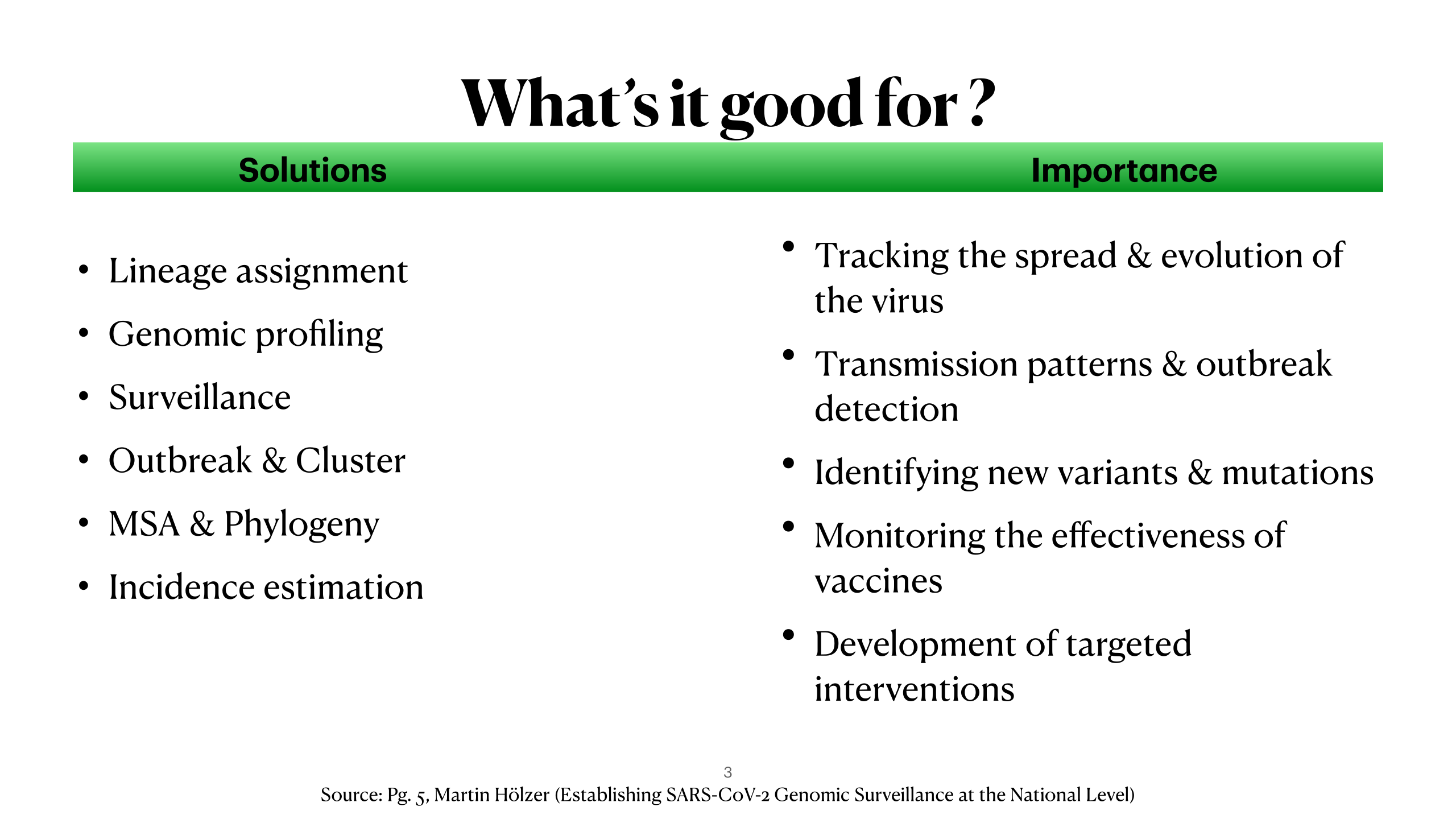
What’s it good for ? Solutions Import nce • Lineage assignment • Genomic pro ling • Surveillance • Outbreak & Cluster • MSA & Phylogeny • Incidence estimation • Tracking the spread & evolution of the virus • Transmission patterns & outbreak detection • Identifying new variants & mutations • Monitoring the e ectiveness of vaccines • Development of targeted interventions a ff fi Source: Pg. 5, Martin Hölzer (Establishing SARS-CoV-2 Genomic Surveillance at the National Level)
Data
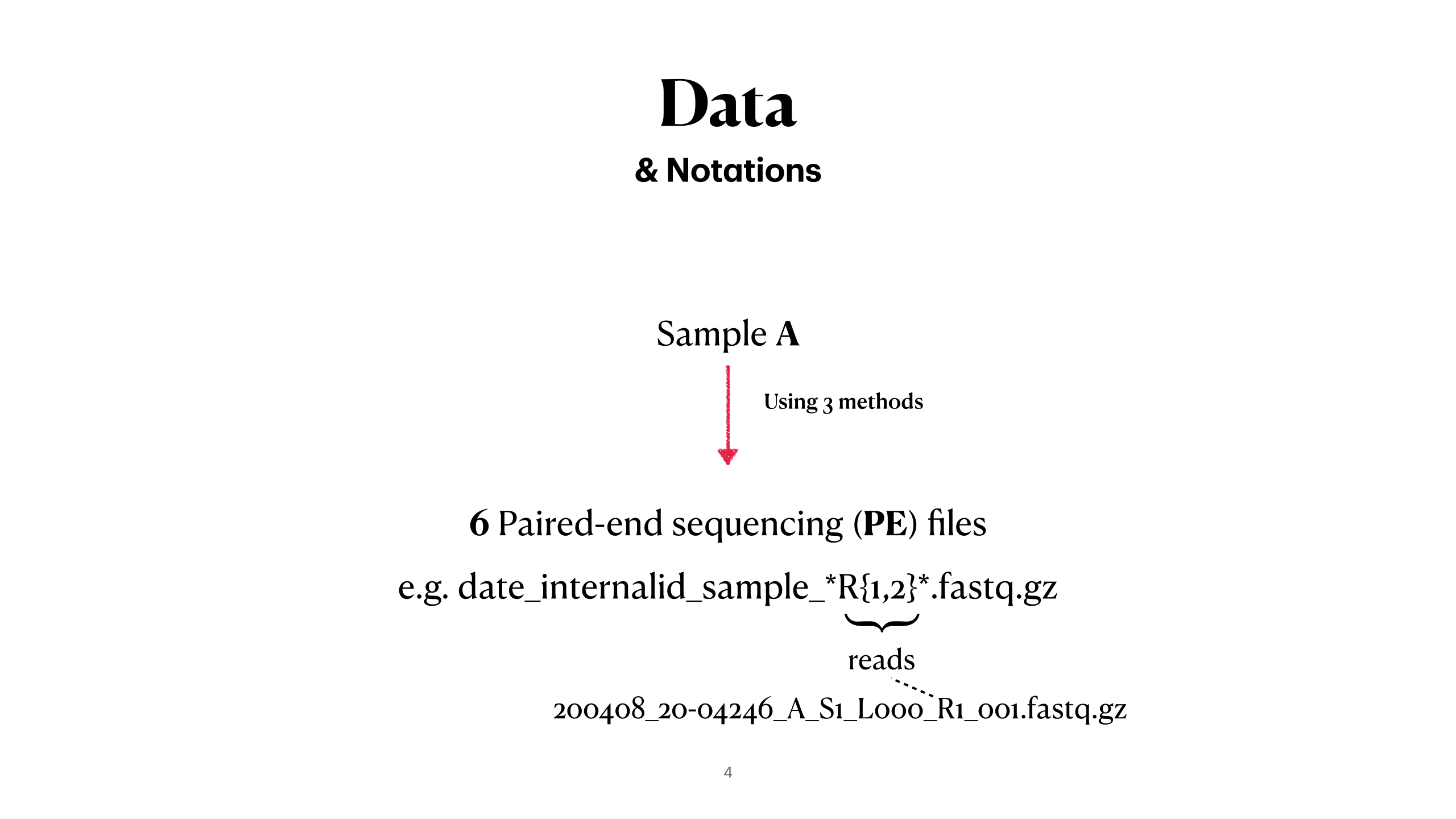
Data & Not tions Sample A Using 3 methods 6 Paired-end sequencing (PE) les e.g. date_internalid_sample_*R{1,2}*.fastq.gz reads 200408_20-04246_A_S1_L000_R1_001.fastq.gz fi a
Files : BED ✓ fastQ ✓
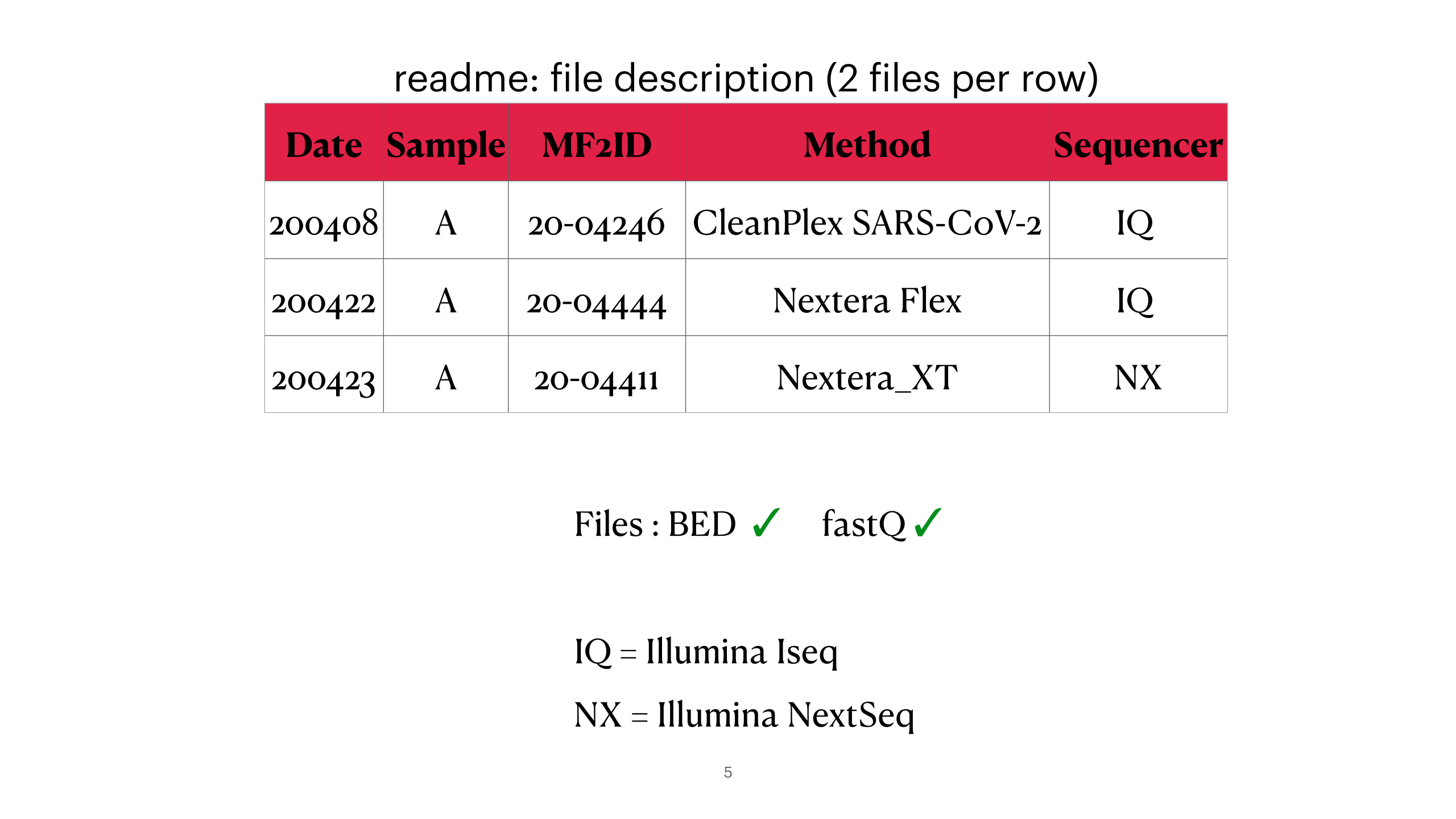
readme: ile description (2 iles per row) Date Sample MF2ID Method A 20-04246 CleanPlex SARS-CoV-2 IQ A Nextera Flex IQ A Nextera_XT NX Files : BED ✓ fastQ ✓ IQ = Illumina Iseq NX = Illumina NextSeq f f Sequencer
Goal
Goal Quality control Mapping Consensus sequence Lineage annotation Consensus QC
Methods

Methods (pipelines go cl nk !) a
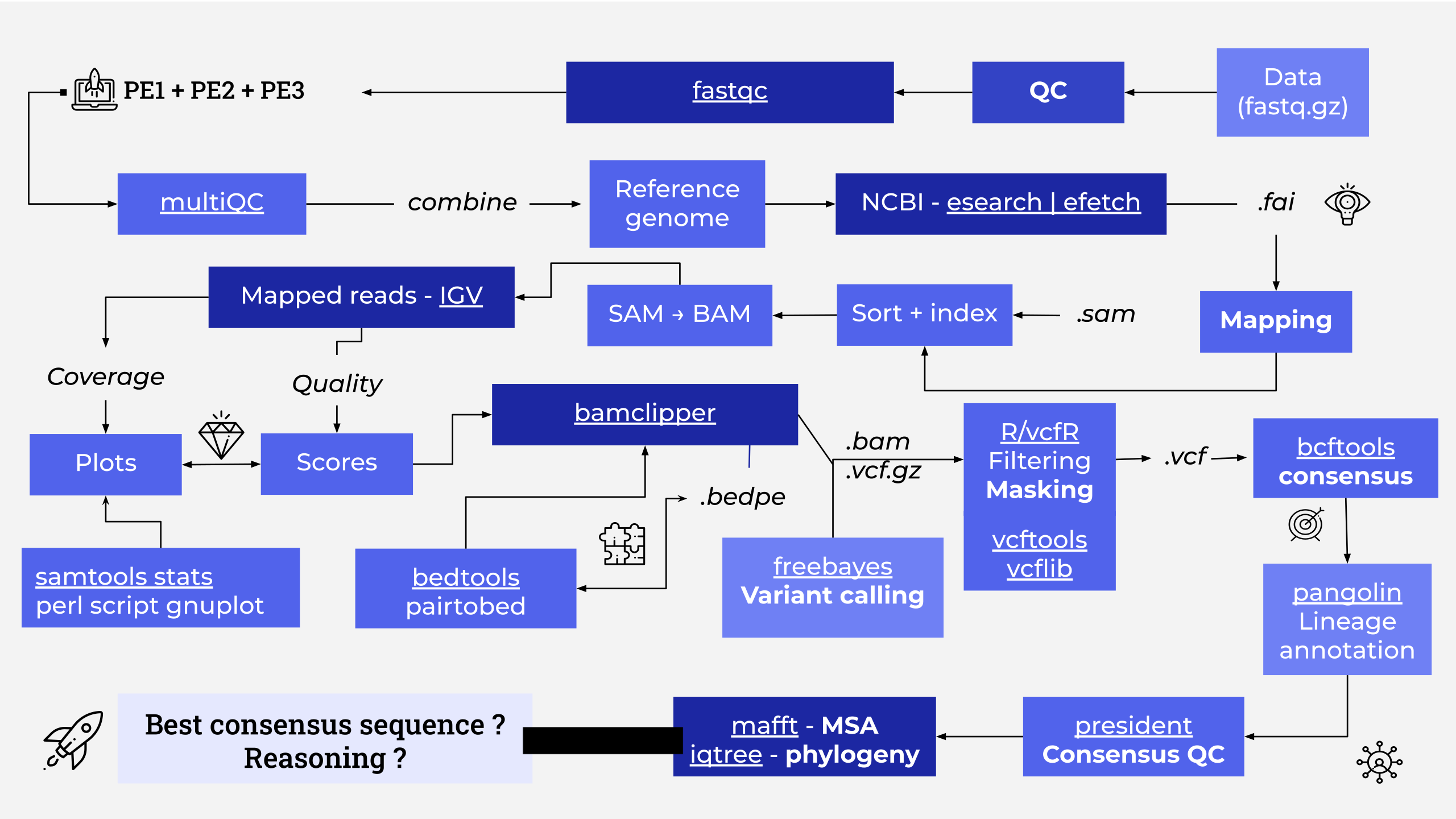
Workflow diagram: QC of the fastq data (fastqc, multiQC), reference genome from NCBI, mapping, sort and index, mapped reads in IGV, coverage and quality plots, bamclipper, variant calling (freebayes), filtering and masking (vcfR, vcftools), bcftools consensus, pangolin lineage annotation, president consensus QC, mafft alignment and iqtree phylogeny
Tools & Steps

Tools & Steps (everything is optimis tion !) a
Preliminary
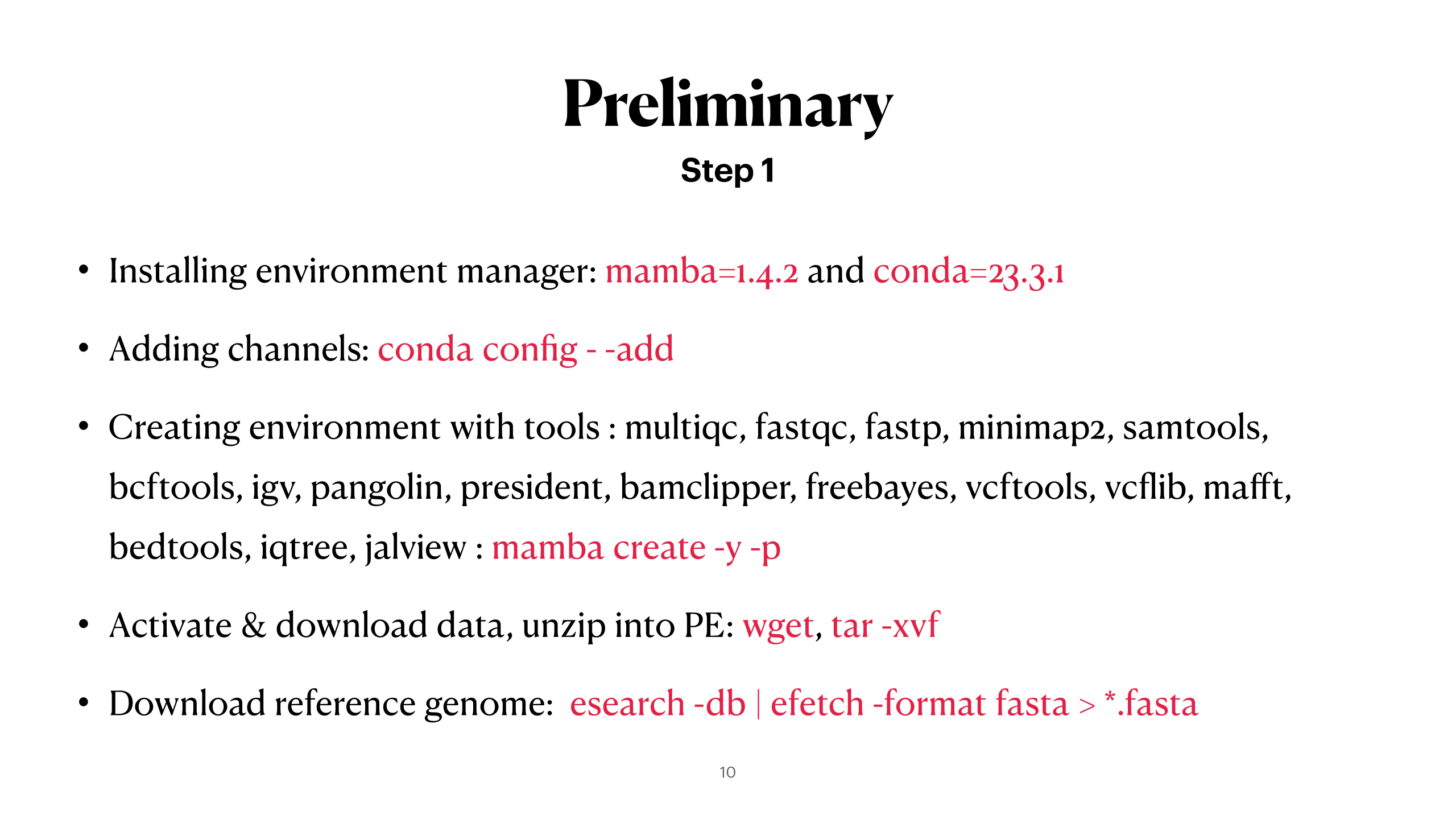
Preliminary Step 1 • Installing environment manager: mamba=1.4.2 and conda=23.3.1 • Adding channels: conda con g - -add • Creating environment with tools : multiqc, fastqc, fastp, minimap2, samtools, bcftools, igv, pangolin, president, bamclipper, freebayes, vcftools, vc ib, ma t, bedtools, iqtree, jalview : mamba create -y -p • Activate & download data, unzip into PE: wget, tar -xvf • Download reference genome: esearch -db | efetch -format fasta > *.fasta ff fl fi
fastQC - quality control
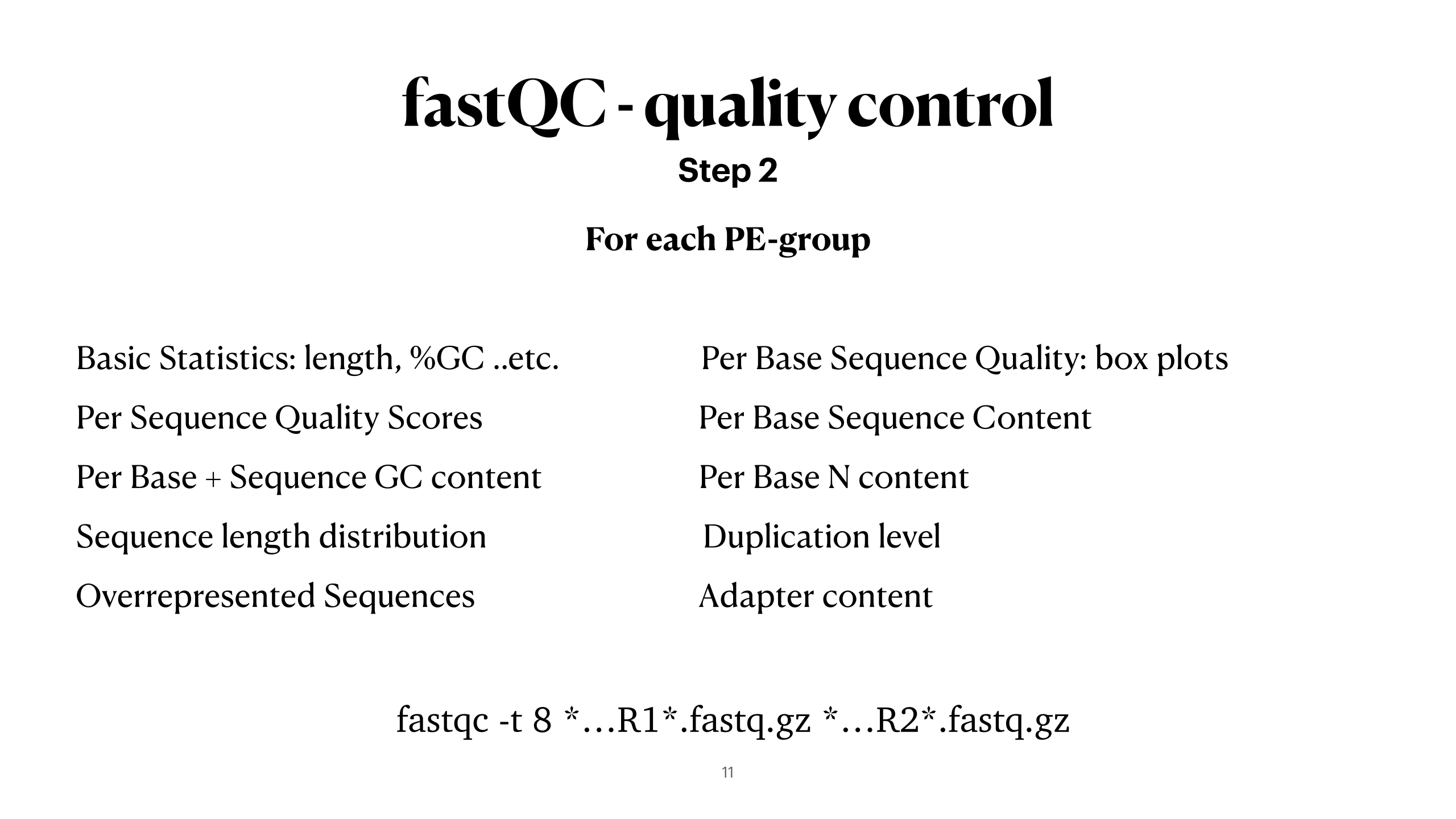
fastQC - quality control Step 2 For each PE-group Basic Statistics: length, %GC ..etc. Per Base Sequence Quality: box plots Per Sequence Quality Scores Per Base Sequence Content Per Base + Sequence GC content Per Base N content Sequence length distribution Duplication level Overrepresented Sequences Adapter content fastqc -t 8 *…R1*.fastq.gz *…R2*.fastq.gz
fastp - preprocessing
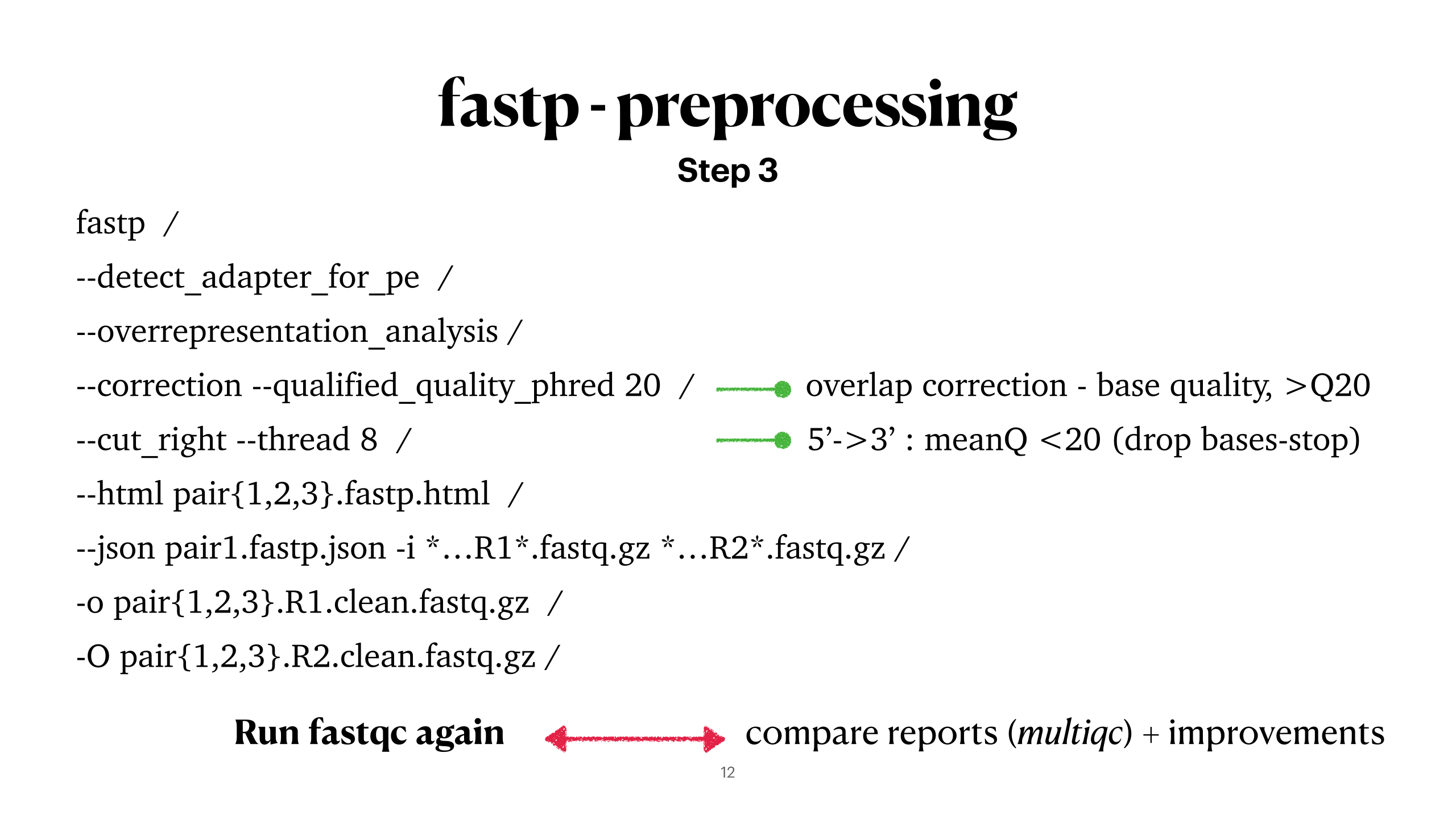
fastp - preprocessing Step 3 fastp / --detect_adapter_for_pe / --overrepresentation_analysis / --correction --qualified_quality_phred 20 / overlap correction - base quality, >Q20 --cut_right --thread 8 / 5’->3’ : meanQ <20 (drop bases-stop) --html pair{1,2,3}.fastp.html / --json pair1.fastp.json -i *…R1*.fastq.gz *…R2*.fastq.gz / -o pair{1,2,3}.R1.clean.fastq.gz / -O pair{1,2,3}.R2.clean.fastq.gz / Run fastqc again compare reports (multiqc) + improvements
minimap2 - Mapping & igv - Visualisation
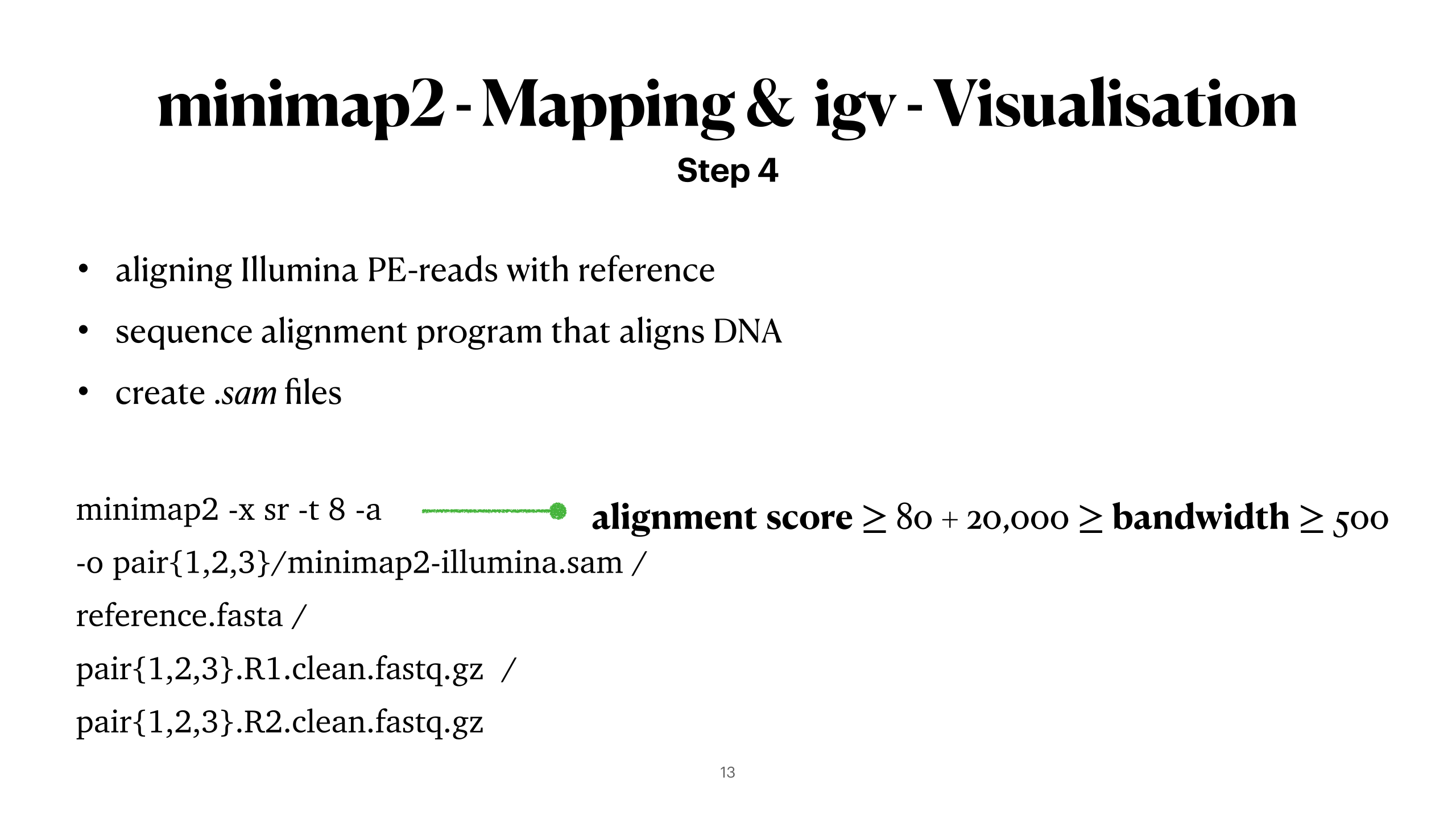
minimap2 - Mapping & igv - Visualisation Step 4 • aligning Illumina PE-reads with reference • sequence alignment program that aligns DNA • create .sam les alignment score ≥ 80 + 20,000 ≥ bandwidth ≥ 500 -o pair{1,2,3}/minimap2-illumina.sam / minimap2 -x sr -t 8 -a reference.fasta / pair{1,2,3}.R1.clean.fastq.gz / pair{1,2,3}.R2.clean.fastq.gz fi
bamclipper - Primer clipping

bamclipper - Primer clipping Step 5
bamclipper - Primer clipping
bamclipper - Primer clipping Step 5 1st Try ×
bamclipper - Primer clipping
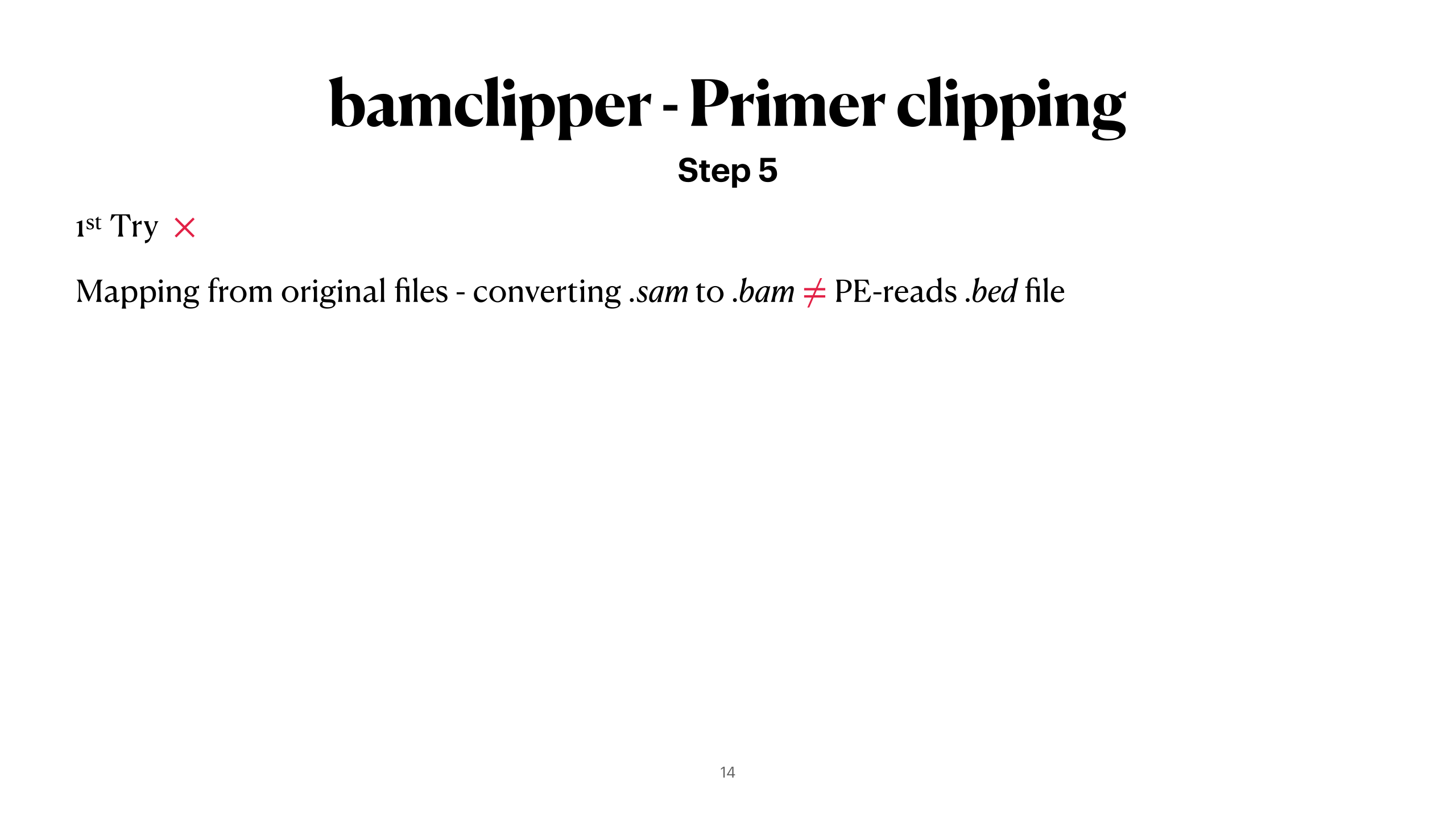
bamclipper - Primer clipping Step 5 1st Try × Mapping from original les - converting .sam to .bam ≠ PE-reads .bed le fi fi
bamclipper - Primer clipping
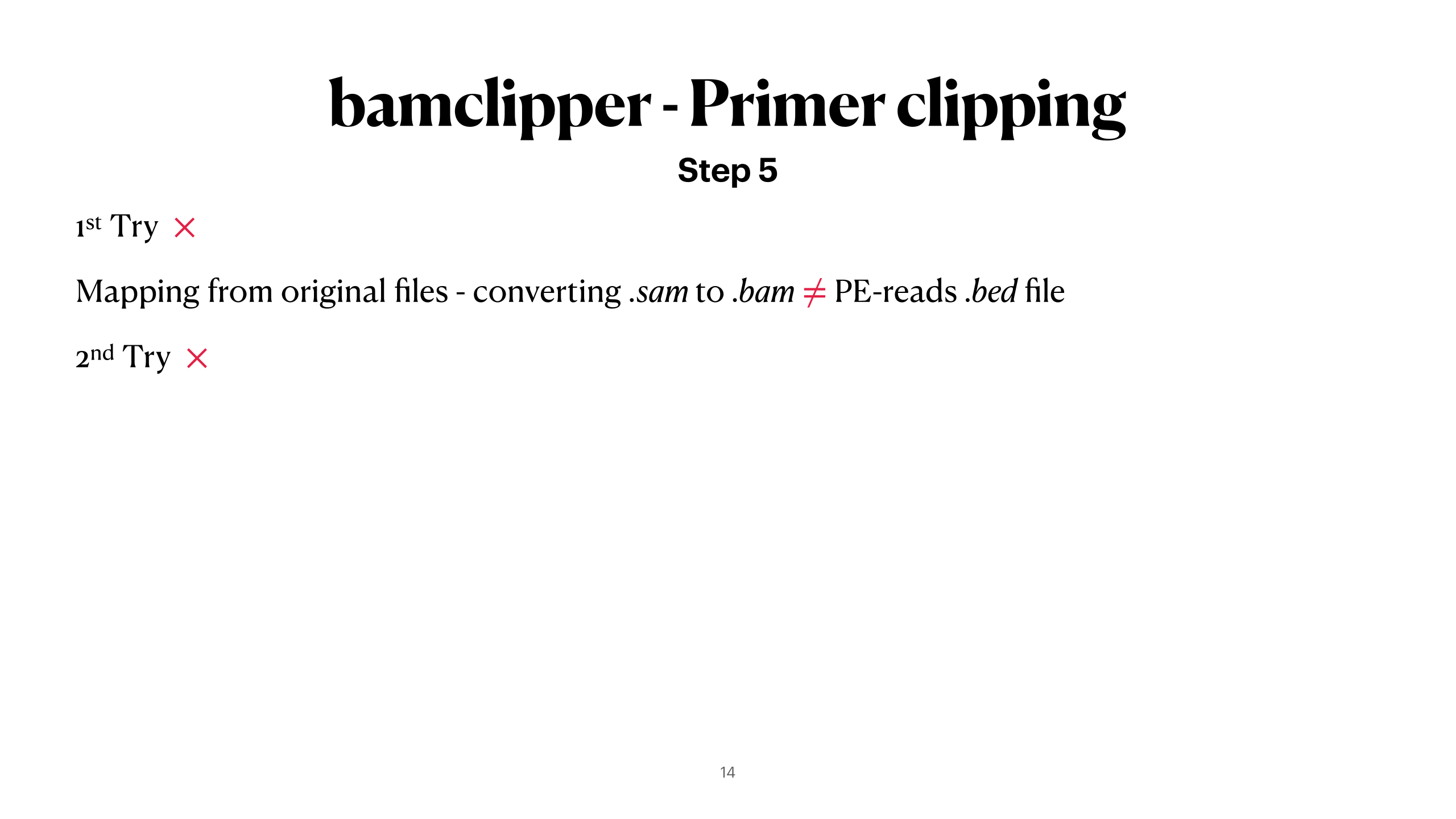
bamclipper - Primer clipping Step 5 1st Try × Mapping from original les - converting .sam to .bam ≠ PE-reads .bed le 2nd Try × fi fi
bamclipper - Primer clipping
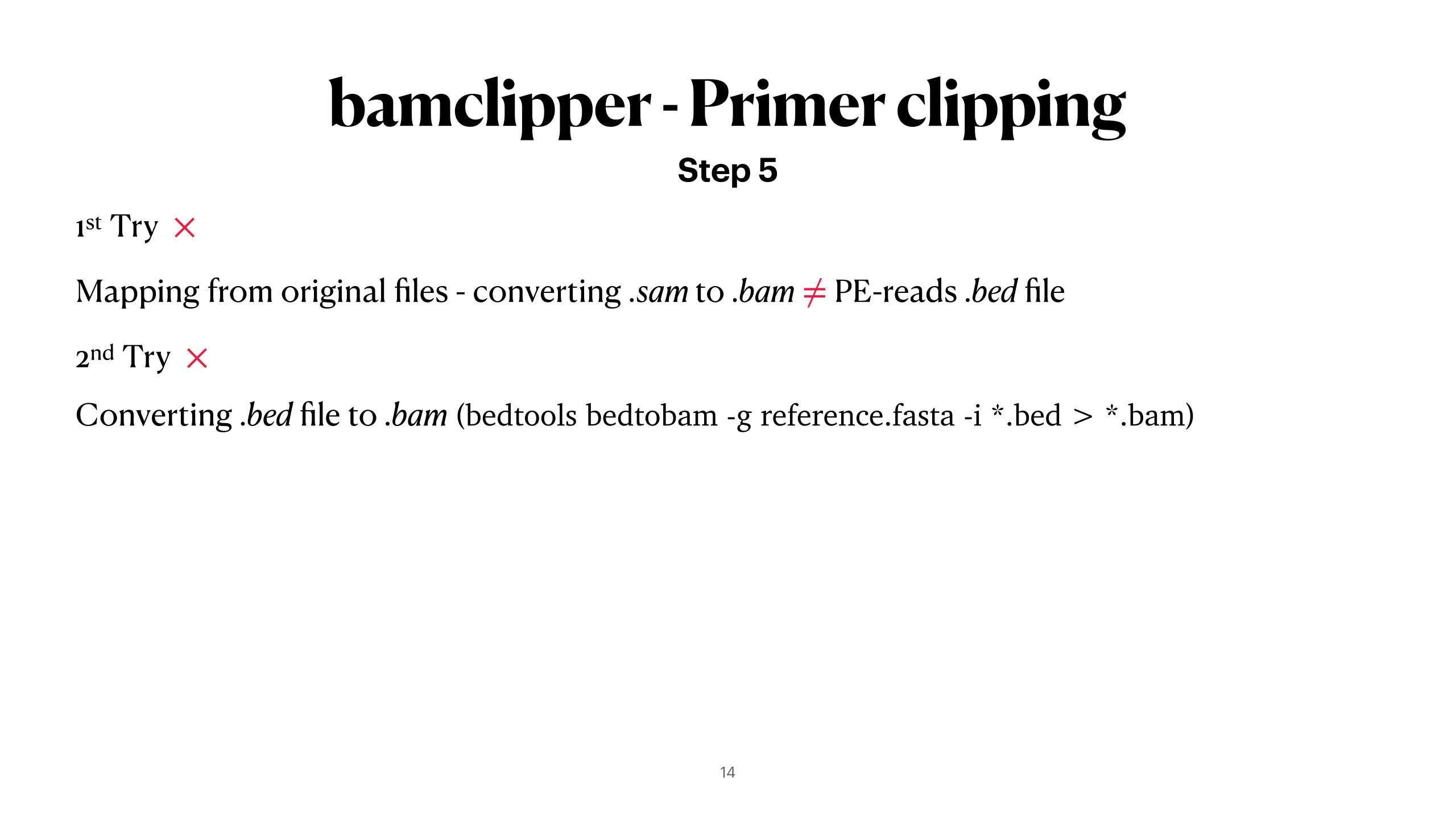
bamclipper - Primer clipping Step 5 1st Try × Mapping from original les - converting .sam to .bam ≠ PE-reads .bed le 2nd Try × Converting .bed le to .bam (bedtools bedtobam -g reference.fasta -i *.bed > *.bam) fi fi fi
bamclipper - Primer clipping
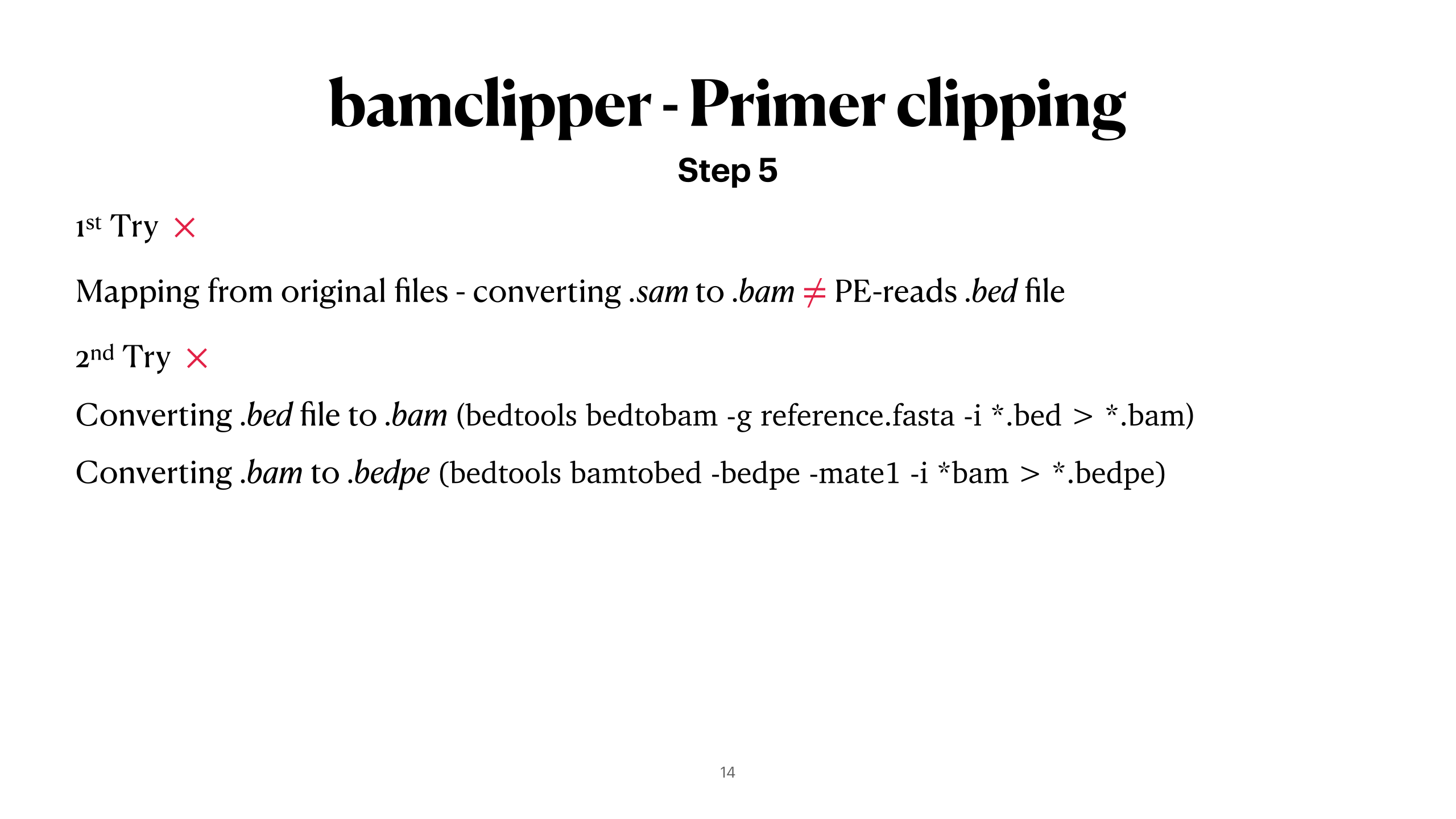
bamclipper - Primer clipping Step 5 1st Try × Mapping from original les - converting .sam to .bam ≠ PE-reads .bed le 2nd Try × Converting .bed le to .bam (bedtools bedtobam -g reference.fasta -i *.bed > *.bam) Converting .bam to .bedpe (bedtools bamtobed -bedpe -mate1 -i *bam > *.bedpe) fi fi fi
bamclipper - Primer clipping
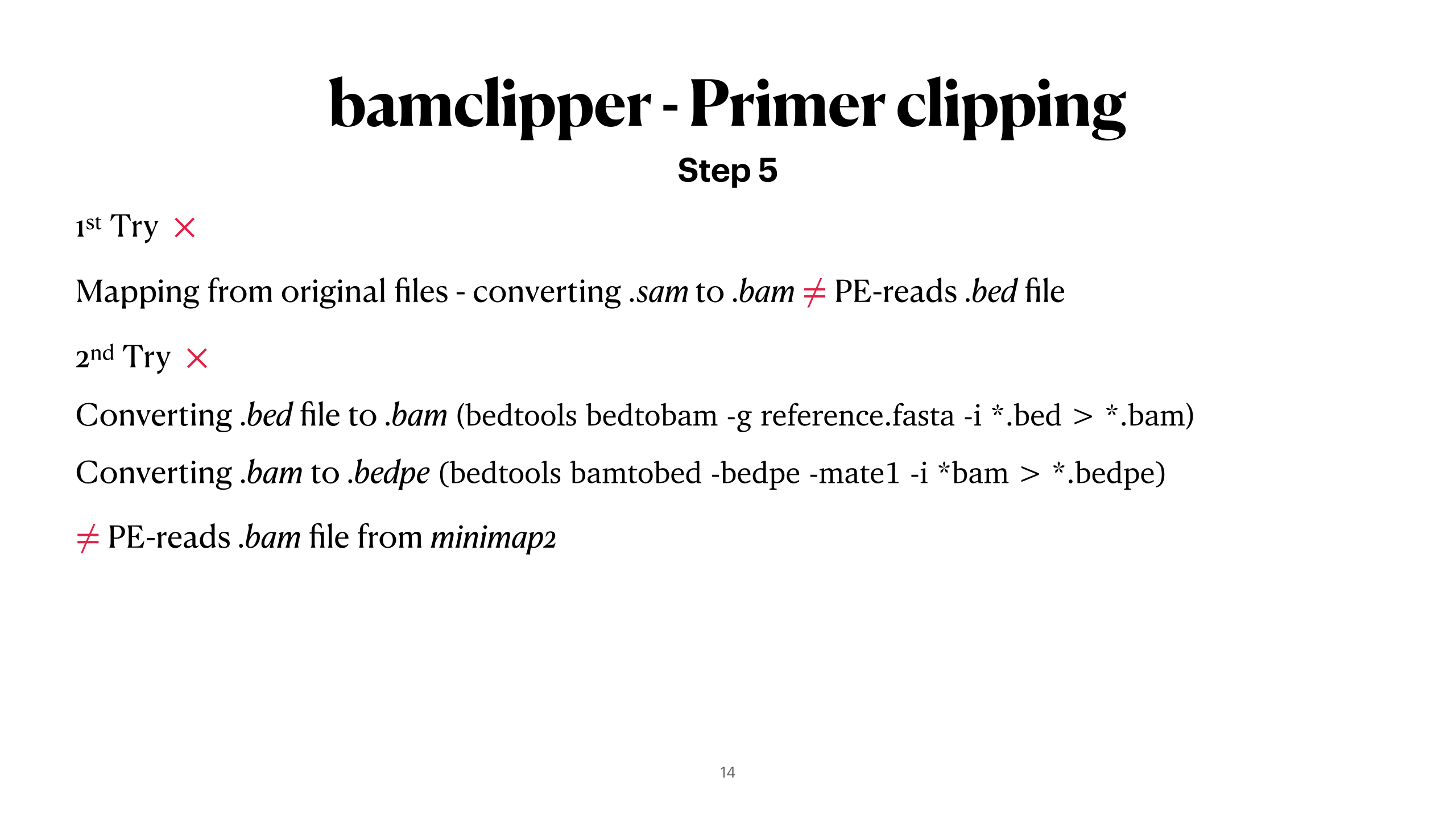
bamclipper - Primer clipping Step 5 1st Try × Mapping from original les - converting .sam to .bam ≠ PE-reads .bed le 2nd Try × Converting .bed le to .bam (bedtools bedtobam -g reference.fasta -i *.bed > *.bam) Converting .bam to .bedpe (bedtools bamtobed -bedpe -mate1 -i *bam > *.bedpe) ≠ PE-reads .bam le from minimap2 fi fi fi fi
bamclipper - Primer clipping
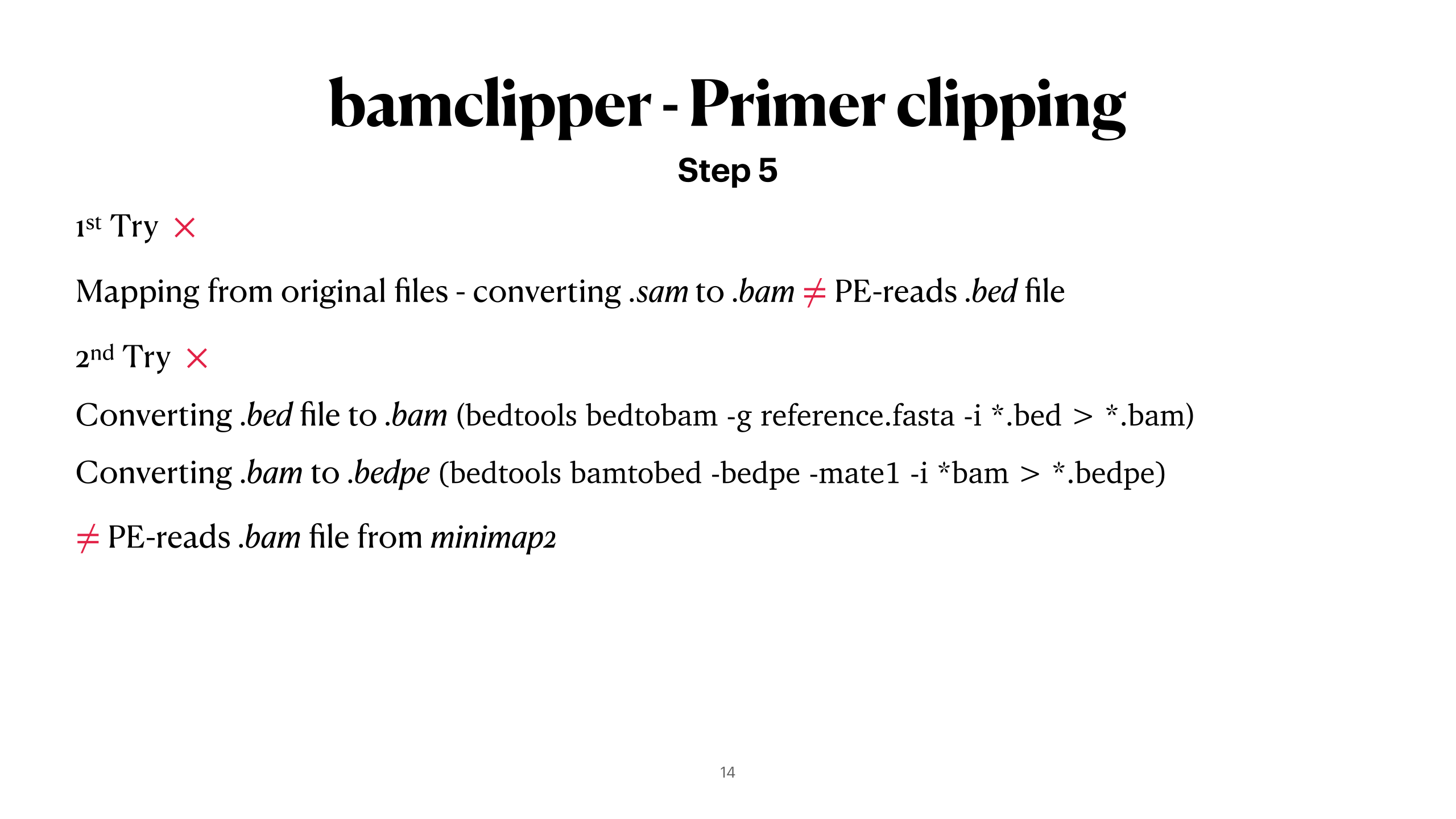
bamclipper - Primer clipping Step 5 1st Try × Mapping from original les - converting .sam to .bam ≠ PE-reads .bed le 2nd Try × Converting .bed le to .bam (bedtools bedtobam -g reference.fasta -i *.bed > *.bam) Converting .bam to .bedpe (bedtools bamtobed -bedpe -mate1 -i *bam > *.bedpe) ≠ PE-reads .bam le from minimap2 fi fi fi fi
bamclipper - Primer clipping

bamclipper - Primer clipping Step 5
bamclipper - Primer clipping
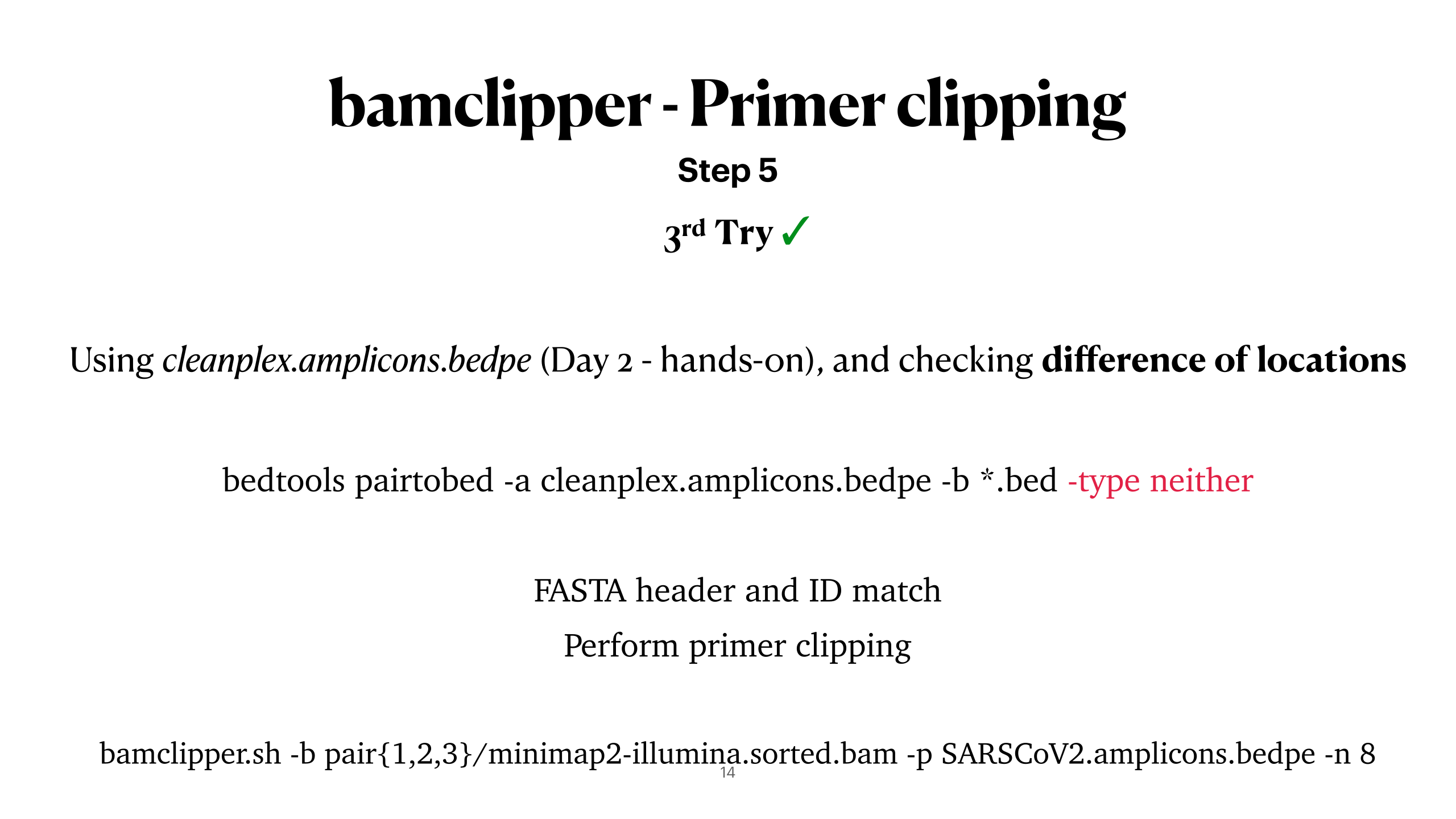
bamclipper - Primer clipping Step 5 3rd Try ✓ Using cleanplex.amplicons.bedpe (Day 2 - hands-on), and checking di erence of locations bedtools pairtobed -a cleanplex.amplicons.bedpe -b *.bed -type neither FASTA header and ID match Perform primer clipping ff bamclipper.sh -b pair{1,2,3}/minimap2-illumina.sorted.bam -p SARSCoV2.amplicons.bedpe -n
freebayes - Variant calling
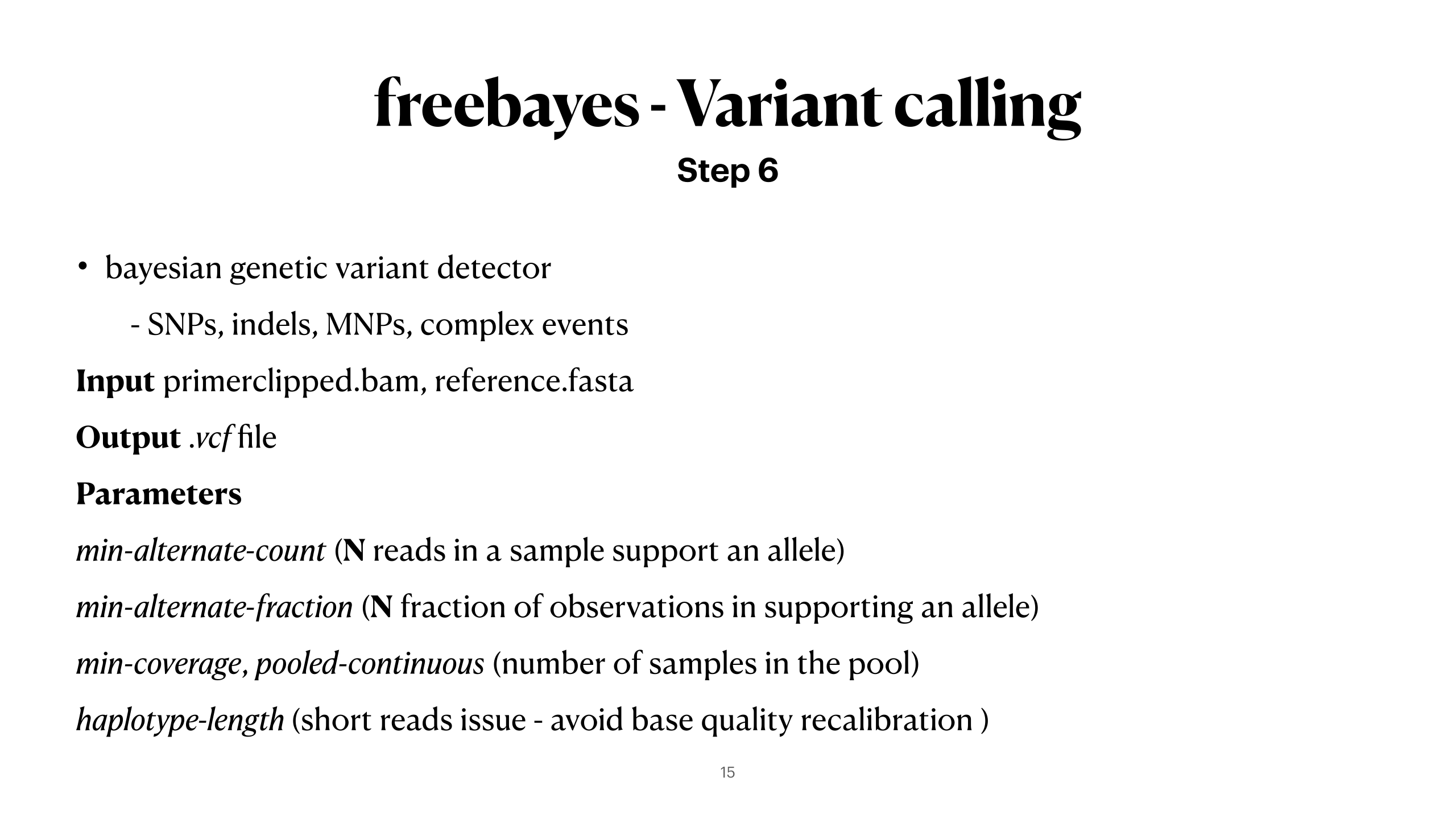
freebayes - Variant calling Step 6 • bayesian genetic variant detector - SNPs, indels, MNPs, complex events Input primerclipped.bam, reference.fasta Output .vcf le Parameters min-alternate-count (N reads in a sample support an allele) min-alternate-fraction (N fraction of observations in supporting an allele) min-coverage, pooled-continuous (number of samples in the pool) haplotype-length (short reads issue - avoid base quality recalibration ) fi
freebayes - Variant calling
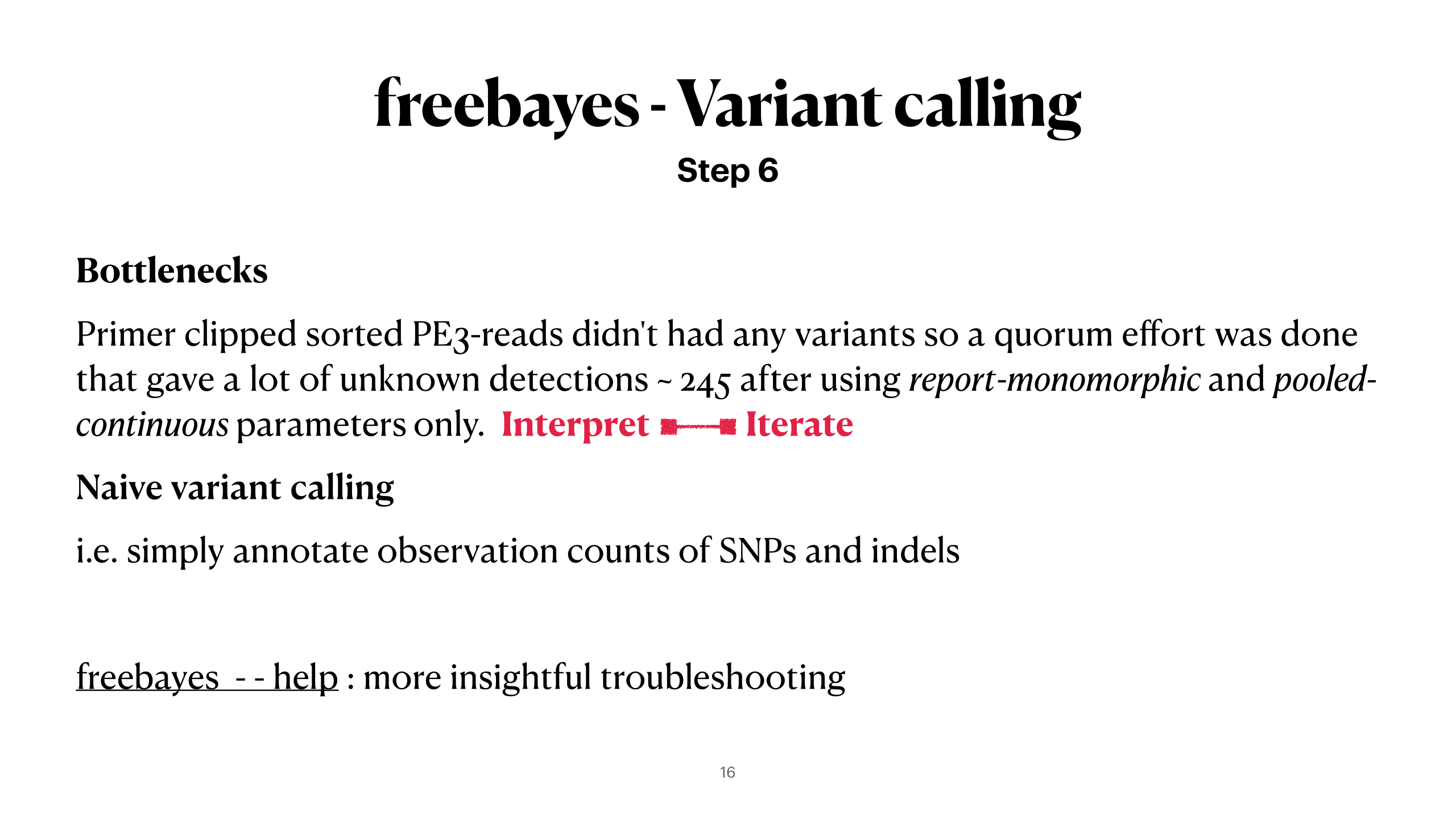
freebayes - Variant calling Step 6 Bottlenecks Primer clipped sorted PE3-reads didn't had any variants so a quorum e ort was done that gave a lot of unknown detections ~ 245 after using report-monomorphic and pooledcontinuous parameters only. Interpret Iterate Naive variant calling i.e. simply annotate observation counts of SNPs and indels freebayes - - help : more insightful troubleshooting ff
freebayes - Variant calling
freebayes - Variant calling Step 6 Bottlenecks Primer clipped sorted PE3-reads didn't had any variants so a quorum e ort was done that gave a lot of unknown detections ~ 245 after using report-monomorphic and pooledcontinuous parameters only. Interpret Iterate Naive variant calling i.e. simply annotate observation counts of SNPs and indels freebayes - - help : more insightful troubleshooting ff
freebayes - Variant calling
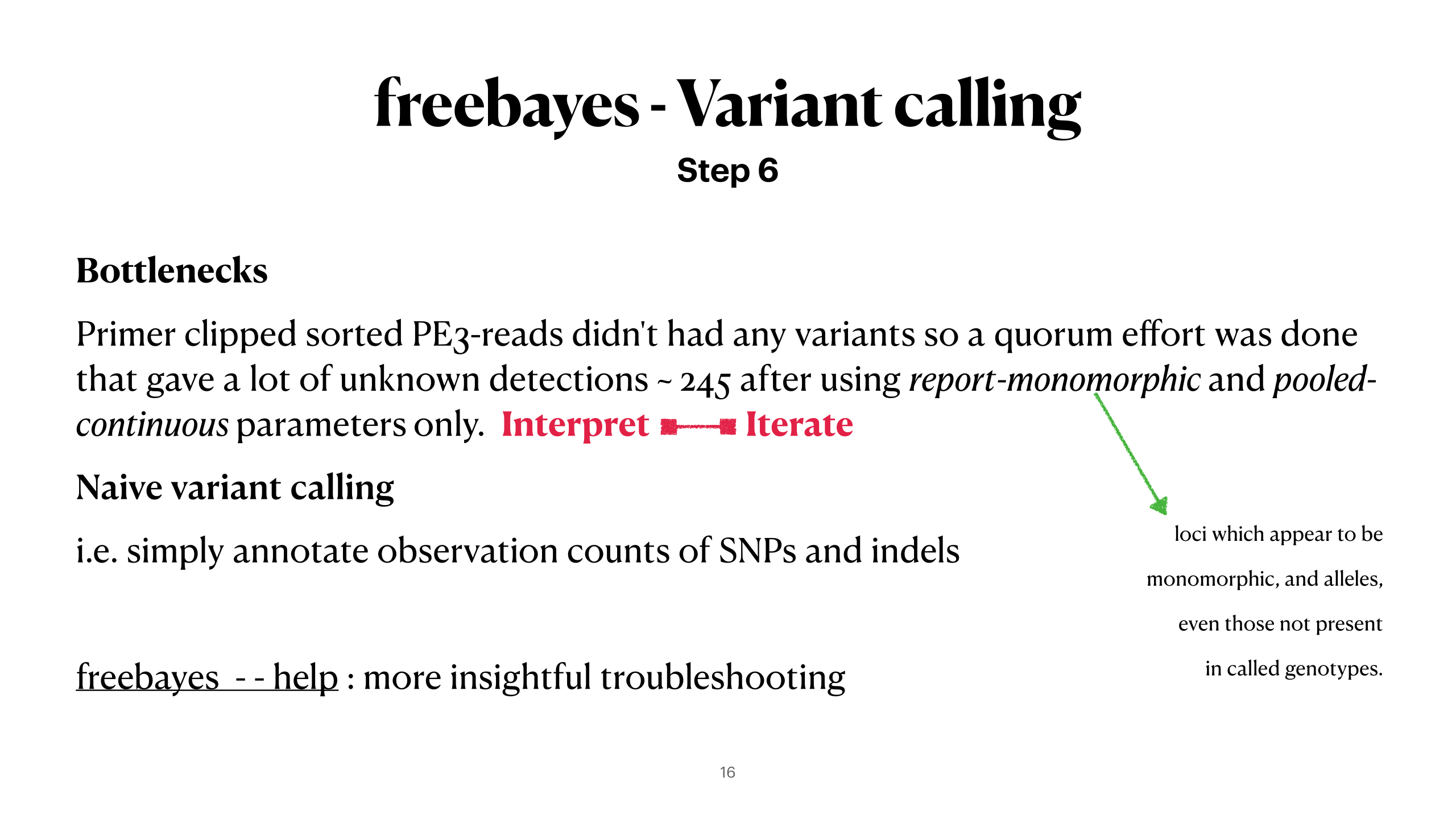
freebayes - Variant calling Step 6 Bottlenecks Primer clipped sorted PE3-reads didn't had any variants so a quorum e ort was done that gave a lot of unknown detections ~ 245 after using report-monomorphic and pooledcontinuous parameters only. Interpret Iterate Naive variant calling loci which appear to be i.e. simply annotate observation counts of SNPs and indels monomorphic, and alleles, even those not present freebayes - - help : more insightful troubleshooting in called genotypes. ff
R/vcfR - masking & iltering
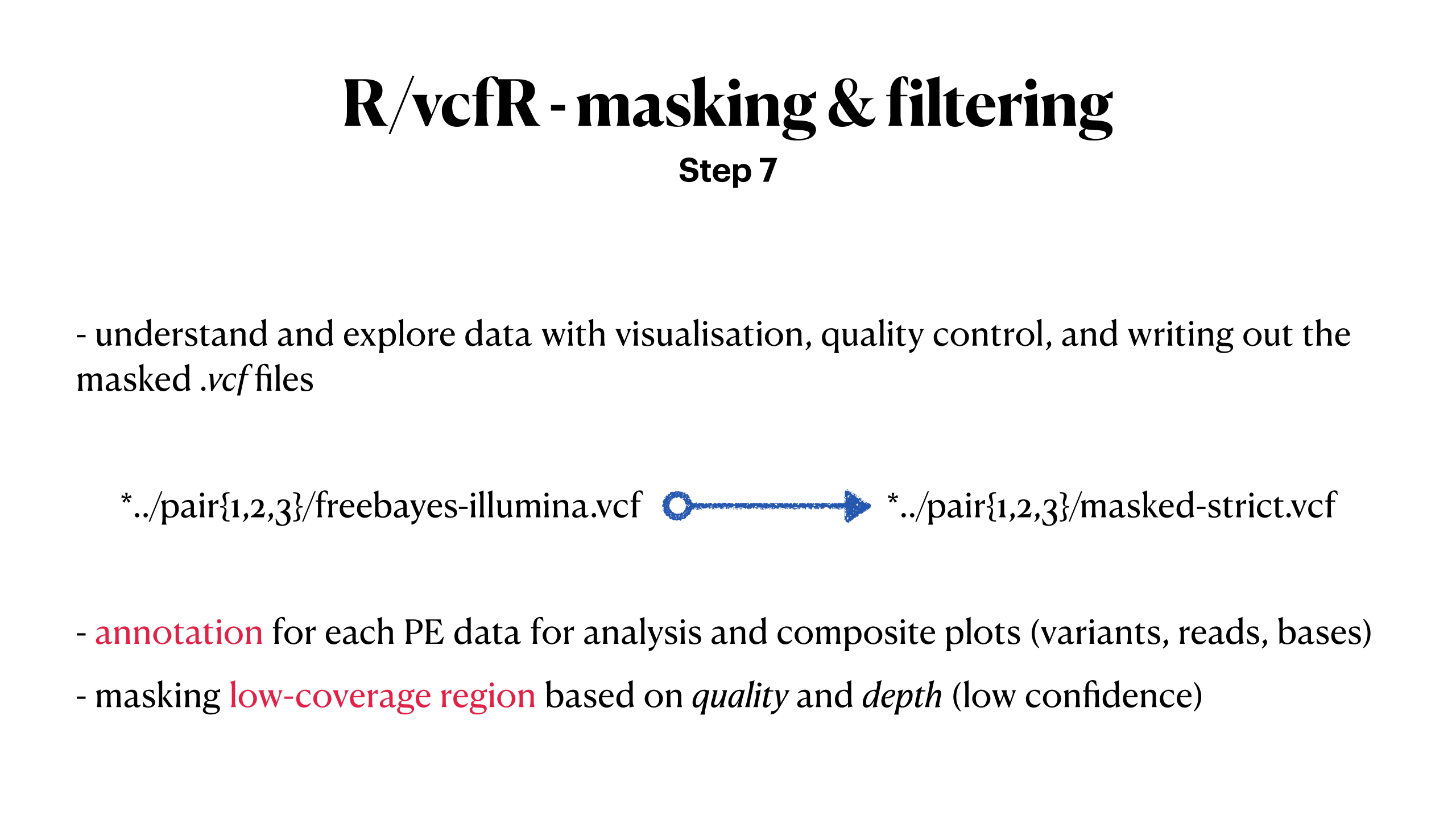
R/vcfR - masking & iltering Step 7 - understand and explore data with visualisation, quality control, and writing out the masked .vcf les *../pair{1,2,3}/freebayes-illumina.vcf *../pair{1,2,3}/masked-strict.vcf - annotation for each PE data for analysis and composite plots (variants, reads, bases) fi f fi - masking low-coverage region based on quality and depth (low con dence)
bcftools - Consensus generation
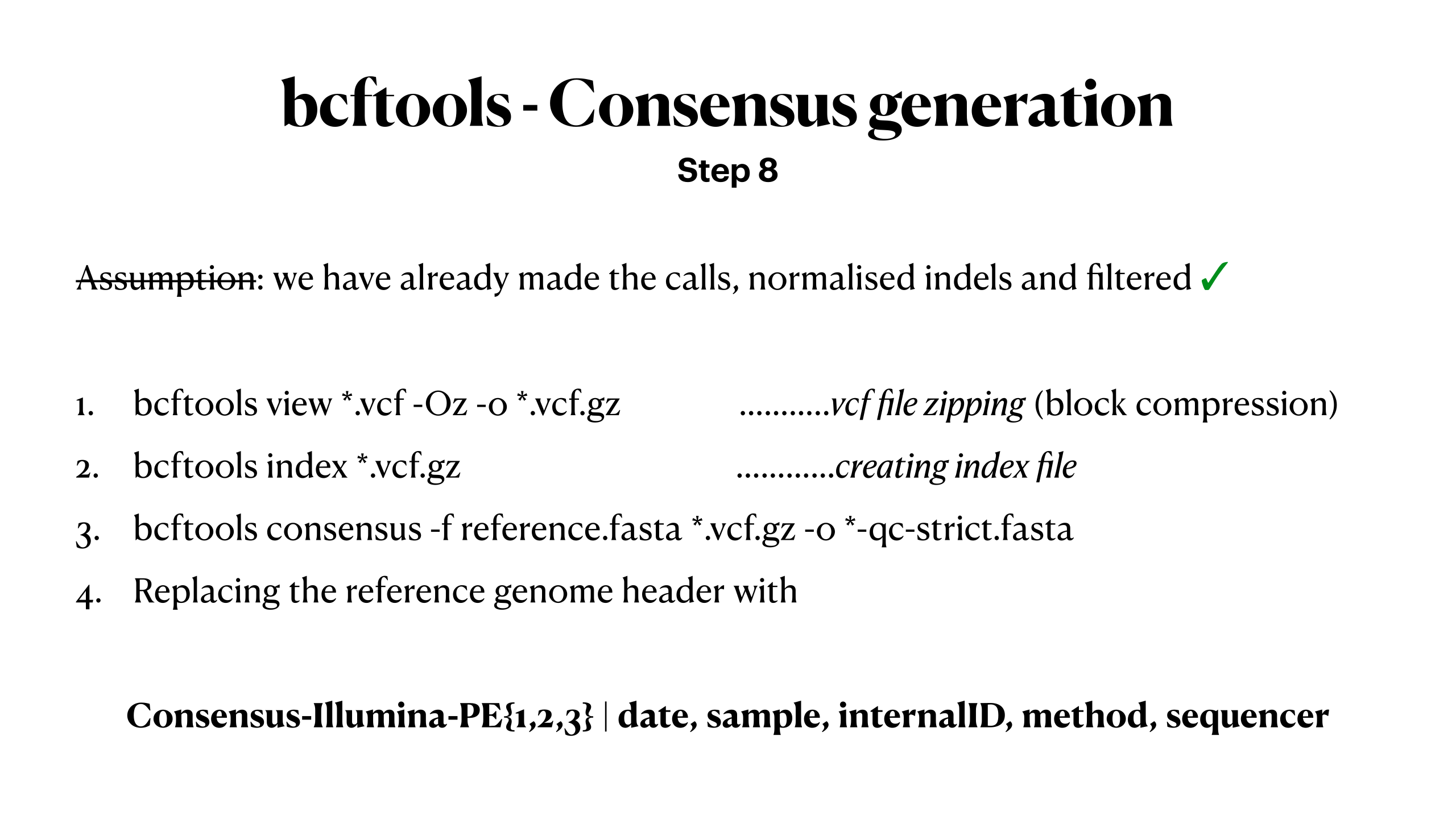
bcftools - Consensus generation Step 8 Assumption: we have already made the calls, normalised indels and ltered ✓ bcftools view *.vcf -Oz -o *.vcf.gz 2. bcftools index *.vcf.gz ………..vcf le zipping (block compression) …………creating index le 3. bcftools consensus -f reference.fasta *.vcf.gz -o *-qc-strict.fasta 4. Replacing the reference genome header with fi fi fi Consensus-Illumina-PE{1,2,3} | date, sample, internalID, method, sequencer
pangolin - Lineage Annotation
pangolin - Lineage Annotation Step 9 - dynamic nomenclature of SARS-CoV-2 lineages a.k.a. pangloin nomenclature, assigns most likely lineage (Pango lineage) to query sequences Source: https://cov-lineages.org/lineage_list.html
pangolin - Lineage Annotation
pangolin - Lineage Annotation Step 9 - dynamic nomenclature of SARS-CoV-2 lineages a.k.a. pangloin nomenclature, assigns most likely lineage (Pango lineage) to query sequences - updated routinely Source: https://cov-lineages.org/lineage_list.html
pangolin - Lineage Annotation
pangolin - Lineage Annotation Step 9 - dynamic nomenclature of SARS-CoV-2 lineages a.k.a. pangloin nomenclature, assigns most likely lineage (Pango lineage) to query sequences - updated routinely - always run update before using the tool Source: https://cov-lineages.org/lineage_list.html
president - Consensus QC
president - Consensus QC Step 10 - calculate pairwise nucleotide identity and reports ambiguous ’N’ Put all three consensus sequences in .fasta le. 2. Run with default setting on the multiple query FASTA sequences. 3. Output the valid + invalid .fasta, and report with PSL alignment columns. Aftermath 4. Create and visualise the progressive alignment using ma Create and visualise phylogenetic tree using iqtree and IROKI. fft fi and jalview.
Results

Results (to the point !)
FastQC: Sequence Counts Aligned Reads Aligned Reads - raw (%) - clean (%) Sample PE1.R1 PE1.R2 PE2.R1 PE2.R2 PE3.R1 PE3.
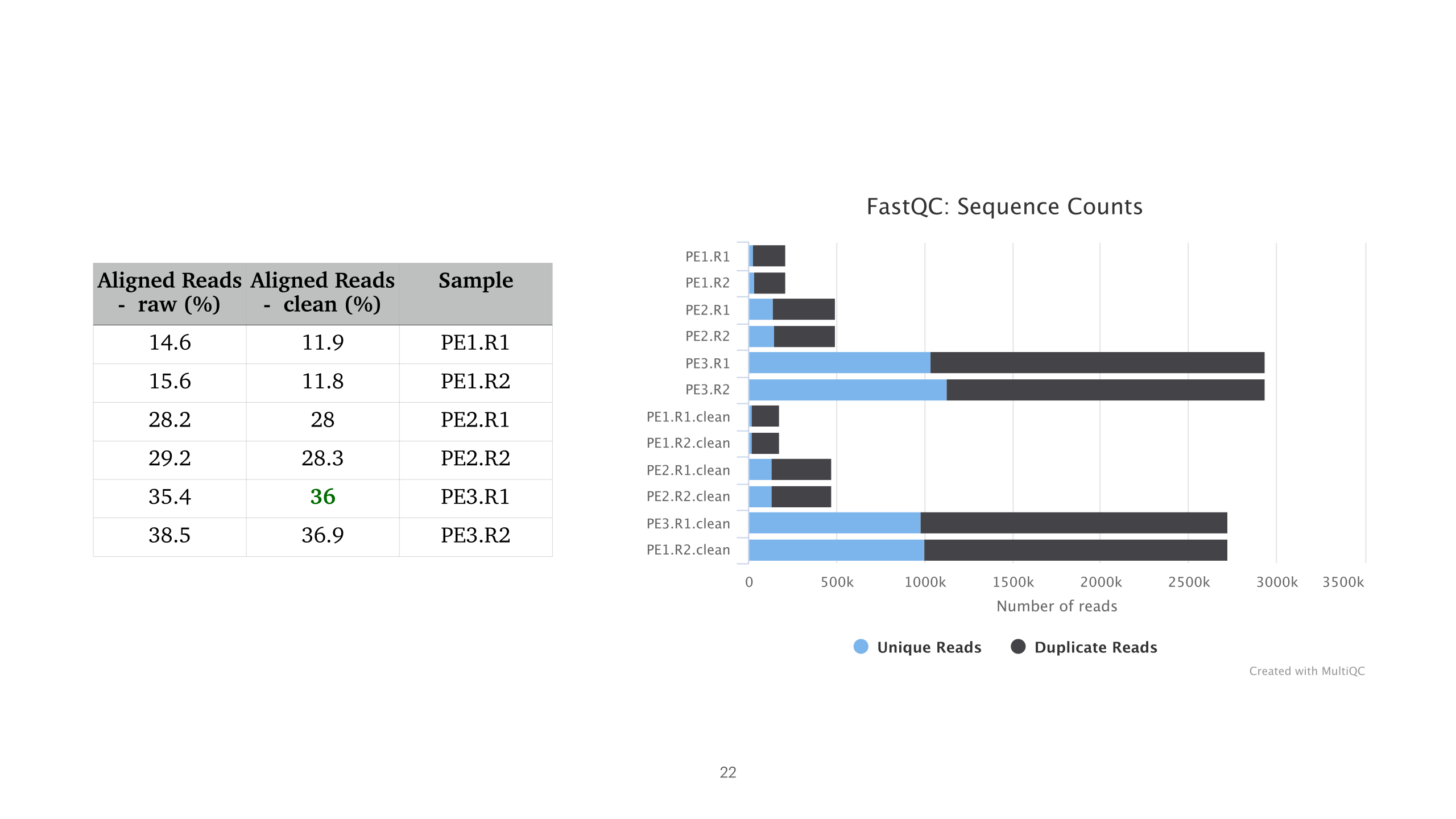
FastQC: Sequence Counts PE1.R1 Aligned Reads Aligned Reads - raw (%) - clean (%) Sample PE1.R2 PE2.R1 PE1.R1 PE1.R2 PE2.R1 PE2.R2 PE3.R1 PE3.R2 PE1.R1.clean PE1.R2.clean PE2.R2 PE3.R1 PE2.R2.clean PE3.R2 PE3.R1.clean PE2.R1.clean PE1.R2.clean 500k 1000k 1500k 2000k 2500k 3000k 3500k Number of reads Unique Reads Duplicate Reads Created with MultiQC
Raw reads Clean reads
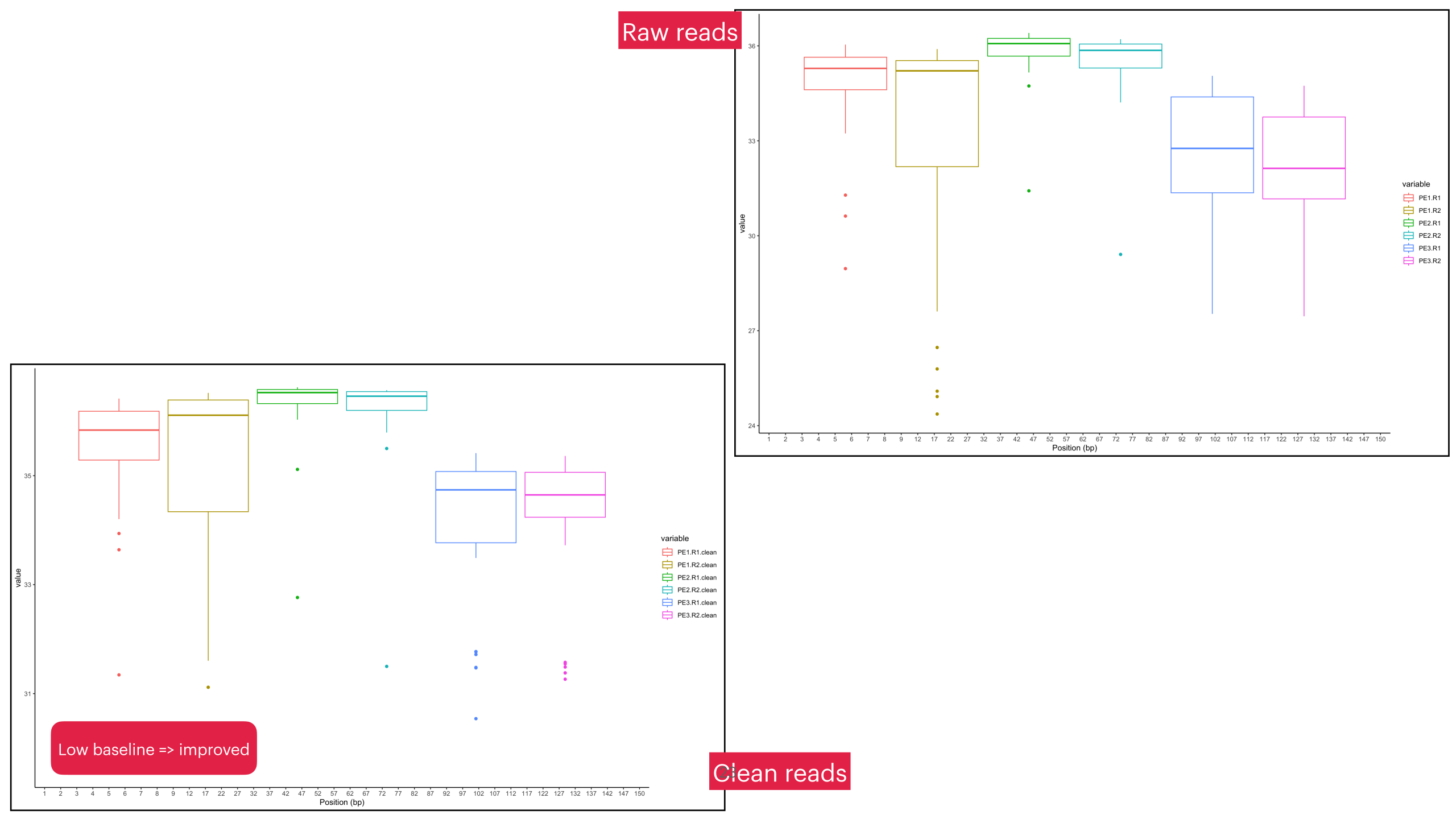
Raw reads Low baseline => improved Clean reads
Raw reads Clean reads
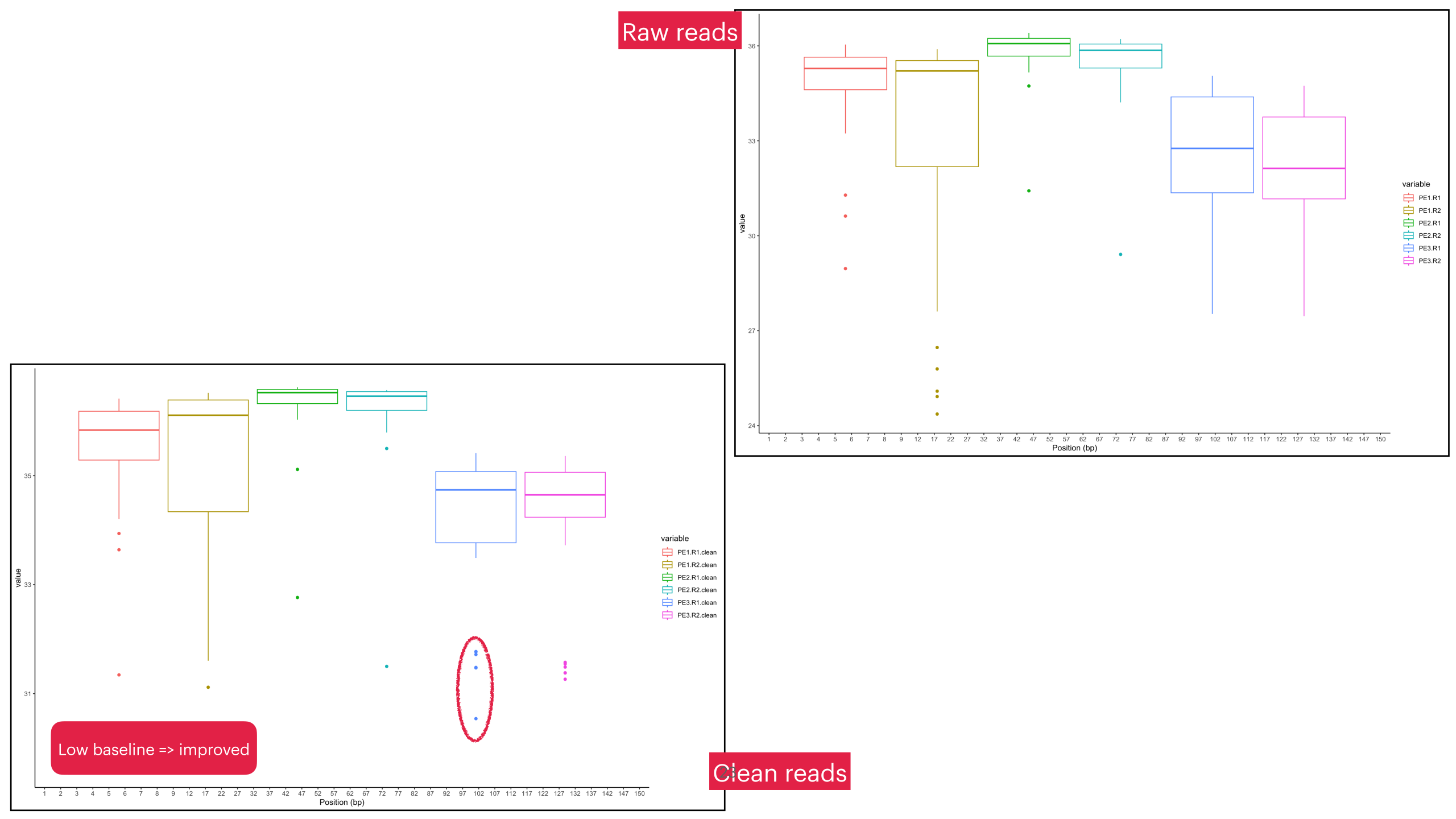
Raw reads Low baseline => improved Clean reads
Raw reads Clean reads
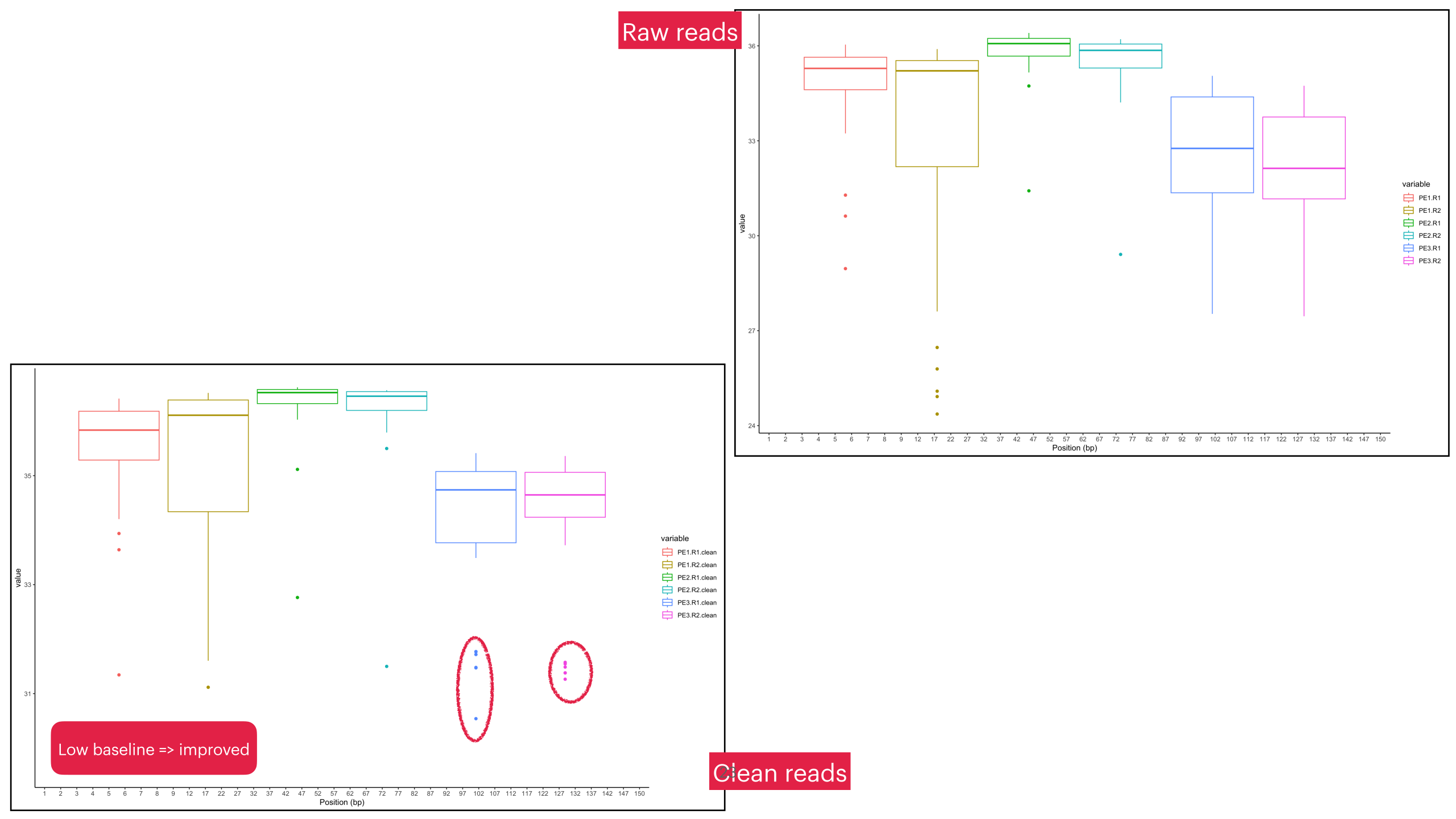
Raw reads Low baseline => improved Clean reads
Raw reads Clean reads
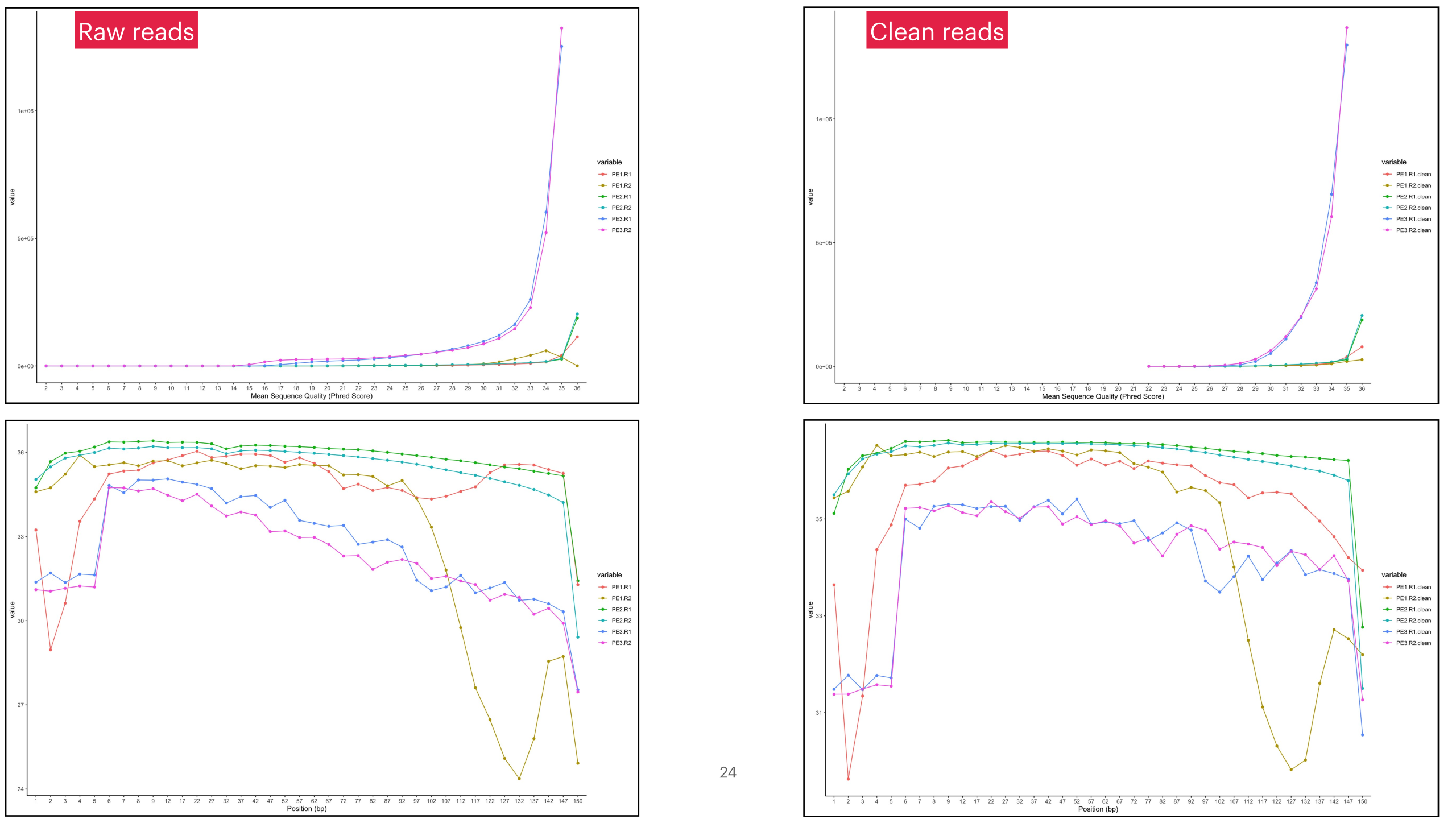
Raw reads Clean reads QUAL > 20
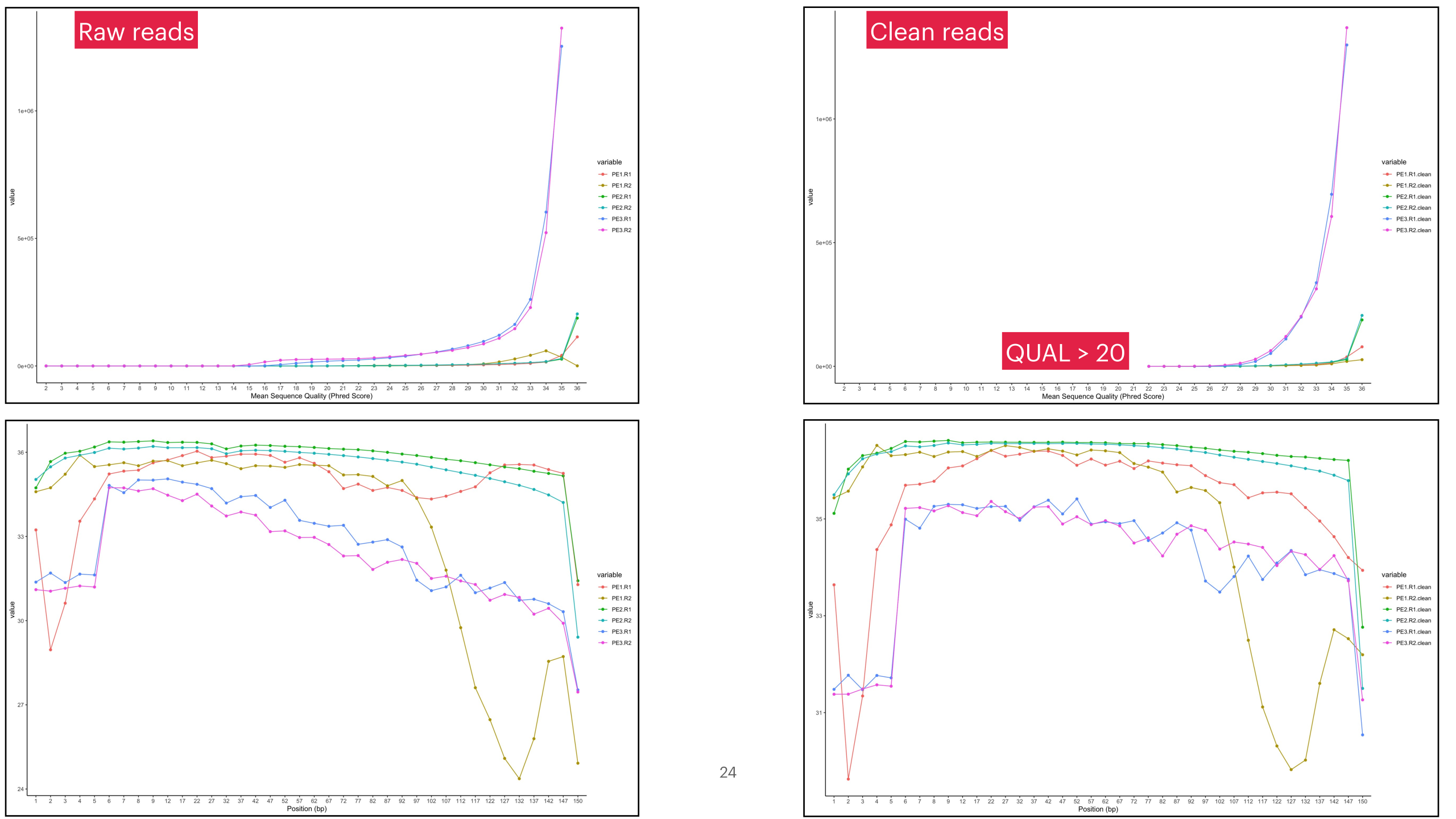
Raw reads Clean reads QUAL > 20
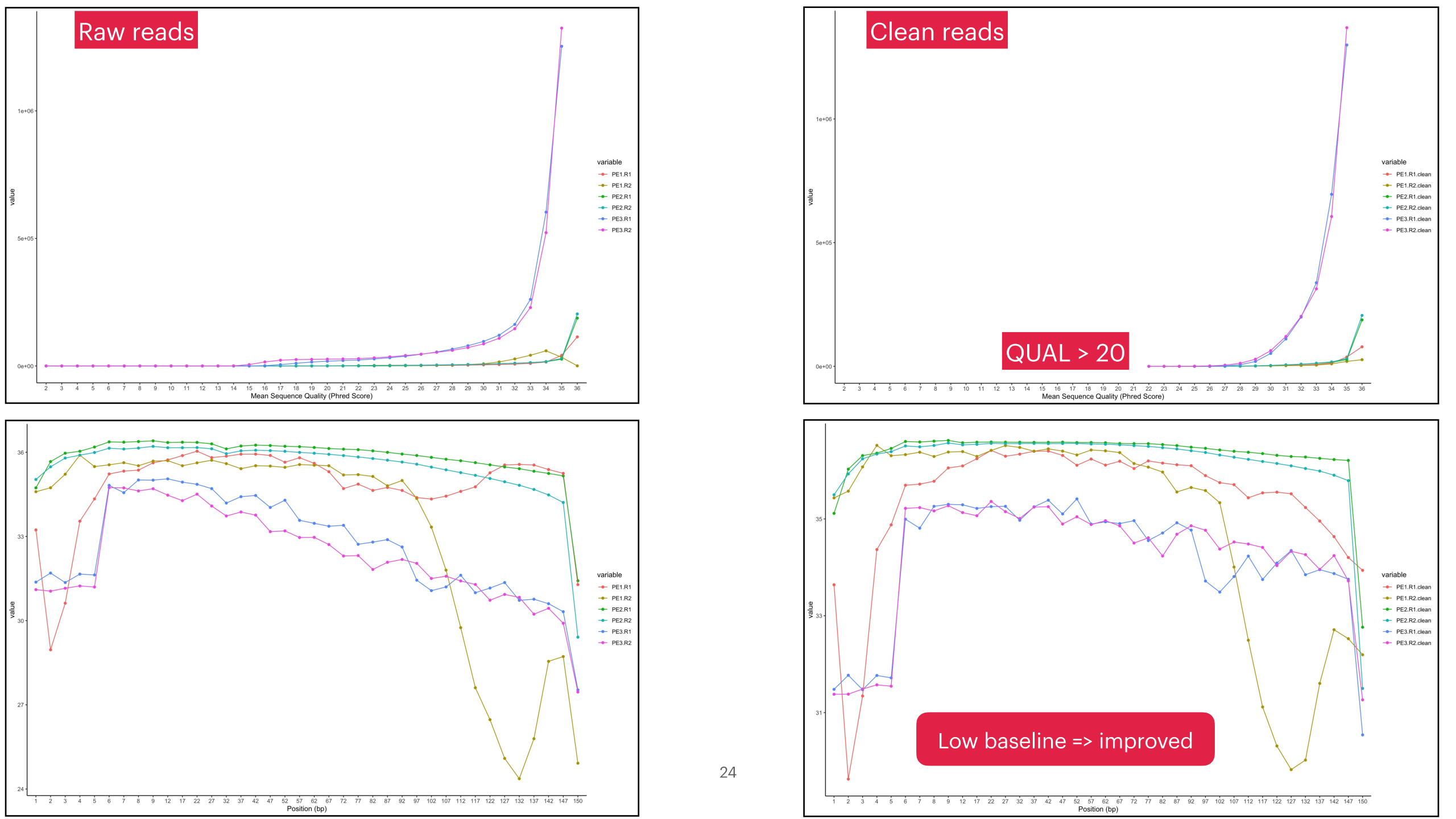
Raw reads Clean reads QUAL > 20 Low baseline => improved
.vcf PE1 PE2 PE3
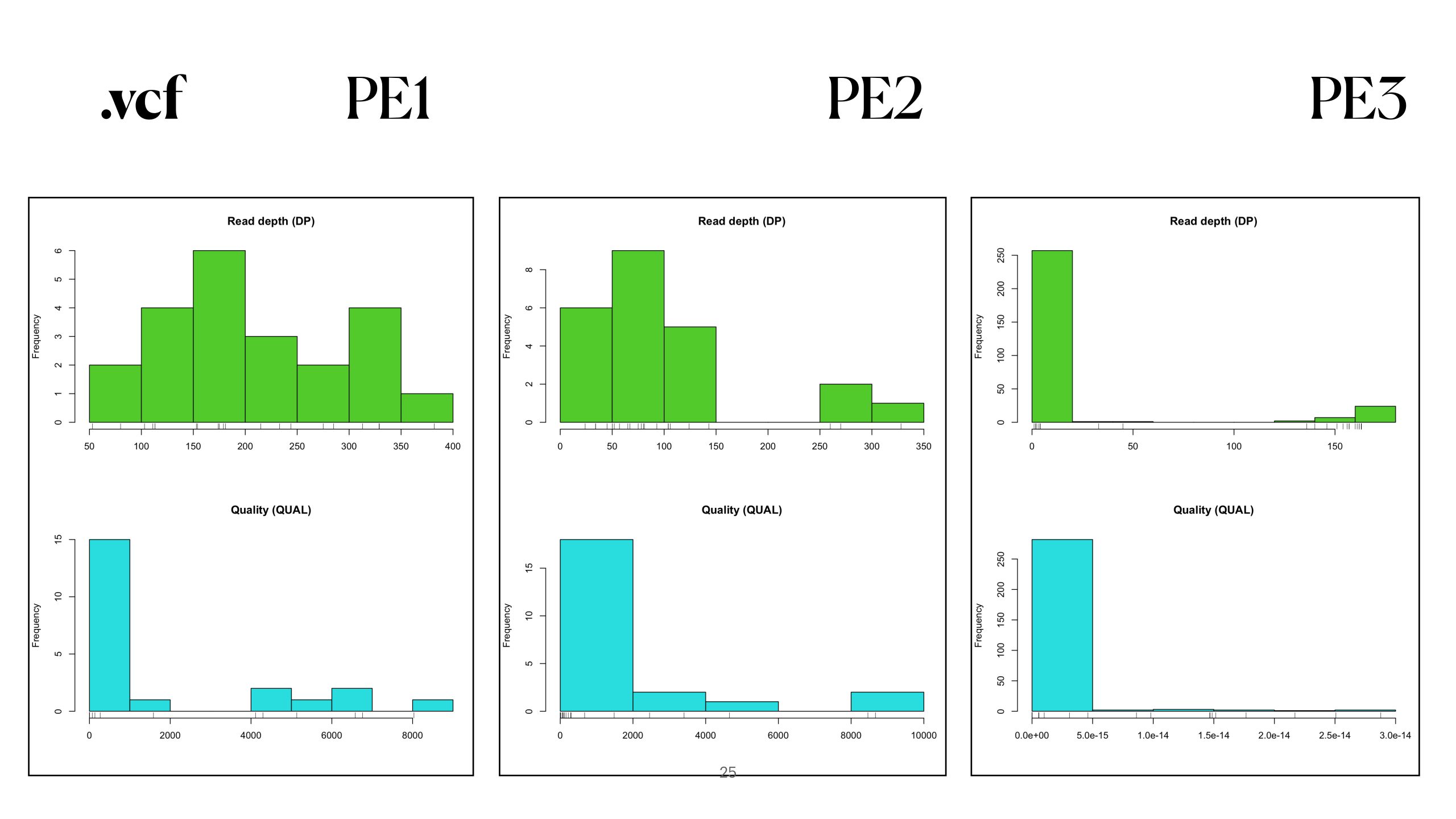
.vcf PE1 PE2 PE3
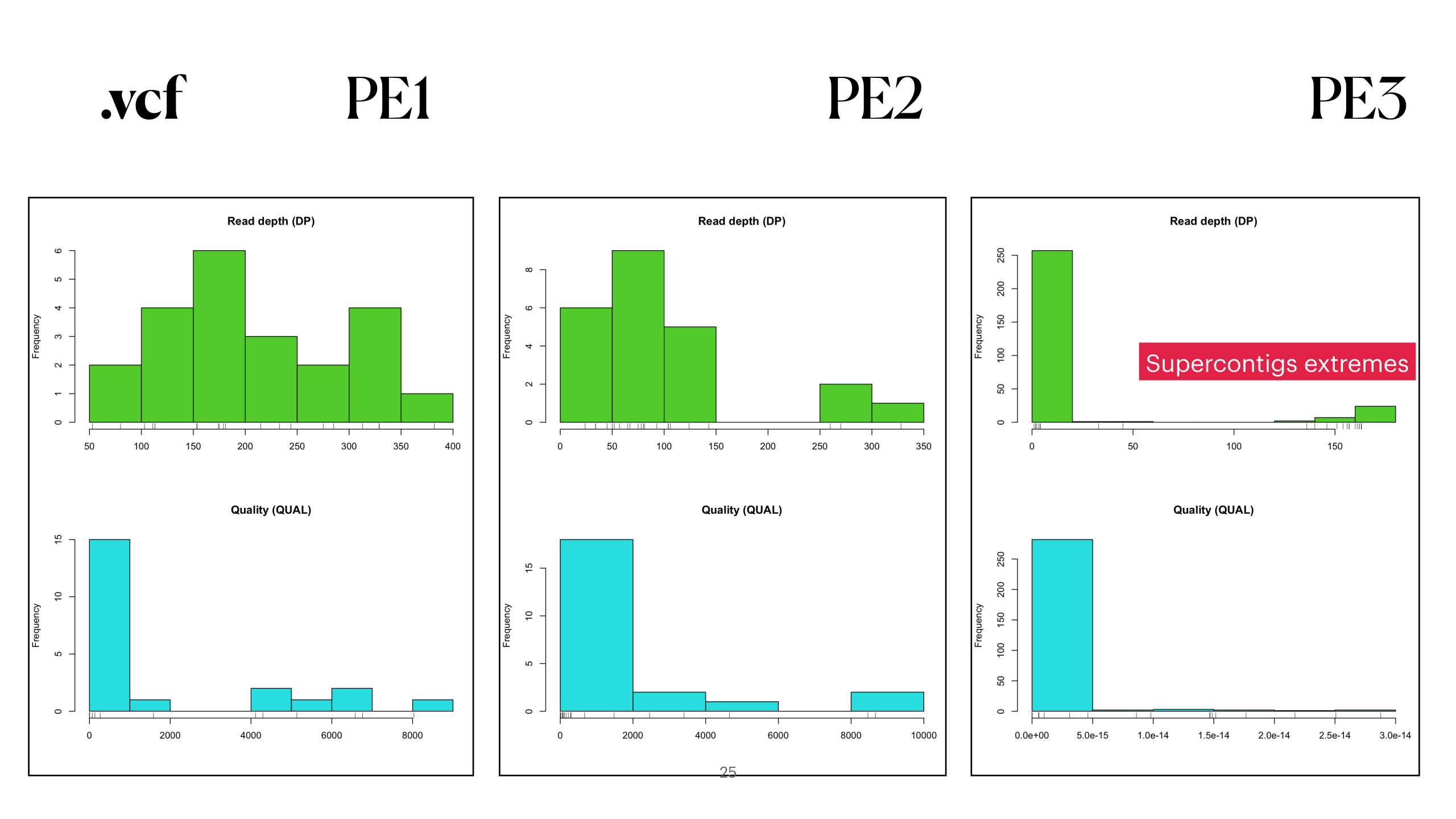
.vcf PE1 PE2 PE3 Supercontigs extremes
mask.vcf PE1 PE2 PE3
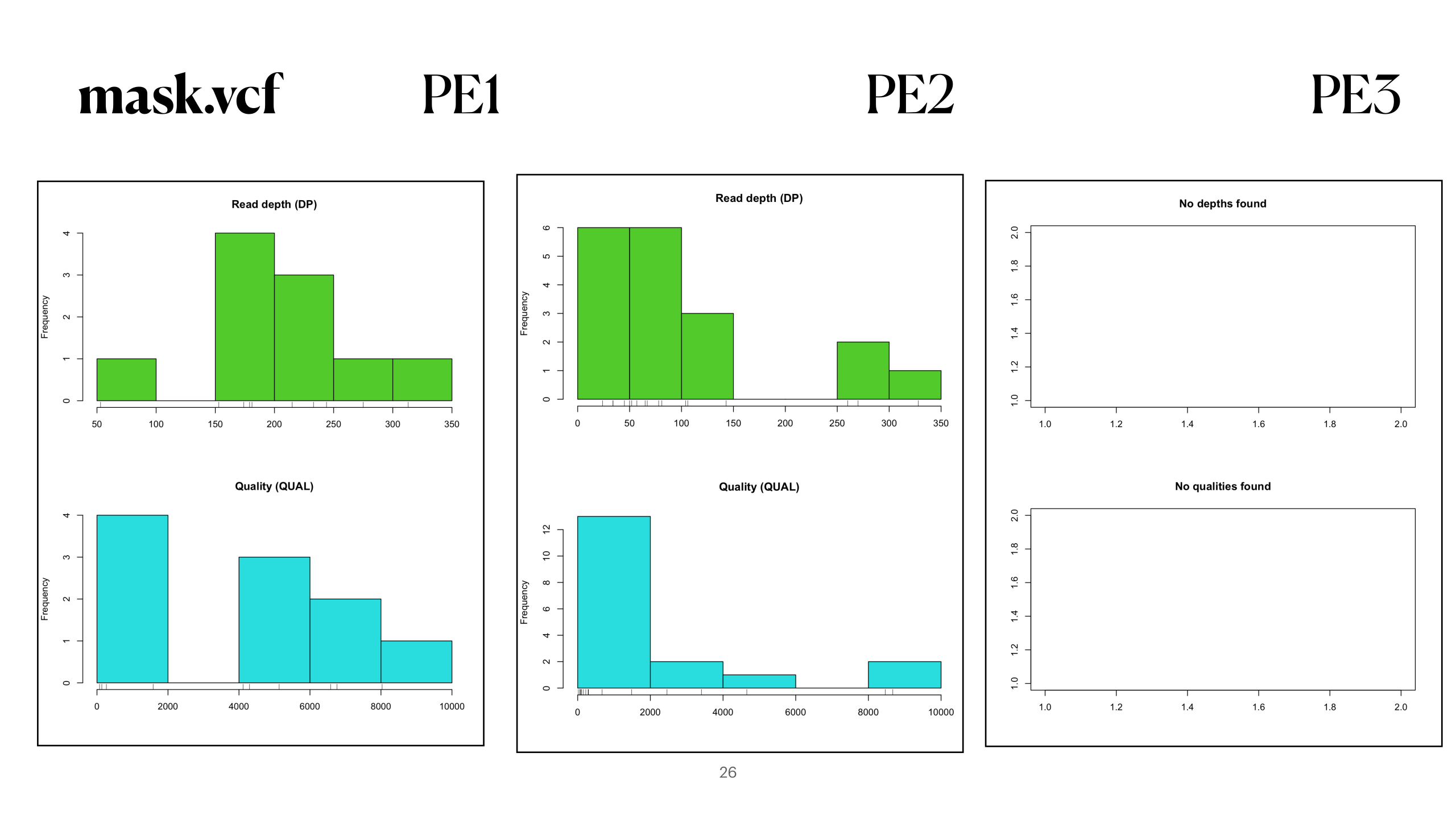
mask.vcf PE1 PE2 PE3
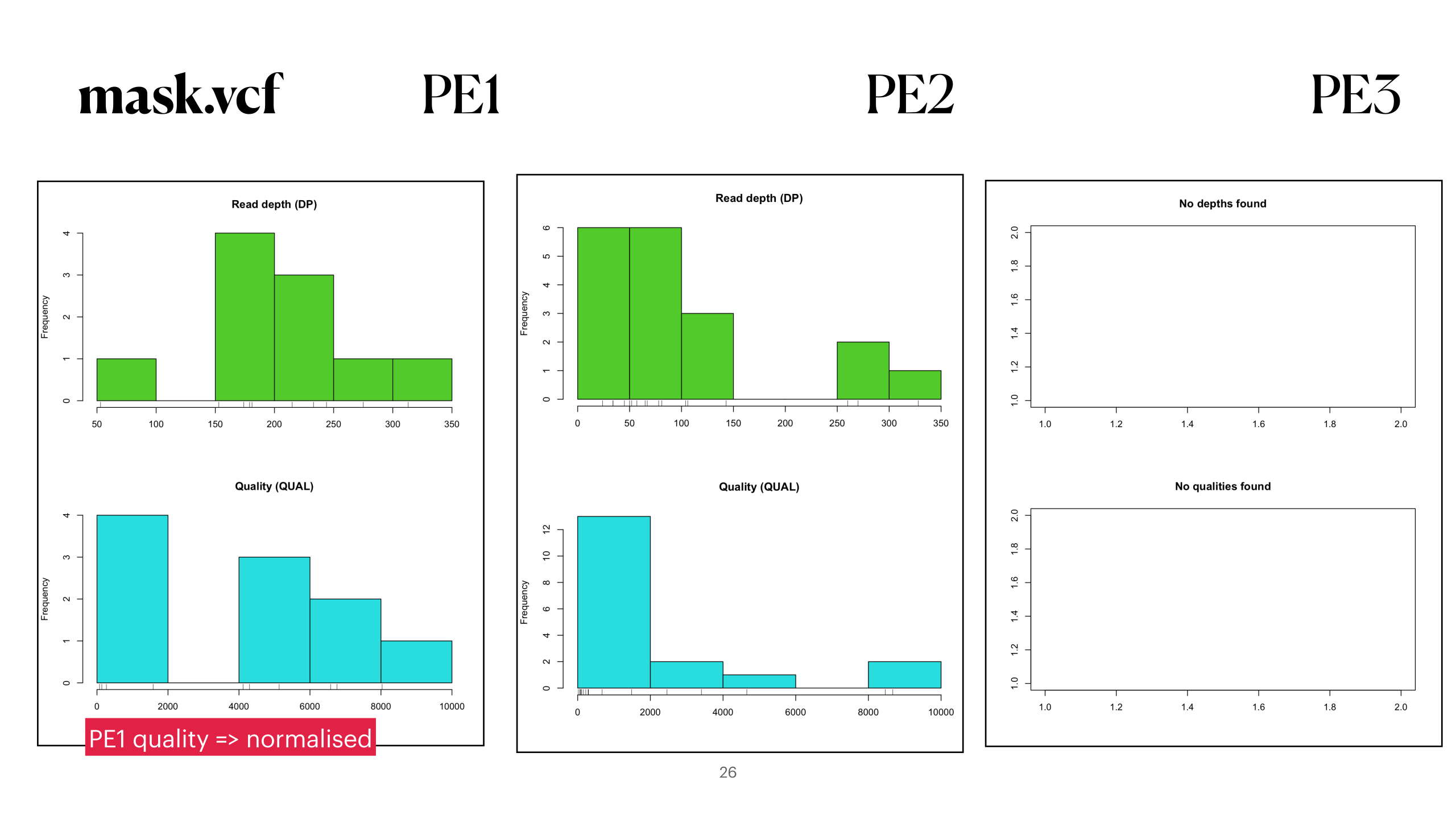
mask.vcf PE1 PE2 PE1 quality => normalised PE3
Read quality of PE1, PE2 and PE3: average quality per cycle of forward and reverse reads, and quality distributions
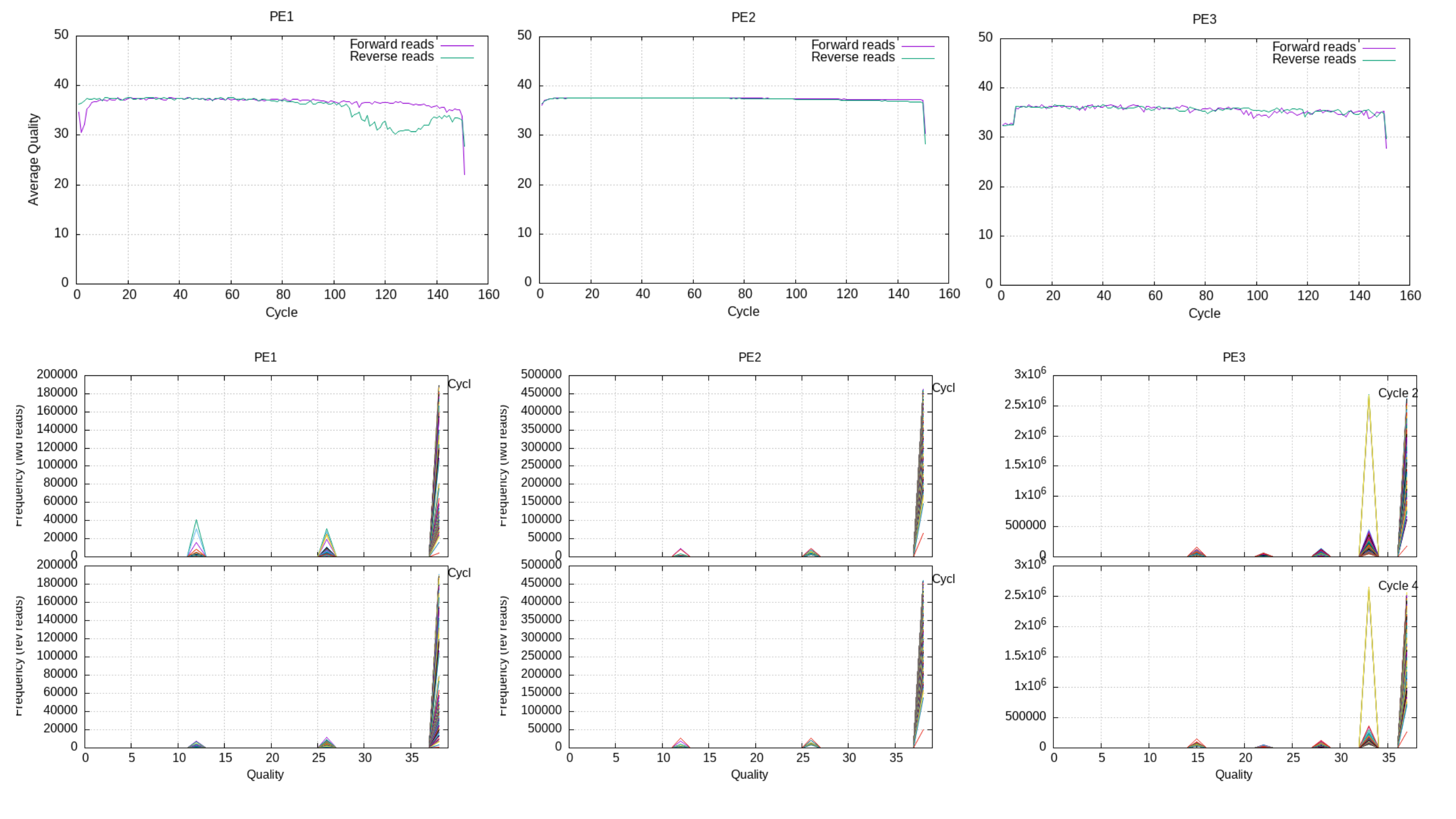
Quality per cycle (25–75th percentile, median, mean) of forward and reverse reads of PE1, PE2 and PE3
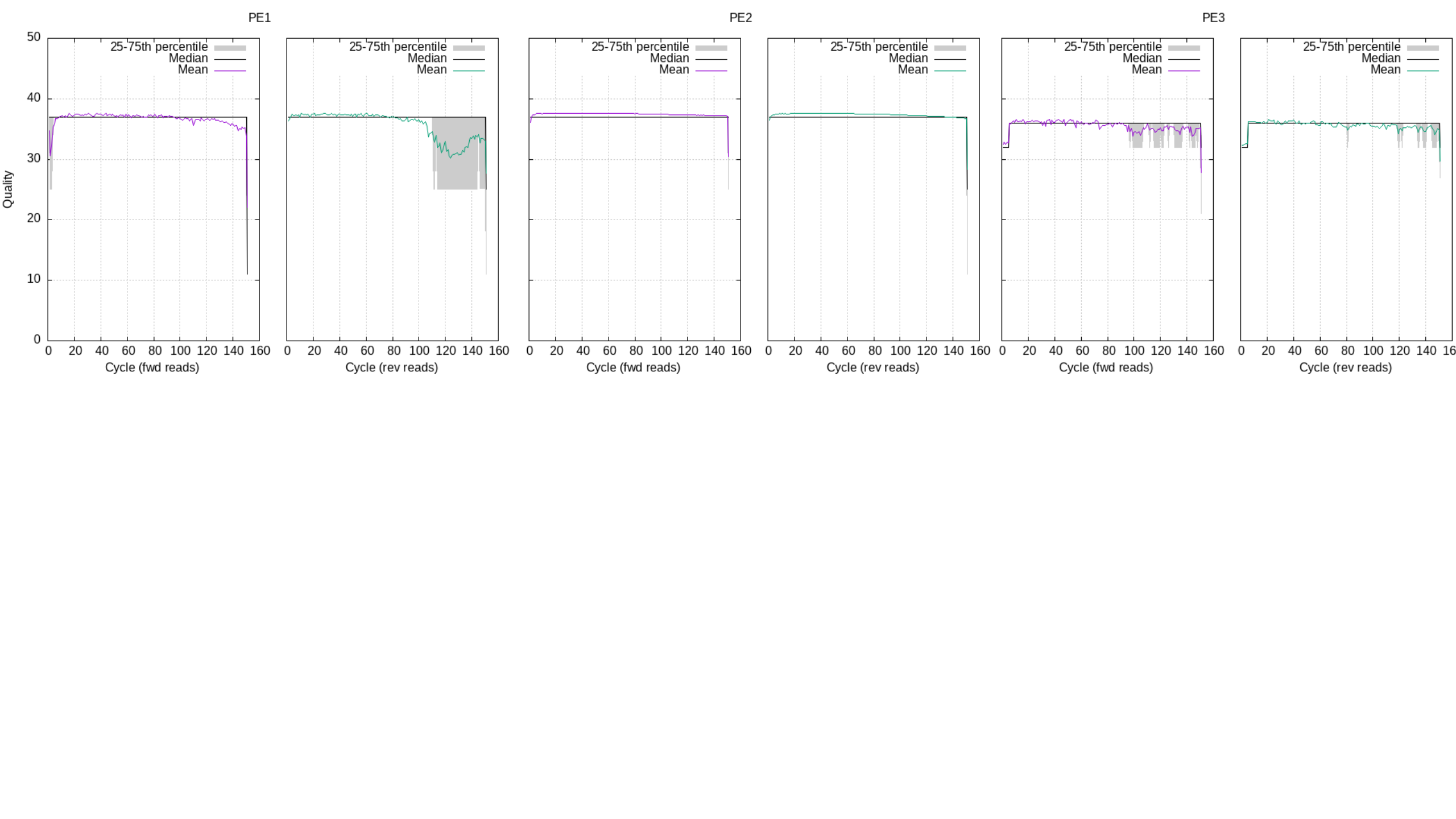
PE1 PE2 PE3
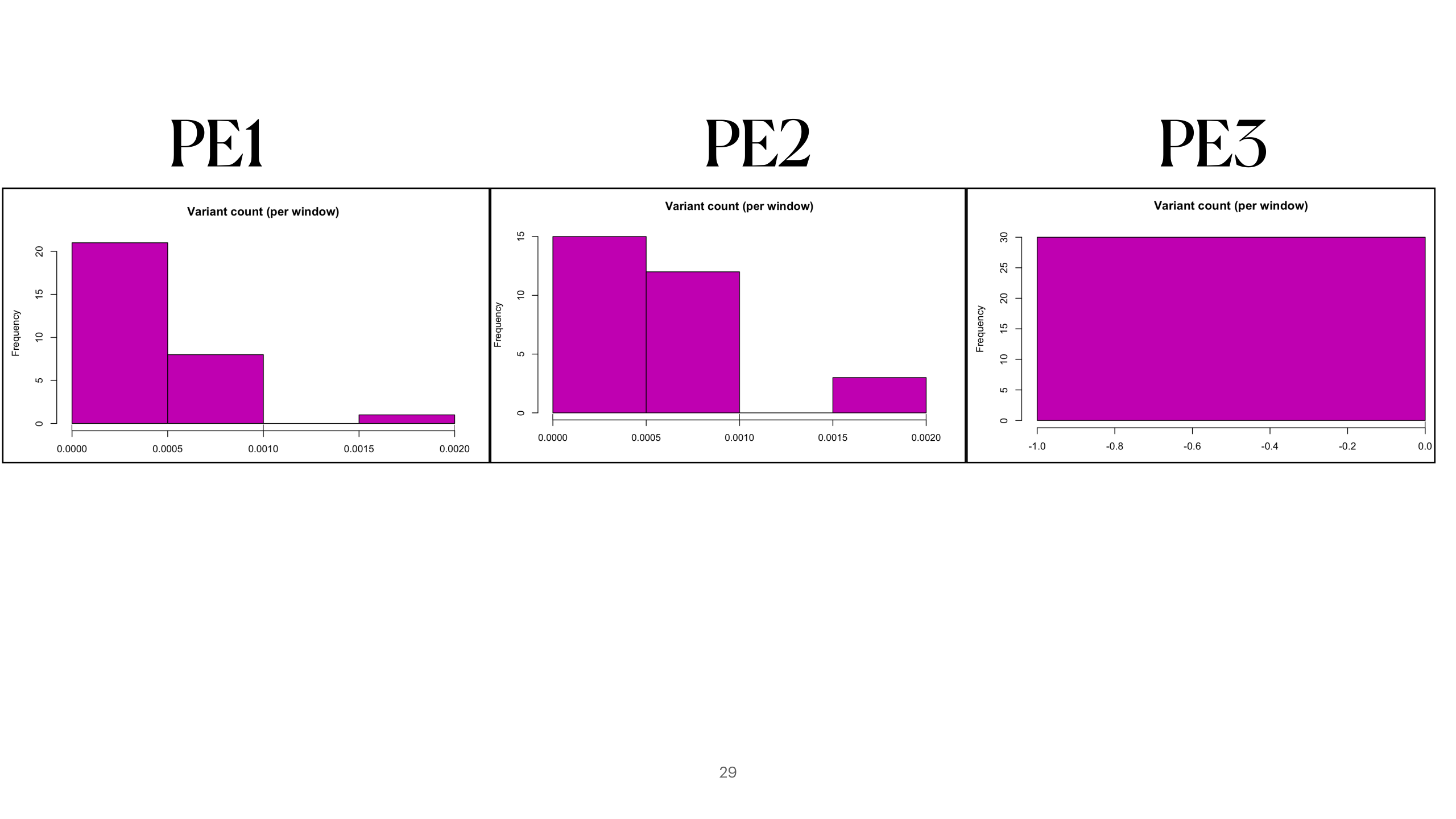
PE1 PE2 PE3
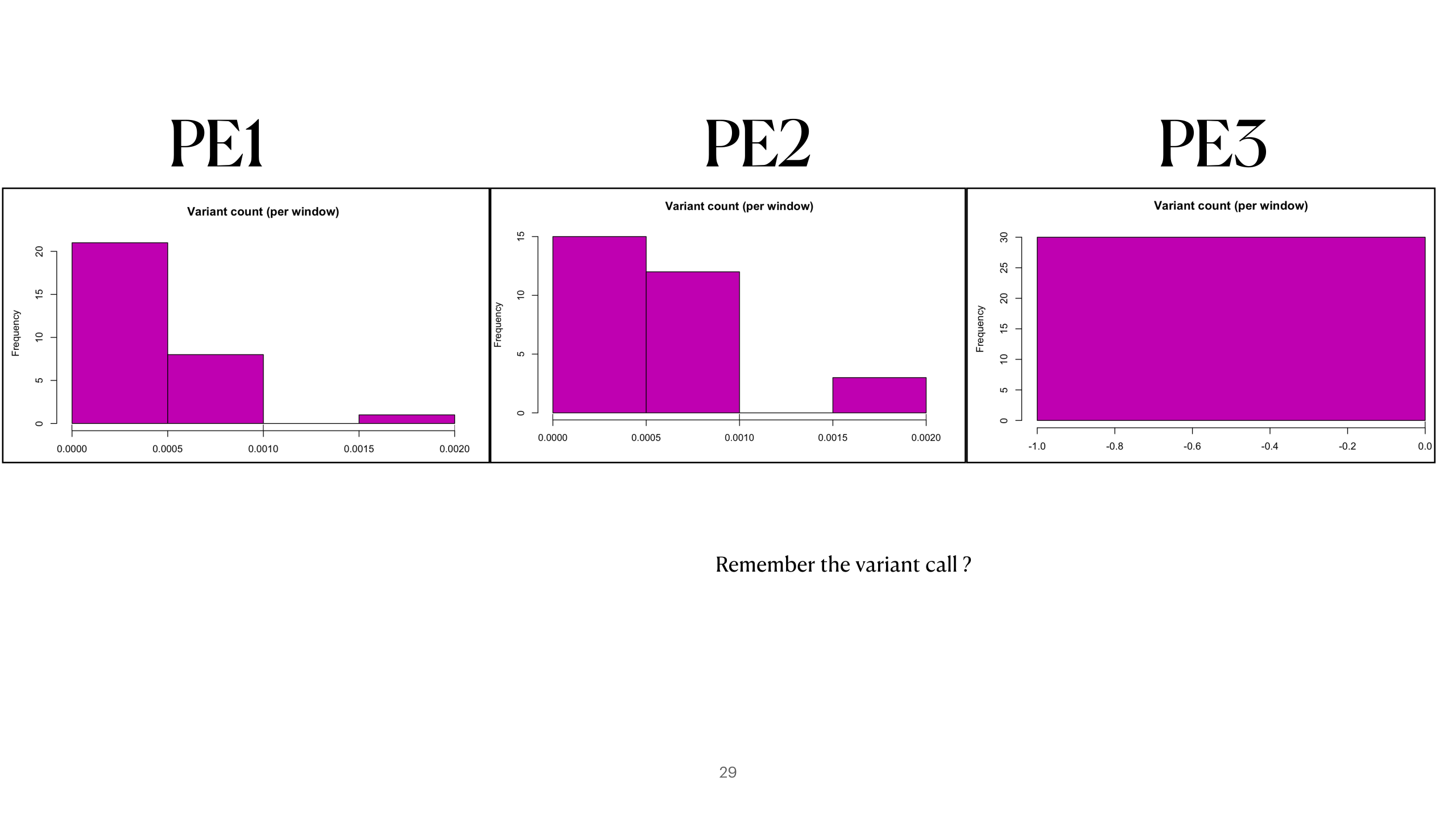
PE1 PE2 Remember the variant call ? PE3
PE1 PE2 PE3
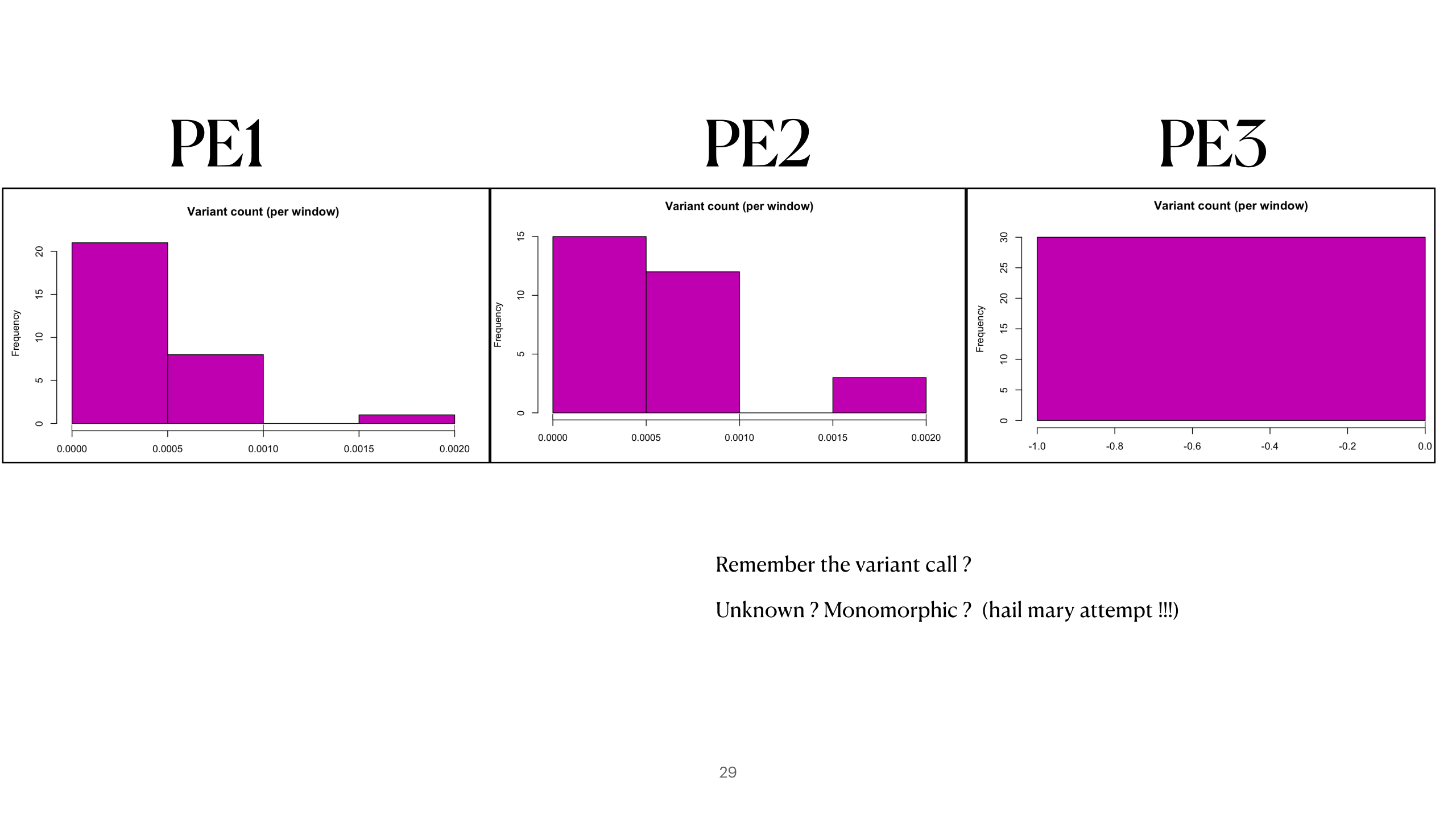
PE1 PE2 PE3 Remember the variant call ? Unknown ? Monomorphic ? (hail mary attempt !!!)
PE1 PE2 PE3
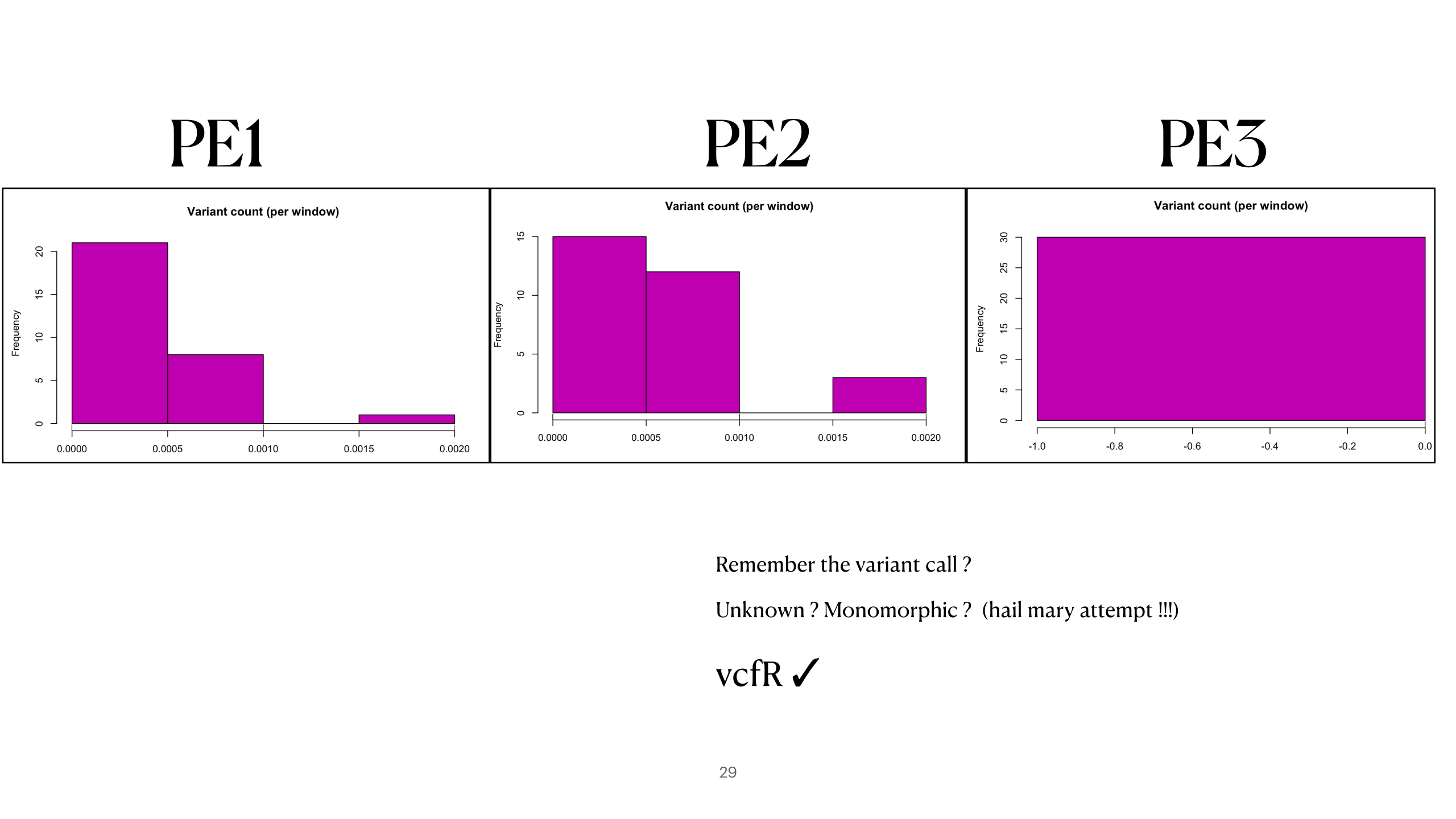
PE1 PE2 PE3 Remember the variant call ? Unknown ? Monomorphic ? (hail mary attempt !!!) vcfR ✓
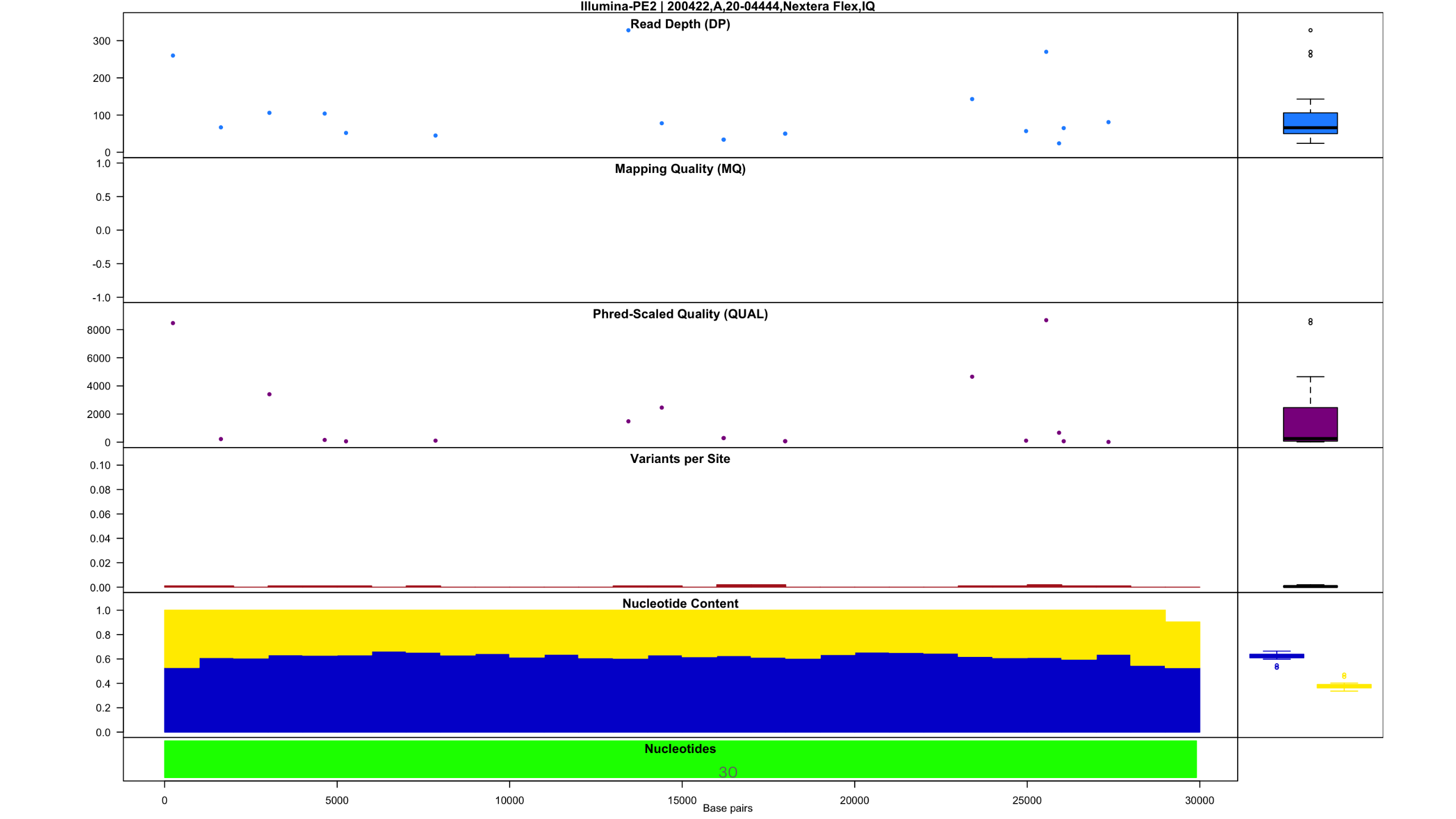
Variant plots for Illumina-PE2 along the genome: read depth, mapping quality, Phred-scaled quality, variants per site and nucleotide content
.g ile + annotated INFO for vcf
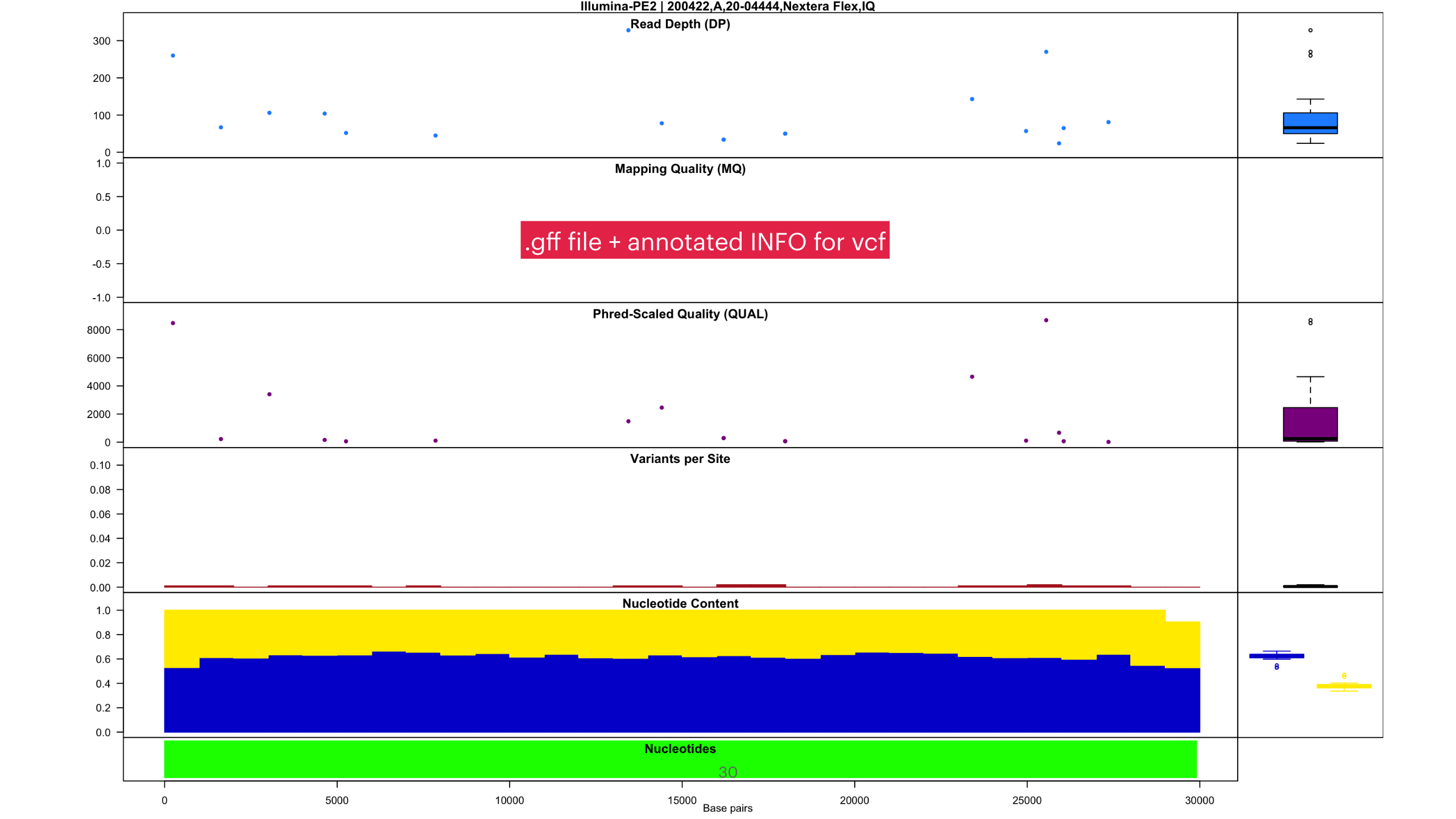
.g ile + annotated INFO for vcf f ff
lineage B.1 0.02 % ambiguous content (2 in 100 base pairs !)
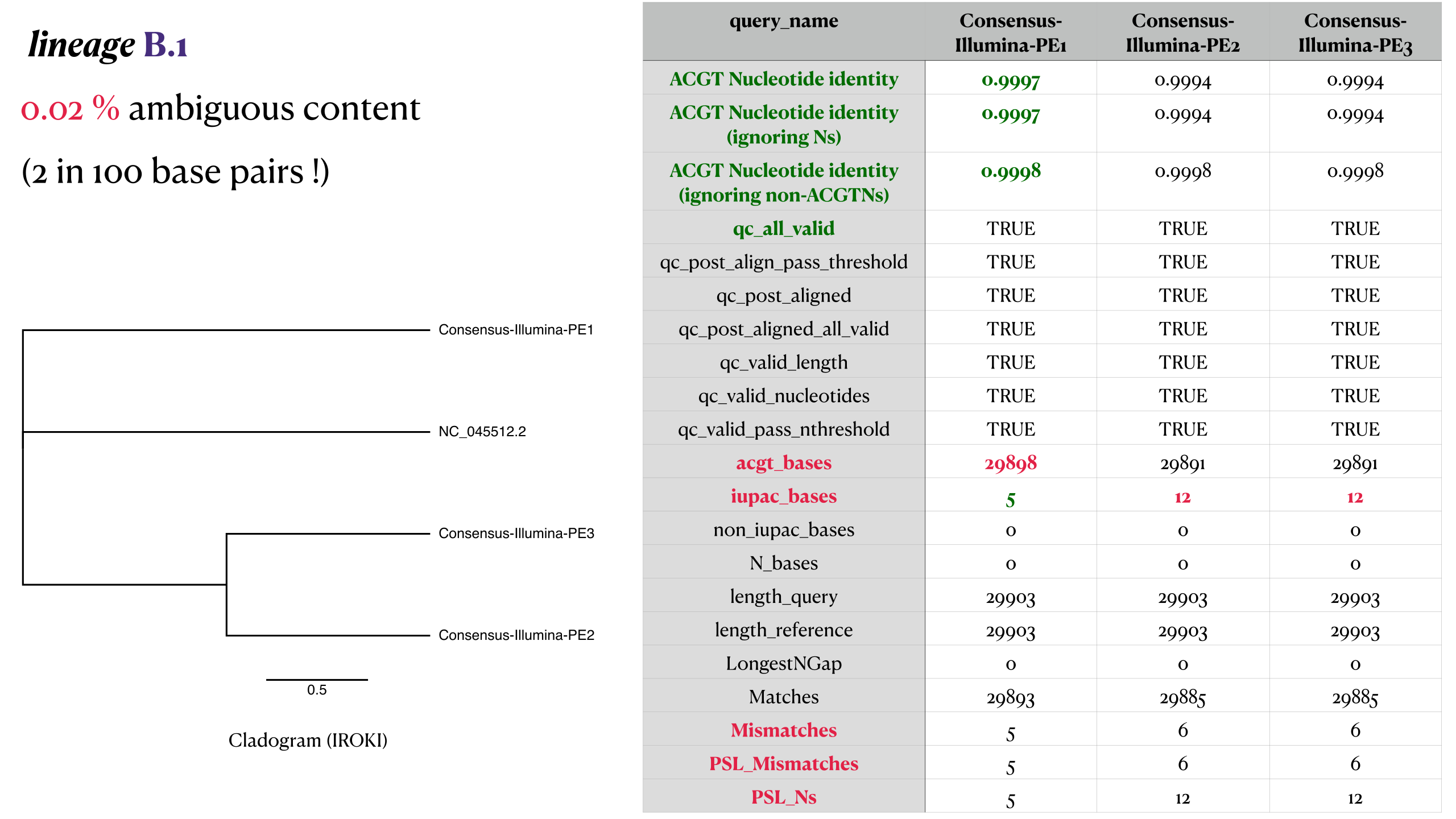
lineage B.1 0.02 % ambiguous content (2 in 100 base pairs !) Consensus-Illumina-PE1 NC_045512.2 Consensus-Illumina-PE3 Consensus-Illumina-PE2 Cladogram (IROKI) query_name ConsensusIllumina-PE1 ConsensusIllumina-PE2 ConsensusIllumina-PE3 ACGT Nucleotide identity ACGT Nucleotide identity (ignoring Ns) ACGT Nucleotide identity (ignoring non-ACGTNs) qc_all_valid TRUE TRUE TRUE qc_post_align_pass_threshold TRUE TRUE TRUE qc_post_aligned TRUE TRUE TRUE qc_post_aligned_all_valid TRUE TRUE TRUE qc_valid_length TRUE TRUE TRUE qc_valid_nucleotides TRUE TRUE TRUE qc_valid_pass_nthreshold TRUE TRUE TRUE acgt_bases iupac_bases non_iupac_bases N_bases length_query length_reference LongestNGap Matches Mismatches PSL_Mismatches PSL_Ns
lineage B.1 0.02 % ambiguous content (2 in 100 base pairs !)
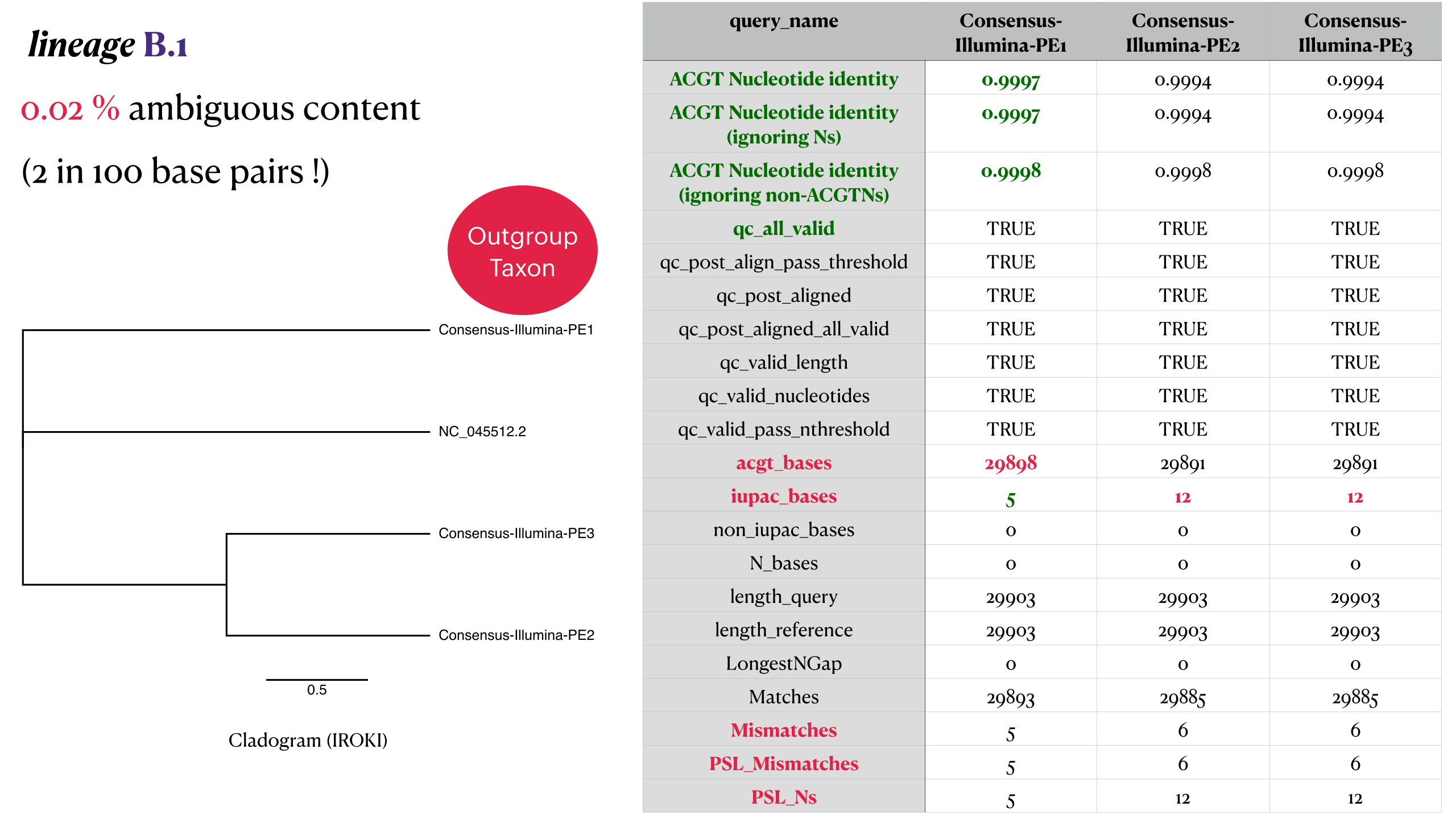
lineage B.1 0.02 % ambiguous content (2 in 100 base pairs !) Outgroup Taxon Consensus-Illumina-PE1 NC_045512.2 Consensus-Illumina-PE3 Consensus-Illumina-PE2 Cladogram (IROKI) query_name ConsensusIllumina-PE1 ConsensusIllumina-PE2 ConsensusIllumina-PE3 ACGT Nucleotide identity ACGT Nucleotide identity (ignoring Ns) ACGT Nucleotide identity (ignoring non-ACGTNs) qc_all_valid TRUE TRUE TRUE qc_post_align_pass_threshold TRUE TRUE TRUE qc_post_aligned TRUE TRUE TRUE qc_post_aligned_all_valid TRUE TRUE TRUE qc_valid_length TRUE TRUE TRUE qc_valid_nucleotides TRUE TRUE TRUE qc_valid_pass_nthreshold TRUE TRUE TRUE acgt_bases iupac_bases non_iupac_bases N_bases length_query length_reference LongestNGap Matches Mismatches PSL_Mismatches PSL_Ns
Interpretation
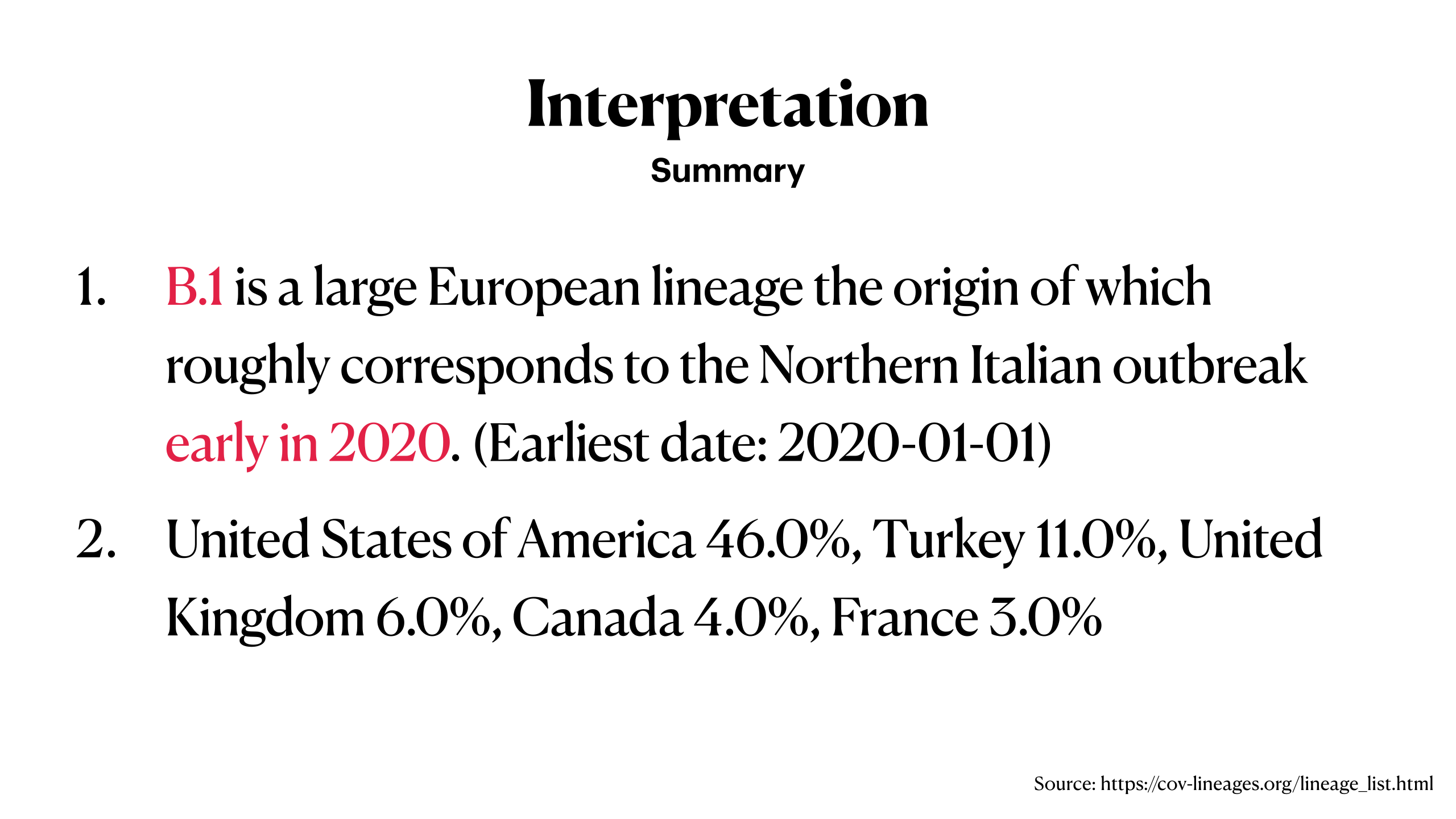
Interpretation Summ ry B.1 is a large European lineage the origin of which roughly corresponds to the Northern Italian outbreak early in 2020. (Earliest date: 2020-01-01) 2. United States of America 46.0%, Turkey 11.0%, United Kingdom 6.0%, Canada 4.0%, France 3.0% a Source: https://cov-lineages.org/lineage_list.html
Conclusion
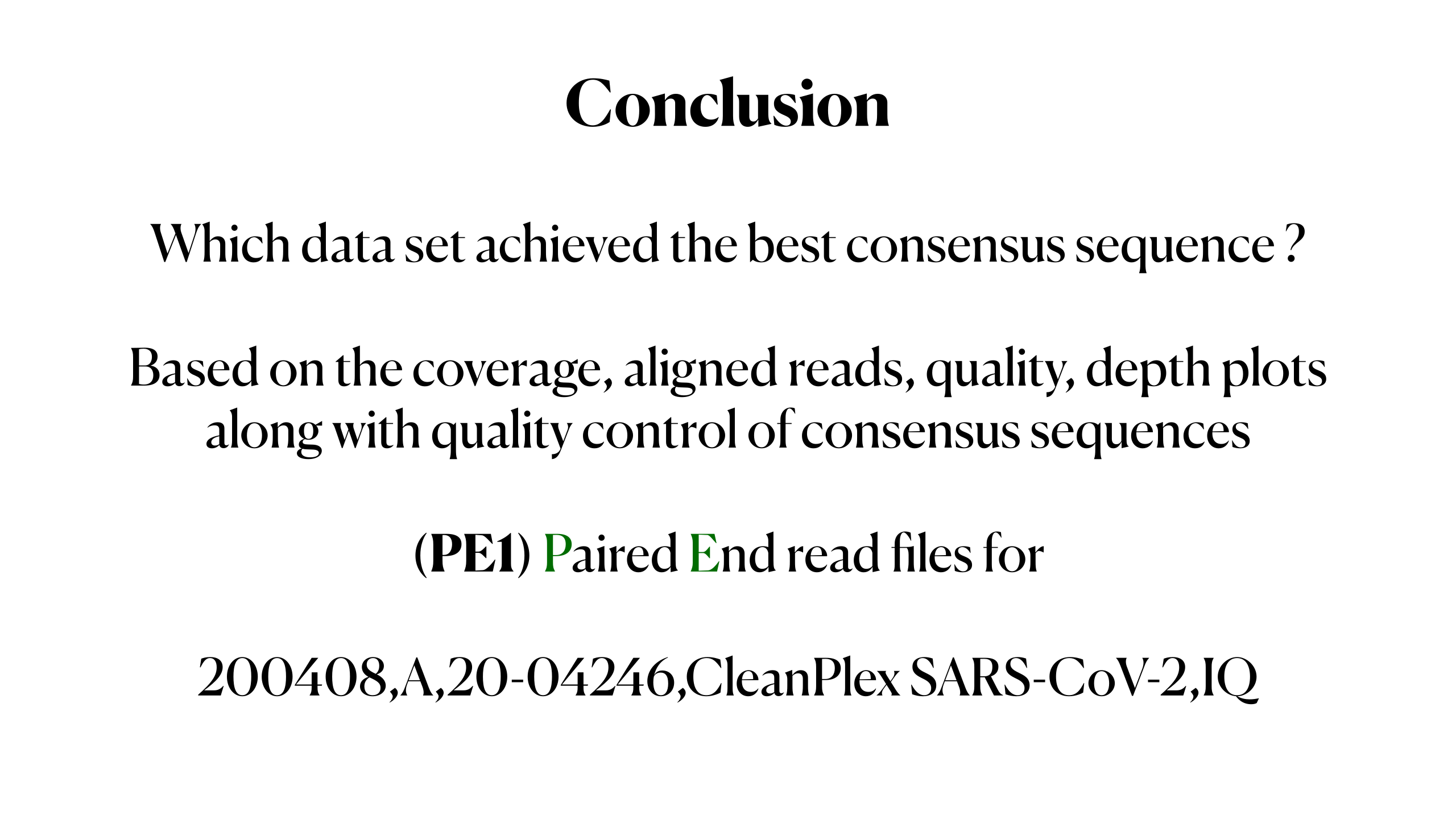
Conclusion Which data set achieved the best consensus sequence ? Based on the coverage, aligned reads, quality, depth plots along with quality control of consensus sequences (PE1) Paired End read les for fi 200408,A,20-04246,CleanPlex SARS-CoV-2,IQ
Discussion • Variant calling needs different parameters or different tools entirely • Interpretation could have been don
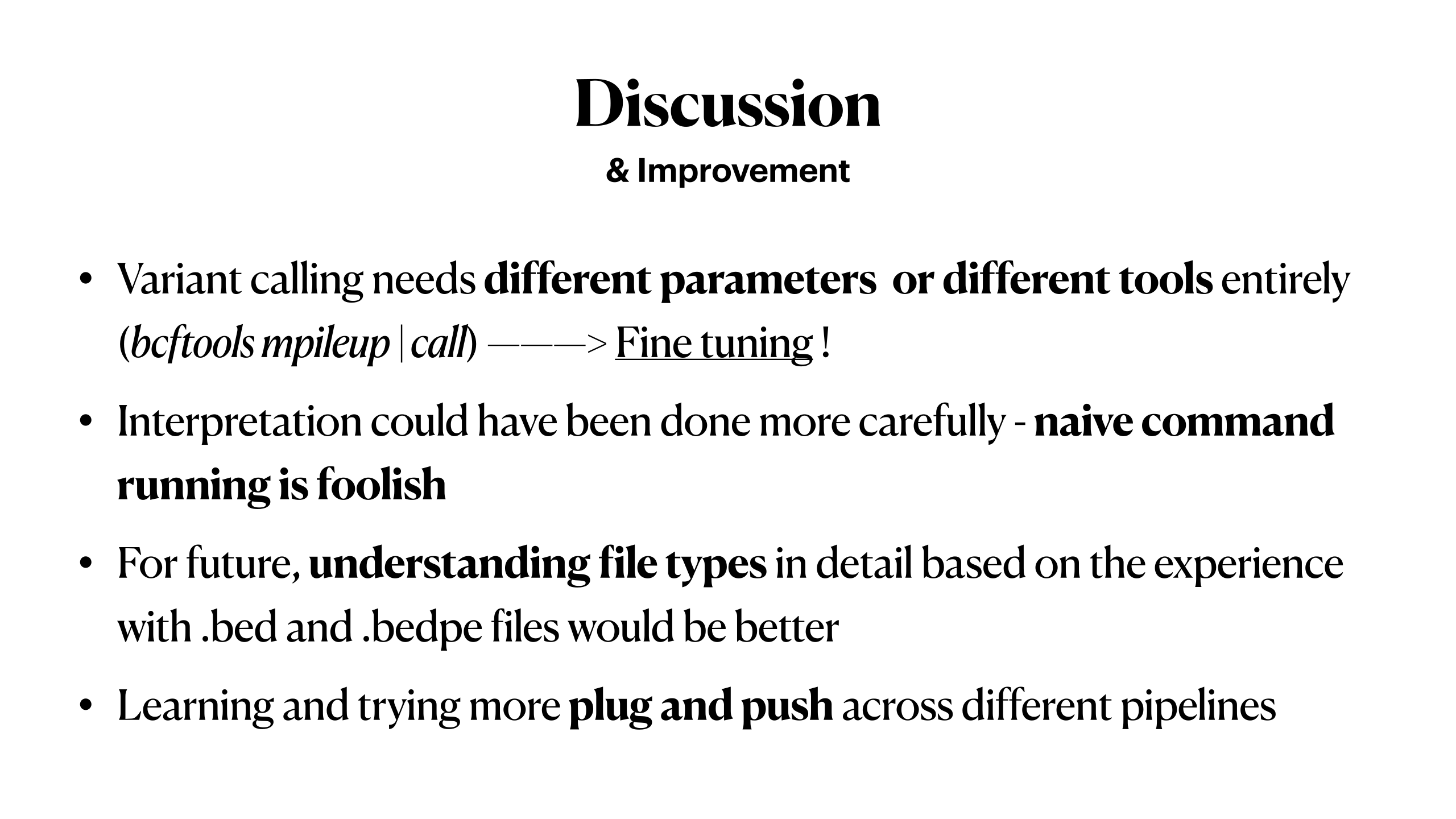
Discussion & Improvement • Variant calling needs different parameters or different tools entirely (bcftools mpileup | call) ———> Fine tuning ! • Interpretation could have been done more carefully - naive command running is foolish • For future, understanding ile types in detail based on the experience with .bed and .bedpe iles would be better f f • Learning and trying more plug and push across different pipelines
Fun project! Thanks !

Fun project! Thanks ! (~ 64 hours *_*)
References
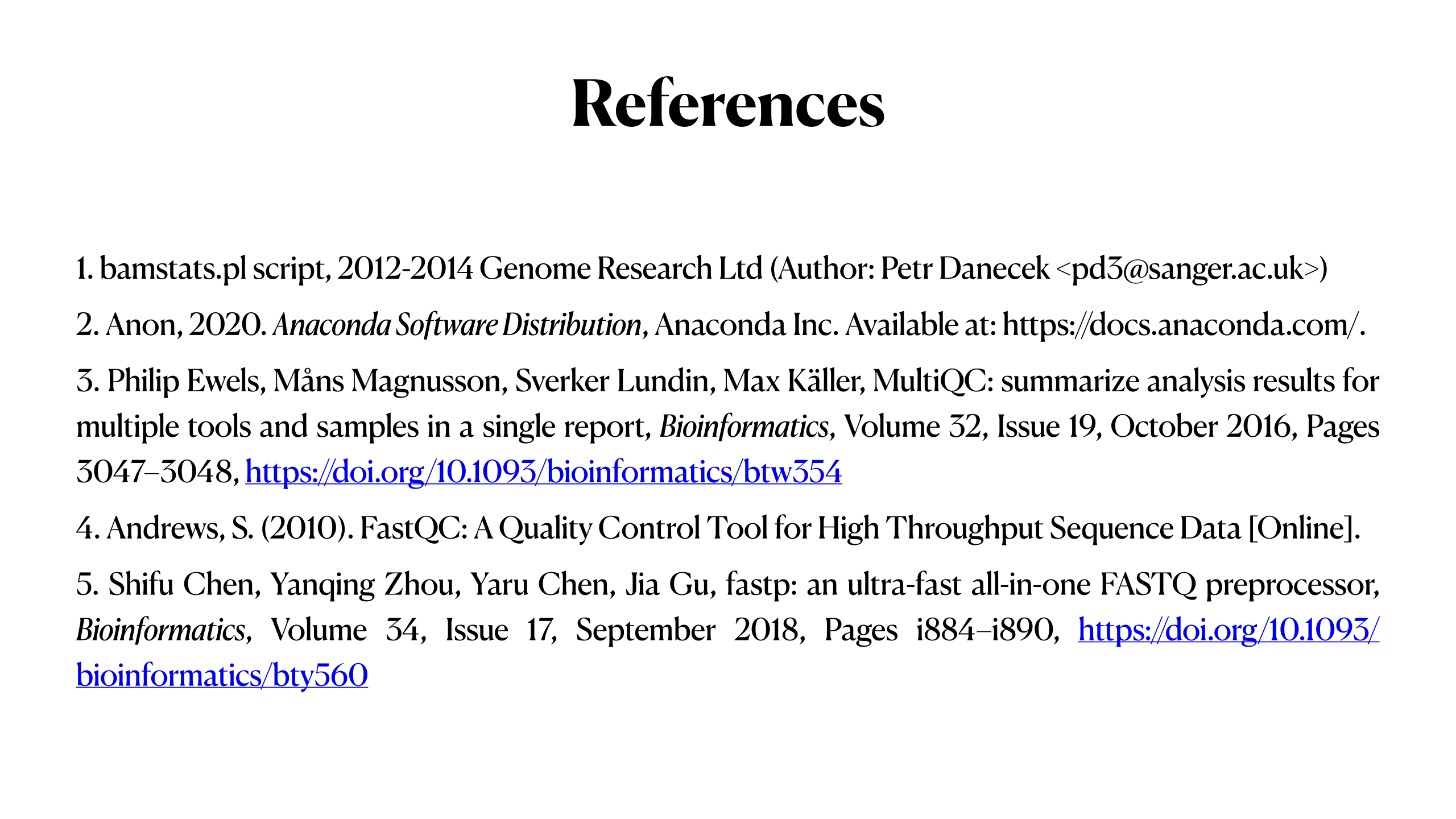
References 1. bamstats.pl script, 2012-2014 Genome Research Ltd (Author: Petr Danecek <pd3@sanger.ac.uk>) 2. Anon, 2020. Anaconda Software Distribution, Anaconda Inc. Available at: https://docs.anaconda.com/. 3. Philip Ewels, Måns Magnusson, Sverker Lundin, Max Käller, MultiQC: summarize analysis results for multiple tools and samples in a single report, Bioinformatics, Volume 32, Issue 19, October 2016, Pages 3047–3048, https://doi.org/10.1093/bioinformatics/btw354 4. Andrews, S. (2010). FastQC: A Quality Control Tool for High Throughput Sequence Data [Online]. 5. Shifu Chen, Yanqing Zhou, Yaru Chen, Jia Gu, fastp: an ultra-fast all-in-one FASTQ preprocessor, Bioinformatics, Volume 34, Issue 17, September 2018, Pages i884–i890, https://doi.org/10.1093/ bioinformatics/bty560
6. Heng Li, Minimap2: pairwise alignment for nucleotide sequences, Bioinformatics, Volume 34, Issue 18, September 2018,
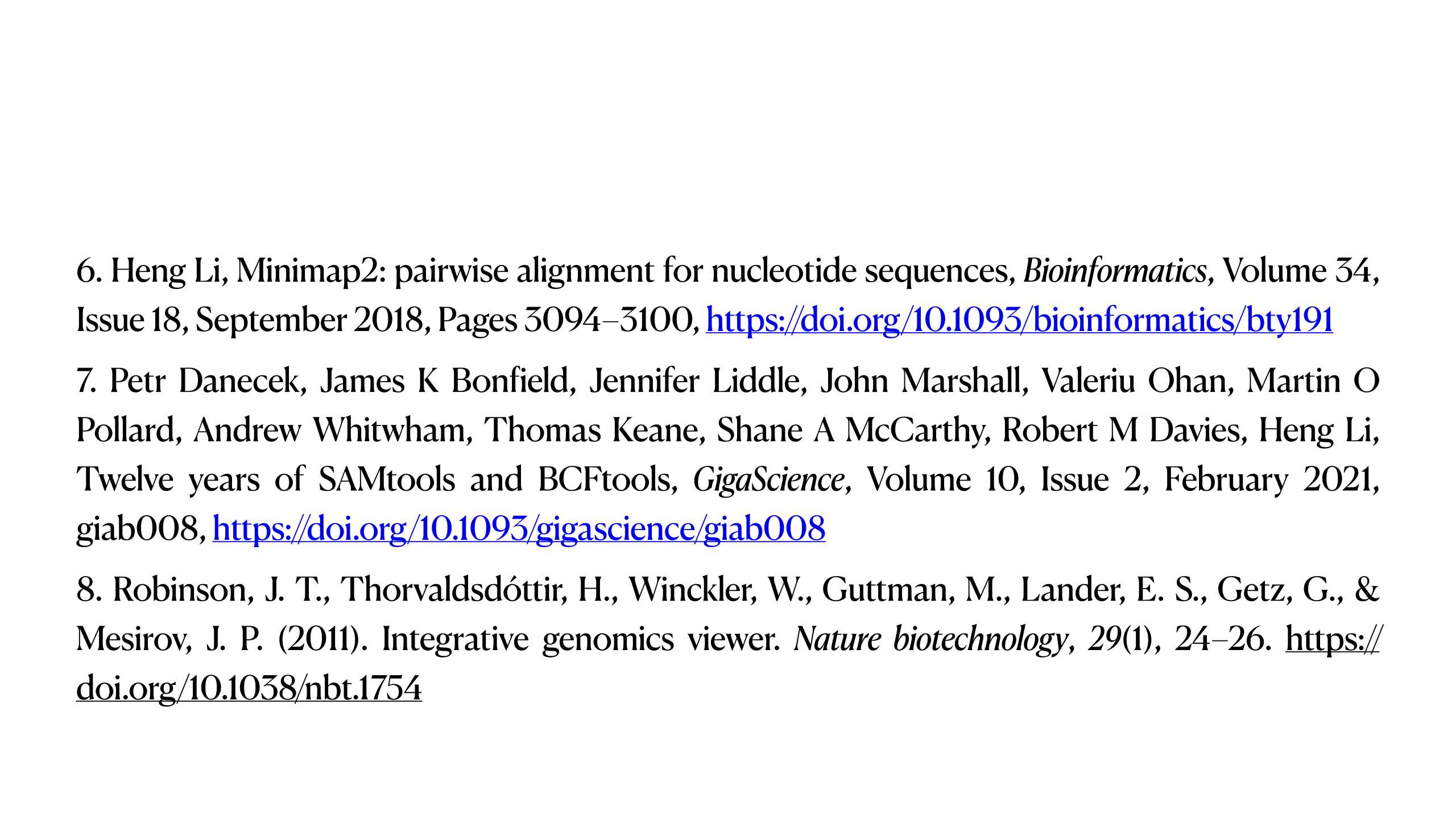
6. Heng Li, Minimap2: pairwise alignment for nucleotide sequences, Bioinformatics, Volume 34, Issue 18, September 2018, Pages 3094–3100, https://doi.org/10.1093/bioinformatics/bty191 7. Petr Danecek, James K Bon ield, Jennifer Liddle, John Marshall, Valeriu Ohan, Martin O Pollard, Andrew Whitwham, Thomas Keane, Shane A McCarthy, Robert M Davies, Heng Li, Twelve years of SAMtools and BCFtools, GigaScience, Volume 10, Issue 2, February 2021, giab008, https://doi.org/10.1093/gigascience/giab008 f 8. Robinson, J. T., Thorvaldsdóttir, H., Winckler, W., Guttman, M., Lander, E. S., Getz, G., & Mesirov, J. P. (2011). Integrative genomics viewer. Nature biotechnology, 29(1), 24–26. https:// doi.org/10.1038/nbt.1754
9. O’Toole Á, Hill V, Pybus OG et al. Tracking the international spread of SARS-CoV-2 lineages B.1.1.7 and B.1.351/501Y-
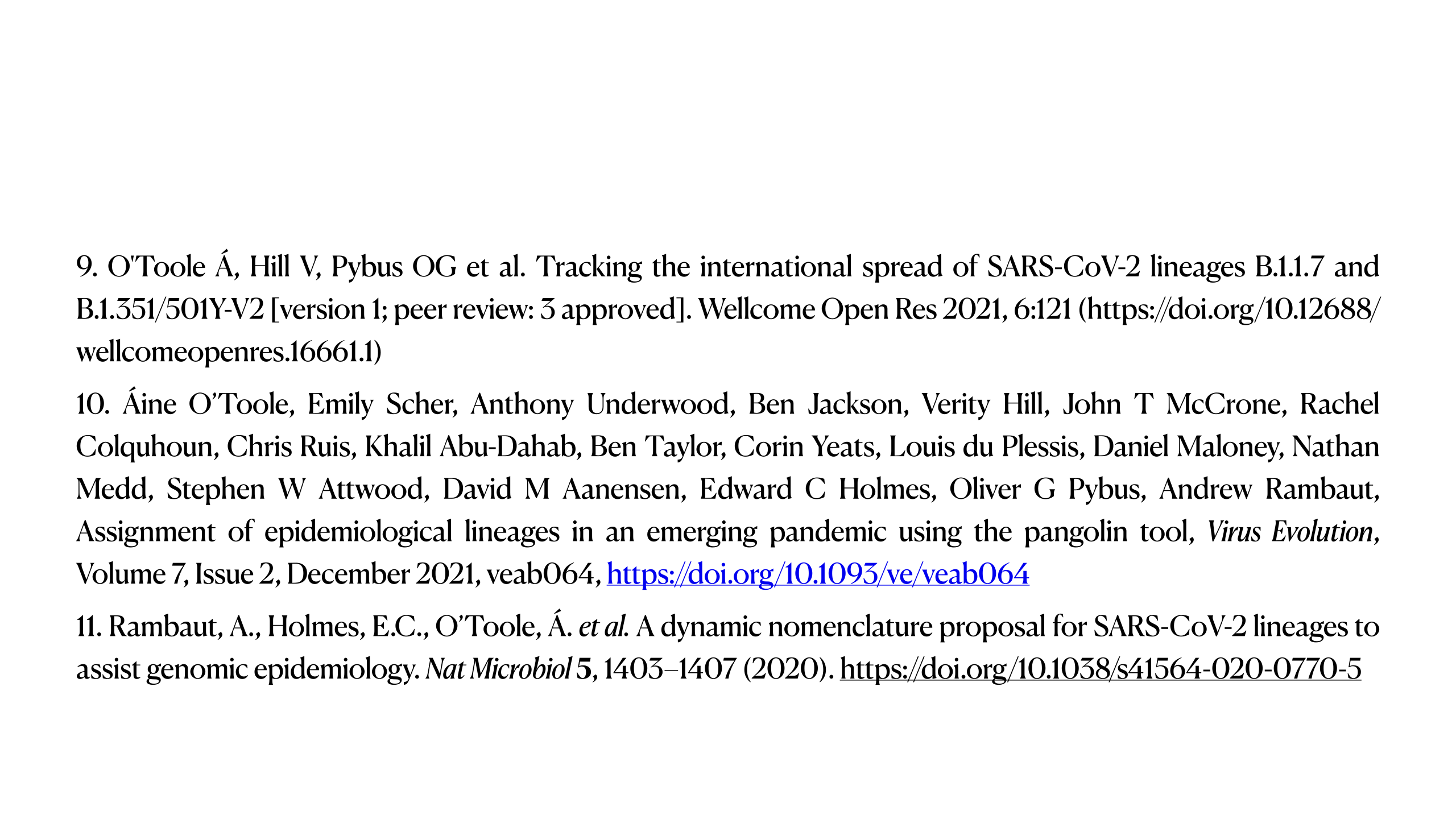
9. O'Toole Á, Hill V, Pybus OG et al. Tracking the international spread of SARS-CoV-2 lineages B.1.1.7 and B.1.351/501Y-V2 [version 1; peer review: 3 approved]. Wellcome Open Res 2021, 6:121 (https://doi.org/10.12688/ wellcomeopenres.16661.1) 10. Áine O’Toole, Emily Scher, Anthony Underwood, Ben Jackson, Verity Hill, John T McCrone, Rachel Colquhoun, Chris Ruis, Khalil Abu-Dahab, Ben Taylor, Corin Yeats, Louis du Plessis, Daniel Maloney, Nathan Medd, Stephen W Attwood, David M Aanensen, Edward C Holmes, Oliver G Pybus, Andrew Rambaut, Assignment of epidemiological lineages in an emerging pandemic using the pangolin tool, Virus Evolution, Volume 7, Issue 2, December 2021, veab064, https://doi.org/10.1093/ve/veab064 11. Rambaut, A., Holmes, E.C., O’Toole, Á. et al. A dynamic nomenclature proposal for SARS-CoV-2 lineages to assist genomic epidemiology. Nat Microbiol 5, 1403–1407 (2020). https://doi.org/10.1038/s41564-020-0770-5
12. Tool for QC with consensus sequences https://github.com/rki-mf1/president 13. Au, C., Ho, D., Kwong, A. et al. BAMCl
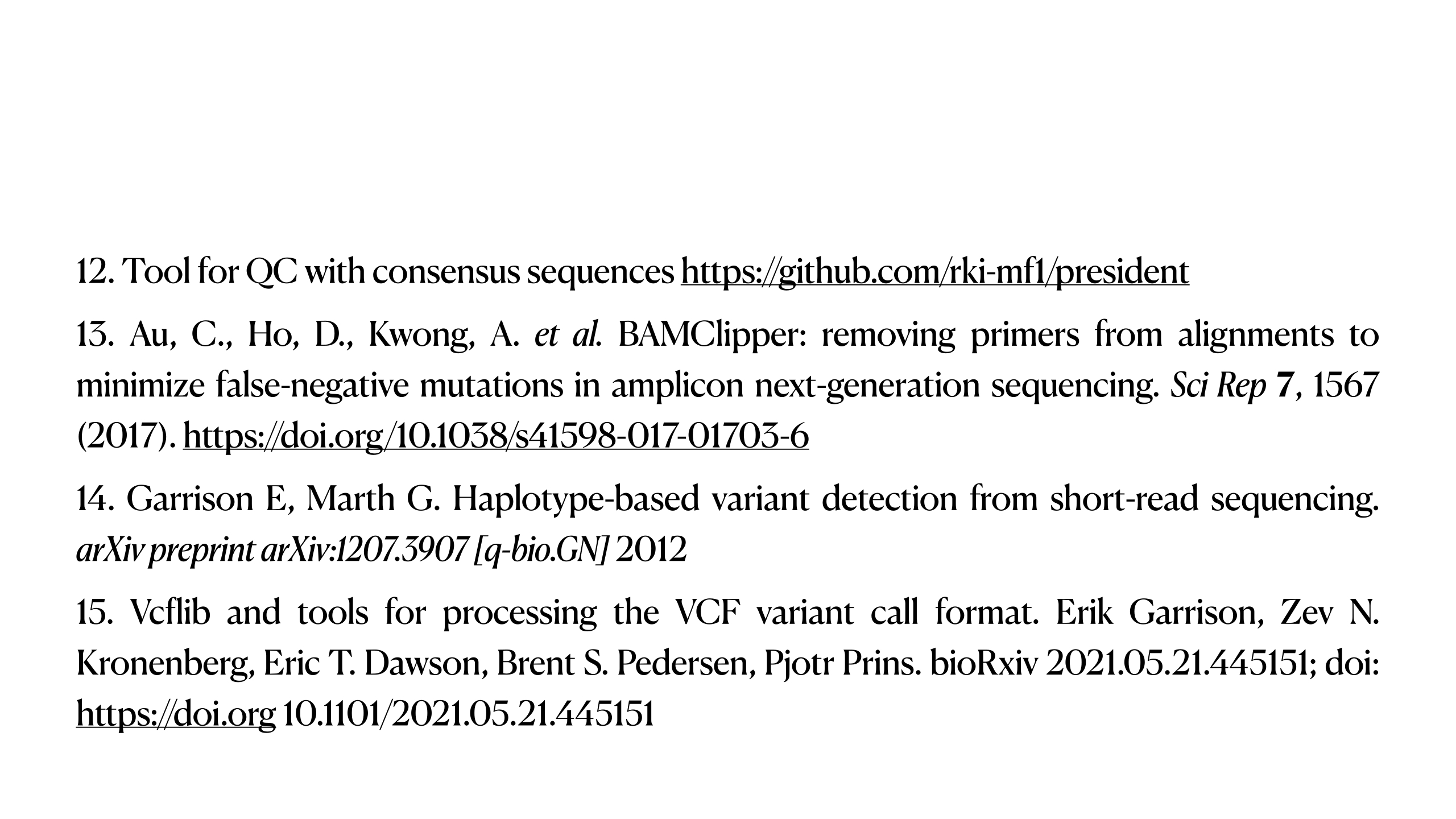
12. Tool for QC with consensus sequences https://github.com/rki-mf1/president 13. Au, C., Ho, D., Kwong, A. et al. BAMClipper: removing primers from alignments to minimize false-negative mutations in amplicon next-generation sequencing. Sci Rep 7, 1567 (2017). https://doi.org/10.1038/s41598-017-01703-6 14. Garrison E, Marth G. Haplotype-based variant detection from short-read sequencing. arXiv preprint arXiv:1207.3907 [q-bio.GN] 2012 f 15. Vc lib and tools for processing the VCF variant call format. Erik Garrison, Zev N. Kronenberg, Eric T. Dawson, Brent S. Pedersen, Pjotr Prins. bioRxiv 2021.05.21.445151; doi: https://doi.org 10.1101/2021.05.21.445151
16. Petr Danecek, Adam Auton, Goncalo Abecasis, Cornelis A. Albers, Eric Banks, Mark A. DePristo, Robert E. Handsaker, G
16. Petr Danecek, Adam Auton, Goncalo Abecasis, Cornelis A. Albers, Eric Banks, Mark A. DePristo, Robert E. Handsaker, Gerton Lunter, Gabor T. Marth, Stephen T. Sherry, Gilean McVean, Richard Durbin, 1000 Genomes Project Analysis Group, The variant call format and VCFtools, Bioinformatics, Volume 27, Issue 15, August 2011, Pages 2156–2158, https:// doi.org/10.1093/bioinformatics/btr330 17. Waterhouse, A.M., Procter, J.B., Martin, D.M.A, Clamp, M., Barton, G.J (2009), "Jalview version 2: A Multiple Sequence Alignment and Analysis Workbench,” Bioinformatics 25 (9) 1189-1191 doi: 10.1093/bioinformatics/btp033 18. Nguyen, L. T., Schmidt, H. A., von Haeseler, A., & Minh, B. Q. (2015). IQ-TREE: a fast and effective stochastic algorithm for estimating maximum-likelihood phylogenies. Molecular biology and evolution, 32(1), 268–274. https://doi.org/10.1093/ molbev/msu300 f 19. Bui Quang Minh, Heiko A Schmidt, Olga Chernomor, Dominik Schrempf, Michael D Woodhams, Arndt von Haeseler, Robert Lanfear, IQ-TREE 2: New Models and Ef icient Methods for Phylogenetic Inference in the Genomic Era, Molecular Biology and Evolution, Volume 37, Issue 5, May 2020, Pages 1530–1534, https://doi.org/10.1093/molbev/msaa015
20. Aaron R. Quinlan, Ira M. Hall, BEDTools: a lexible suite of utilities for comparing genomic features, Bioinformatics
20. Aaron R. Quinlan, Ira M. Hall, BEDTools: a lexible suite of utilities for comparing genomic features, Bioinformatics, Volume 26, Issue 6, March 2010, Pages 841–842, https://doi.org/10.1093/bioinformatics/btq033 21. Katoh, K., & Standley, D. M. (2013). MAFFT multiple sequence alignment software version 7: improvements in performance and usability. Molecular biology and evolution, 30(4), 772–780. https://doi.org/10.1093/molbev/mst010 22. R Core Team (2022). R: A language and environment for statistical computing. R Foundation for Statistical Computing, Vienna, Austria. URL https://www.R-project.org/. 23. Knaus, B.J. and Grünwald, N.J. (2017), vcfr: a package to manipulate and visualize variant call format data in R. Mol Ecol Resour, 17: 44-53. https://doi.org/10.1111/1755-0998.12549 f 24. National Center for Biotechnology Information (NCBI)[Internet]. Bethesda (MD): National Library of Medicine (US), National Center for Biotechnology Information; [1988] – [cited 2023 Sep 29]. Available from: https://www.ncbi.nlm.nih.gov/
Credits
Credits The used Pg. 8 template for work low is from slidesgo 2. This presentation was made on Keynote version 13.2 3. The data iles were provided by instructors 4. The project is available on google drive here. It will be there until formatted into a repo on GitHub. f f 5. Available: https://github.com/bibymaths/SARSCoV2
Device Info
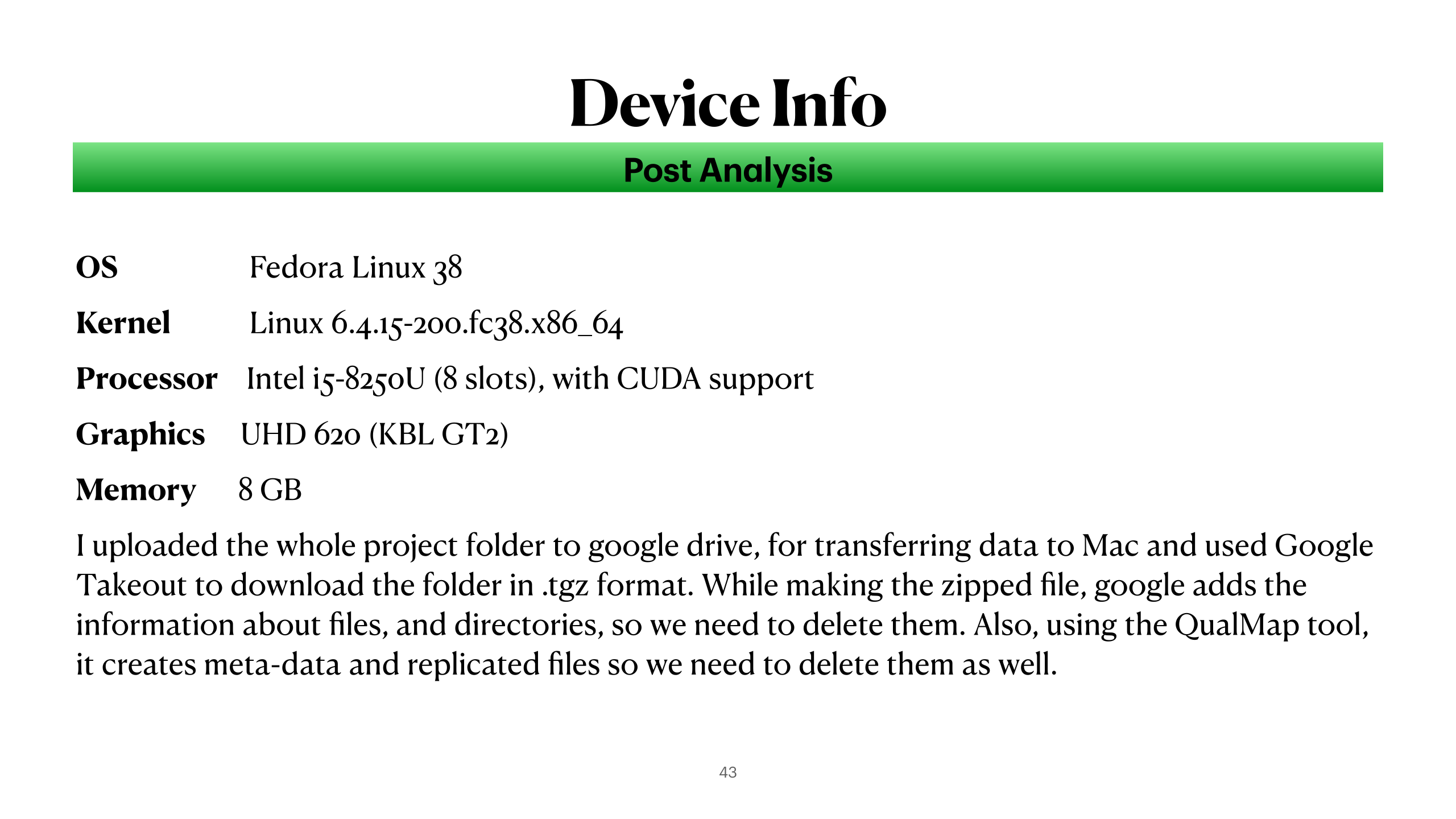
Device Info Post An lysis OS Fedora Linux 38 Kernel Linux 6.4.15-200.fc38.x86_64 Processor Intel i5-8250U (8 slots), with CUDA support Graphics UHD 620 (KBL GT2) Memory 8 GB I uploaded the whole project folder to google drive, for transferring data to Mac and used Google Takeout to download the folder in .tgz format. While making the zipped le, google adds the information about les, and directories, so we need to delete them. Also, using the QualMap tool, it creates meta-data and replicated les so we need to delete them as well. fi fi fi a