A weakly structured stem for human origins in Africa*
A weakly structured stem for human origins in Africa* R gsd le, A.P., We ver, T.D., Atkinson, E.G. et l. A we kly structured stem for hum n origins in Afric . N ture 617, 755–763 (2023) a 12th June 2023 a a a a Hum n Evolution a a a a a a Abhin v Mishr
*Ancient DNA from Eurasia has helped to clarify early human history outside Africa, but there is no comparably ancient D
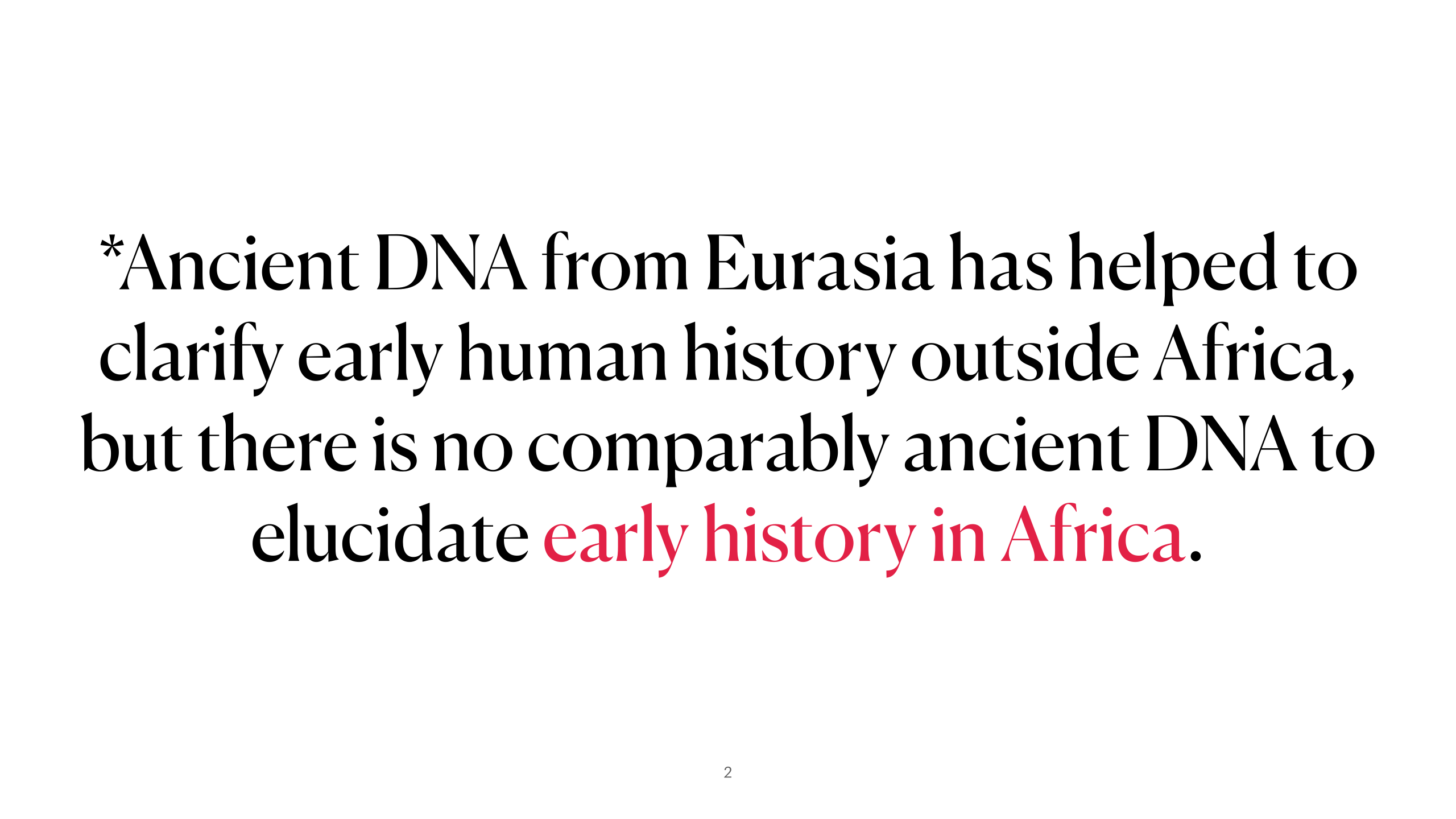
*Ancient DNA from Eurasia has helped to clarify early human history outside Africa, but there is no comparably ancient DNA to elucidate early history in Africa.
Motivation
Motivation Model misspeci ication Bottlenecks in progress Weaknesses in previous studies f
Demographics
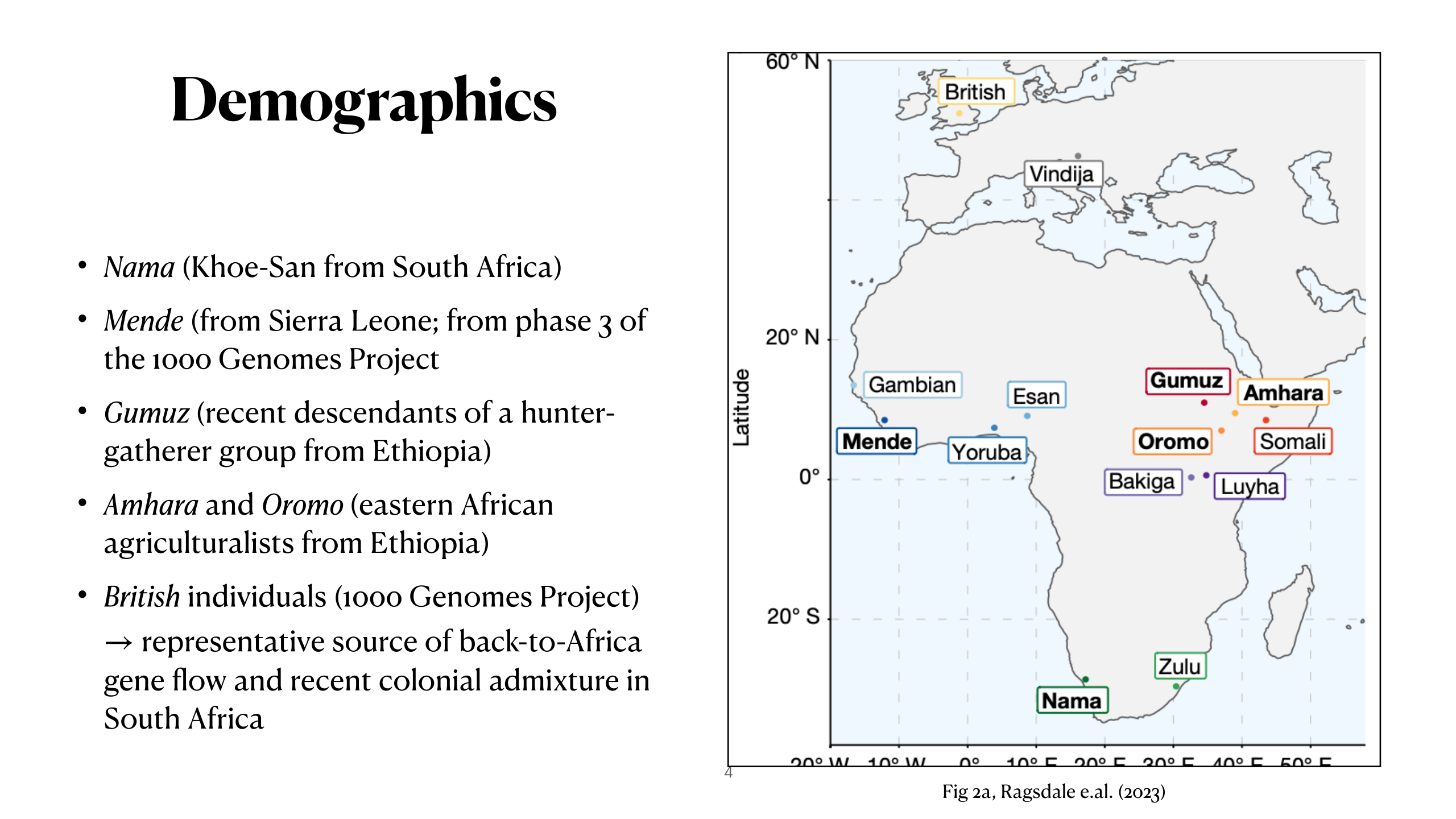
Demographics • Nama (Khoe-San from South Africa) • Mende (from Sierra Leone; from phase 3 of the 1000 Genomes Project • Gumuz (recent descendants of a huntergatherer group from Ethiopia) • Amhara and Oromo (eastern African agriculturalists from Ethiopia) • British individuals (1000 Genomes Project) → representative source of back-to-Africa gene ow and recent colonial admixture in South Africa fl Fig 2a, Ragsdale e.al. (2023)
Starting Models
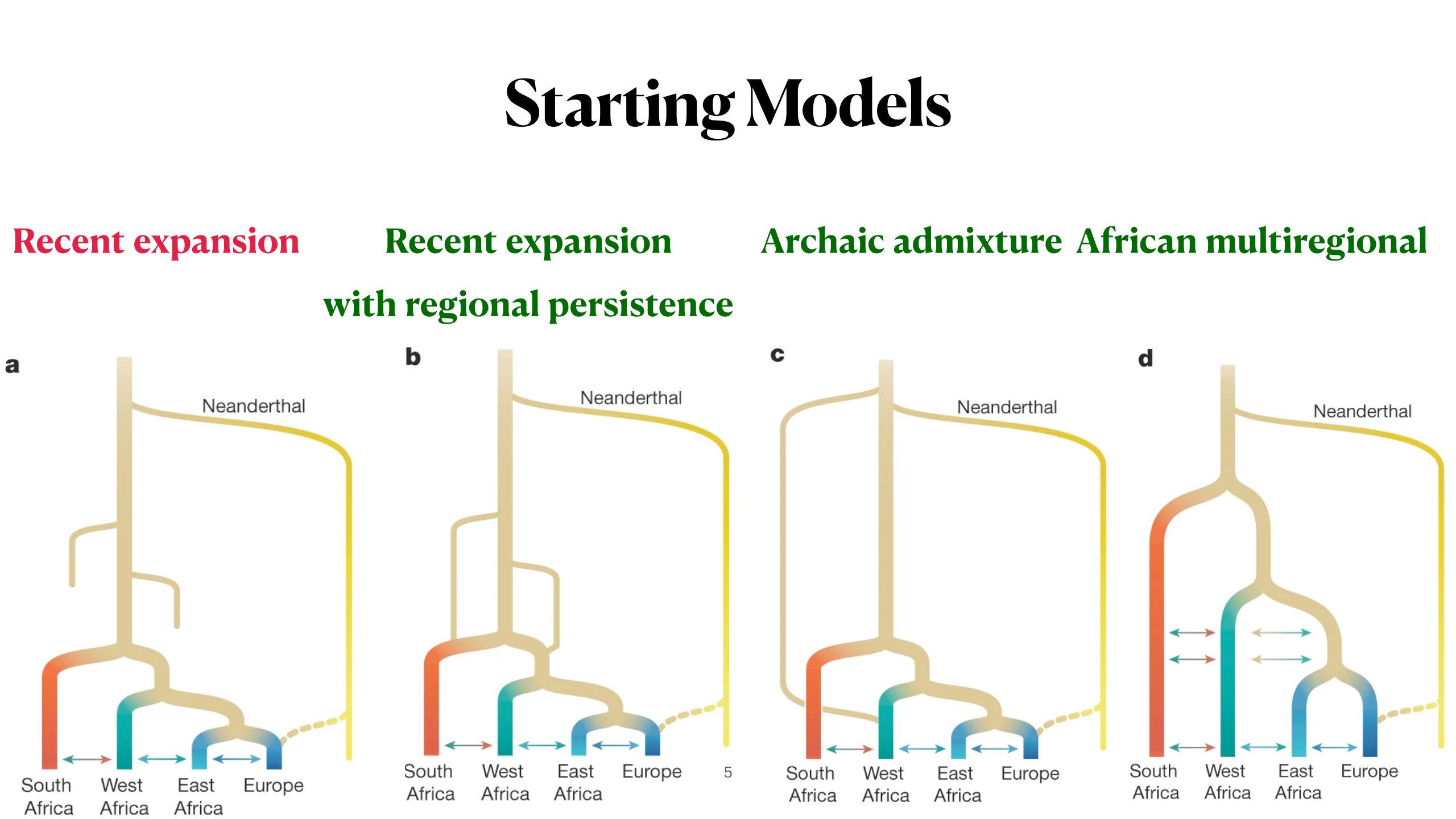
Starting Models Recent expansion Archaic admixture African multiregional Recent expansion with regional persistence
A maximum-likelihood inference framework helped gauge the relative time depth of divergence, assuming that Neanderthals
A maximum-likelihood inference framework helped gauge the relative time depth of divergence, assuming that Neanderthals diverged 550,000 years ago from a common stem.
Methods
Methods D t nd Sequencing - African Diversity Reference Panel (ADRP) and 1000 Genomes Project (1KGP) populations. - Merged with the high-coverage Neanderthal genome from Vindija Cave. - Variant removal in high linkage disequilibrium: ADMIXTURE and PCA (R2 > 0.1). a a a
Methods
Methods Link ge disequilibrium nd diversity st tistics - Expectation & likelihood-based parameter optimisation → software: Moments - Testing multiple scenarios of early population structure: long-lasting continuous migration between stem populations 2. periods of isolation with subsequent merger events a a a
Methods
Methods Model speci ic tion nd itting - Parameters ⇐ population sizes, size changes, split times, continuous migration rates, admixture times, proportions - Likelihoods ⇐ Composite multivariate Gaussian likelihood approach - Con dence intervals ⇐ Re tting each model to 200 block-bootstrap replicate datasets fi f a a f fi
Methods
Methods Gene gene logy reconstruction - Reconstruct genome-wide gene genealogies → Software used: Relate - Coalescence rates within and between populations → e ective population sizes - Compare reconstructed genealogies from data to model predictions to simulate genomic data for each population in models → Software used: msprime ff a
A weakly structured stem best describes two-locus statistics
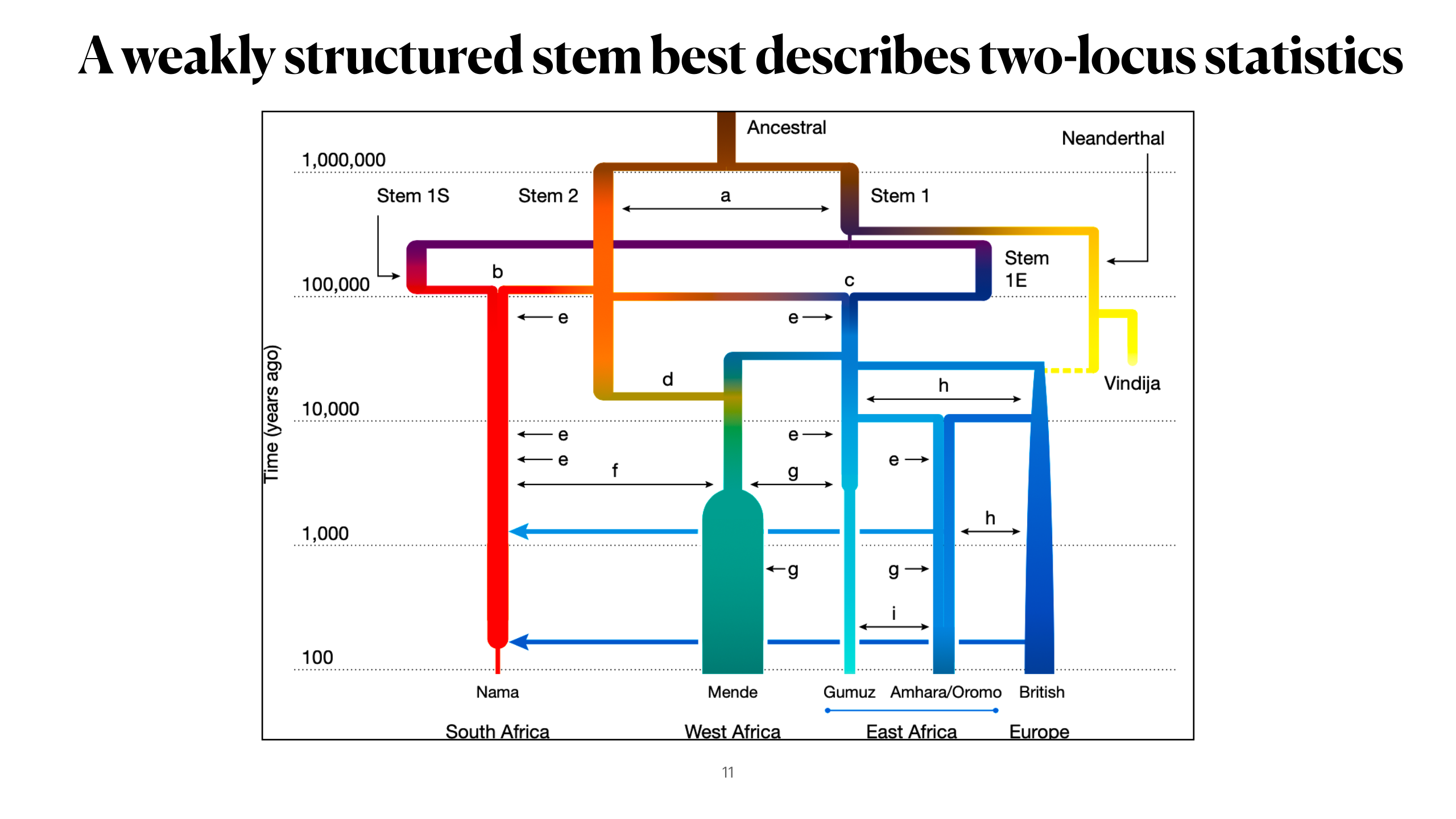
*The weakly structured stem model is not incompatible with archaic admixture having occurred in the ancestry of these fo
*The weakly structured stem model is not incompatible with archaic admixture having occurred in the ancestry of these fossils, but would imply, by contrast, that such individuals are unlikely to have contributed much ancestry to contemporary humans.
Conclusions
Conclusions Highlights Inferring a reticulated African population history in which present-day population structure dates back to Marine Isotope Stage 5 ~ 130,000 - 80,000 years ago. 2. The model explains patterns of polymorphism that had previously been attributed to contributions from archaic hominins in Africa. 3. Fossil remains from coexisting ancestral populations should be genetically and morphologically similar (1-4% differentiation for genetic drift). 4. Model misspeci ication explains the variation in previous estimates of divergence times. f
Takeways
Takeways Highlights • Geographical patterns of contemporary H. sapiens population structure probably arose during Marine Isotope Stage 5. • Studying a range of models is key to making robust inferences about deep history. Challenge: co-estimation of divergence time and subsequent migration Future prospect: predictions of model to be related to the fossil record
“The knowledge that has not come down to us is larger than the knowledge that has.”
“The knowledge that has not come down to us is larger than the knowledge that has.” Ibn Kh ldun, The Muq ddim h (1377 AD) a a a
Thanks for listening!