Dynamic Programming: Biological Sequence Analysis
Credits: Wikipedia, Wolfgang Beyer Abhinav Mishra Dynamic Programming: Biological Sequence Analysis What? How? Why?
“The problem is not to be considered solved in the mathematical sense until the structure of the optimal policy is under
“The problem is not to be considered solved in the mathematical sense until the structure of the optimal policy is understood.” Richard Bellman (pg. ix, ‘Dynamic Programming’, 1957)
Biological Problem
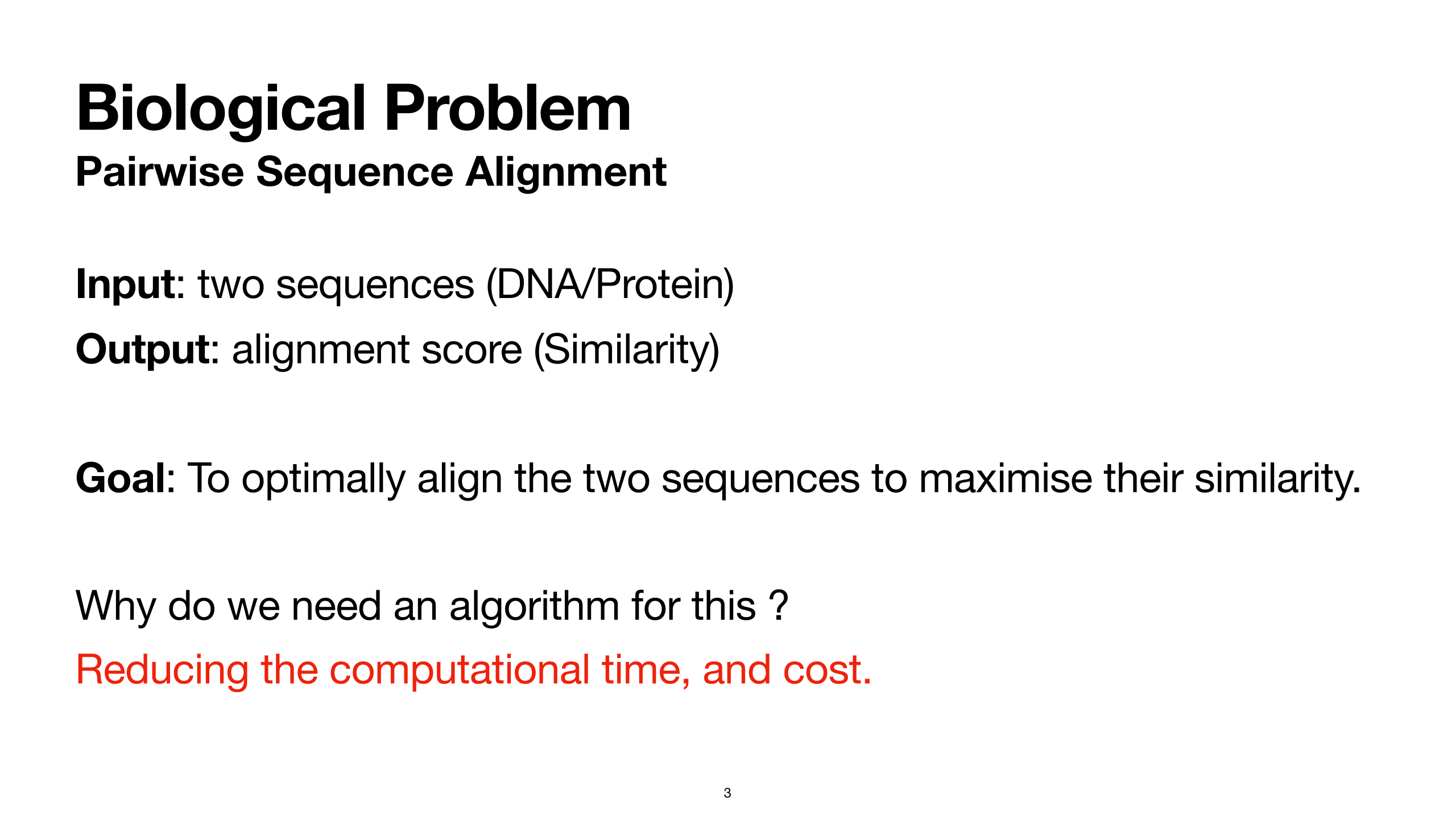
Biological Problem Pairwise Sequence Alignment Input: two sequences (DNA/Protein) Output: alignment score (Similarity) Goal: To optimally align the two sequences to maximise their similarity. Why do we need an algorithm for this ? Reducing the computational time, and cost.
Biological Problem • Scoring matrix σ(a, b) • Gap Penalty γ
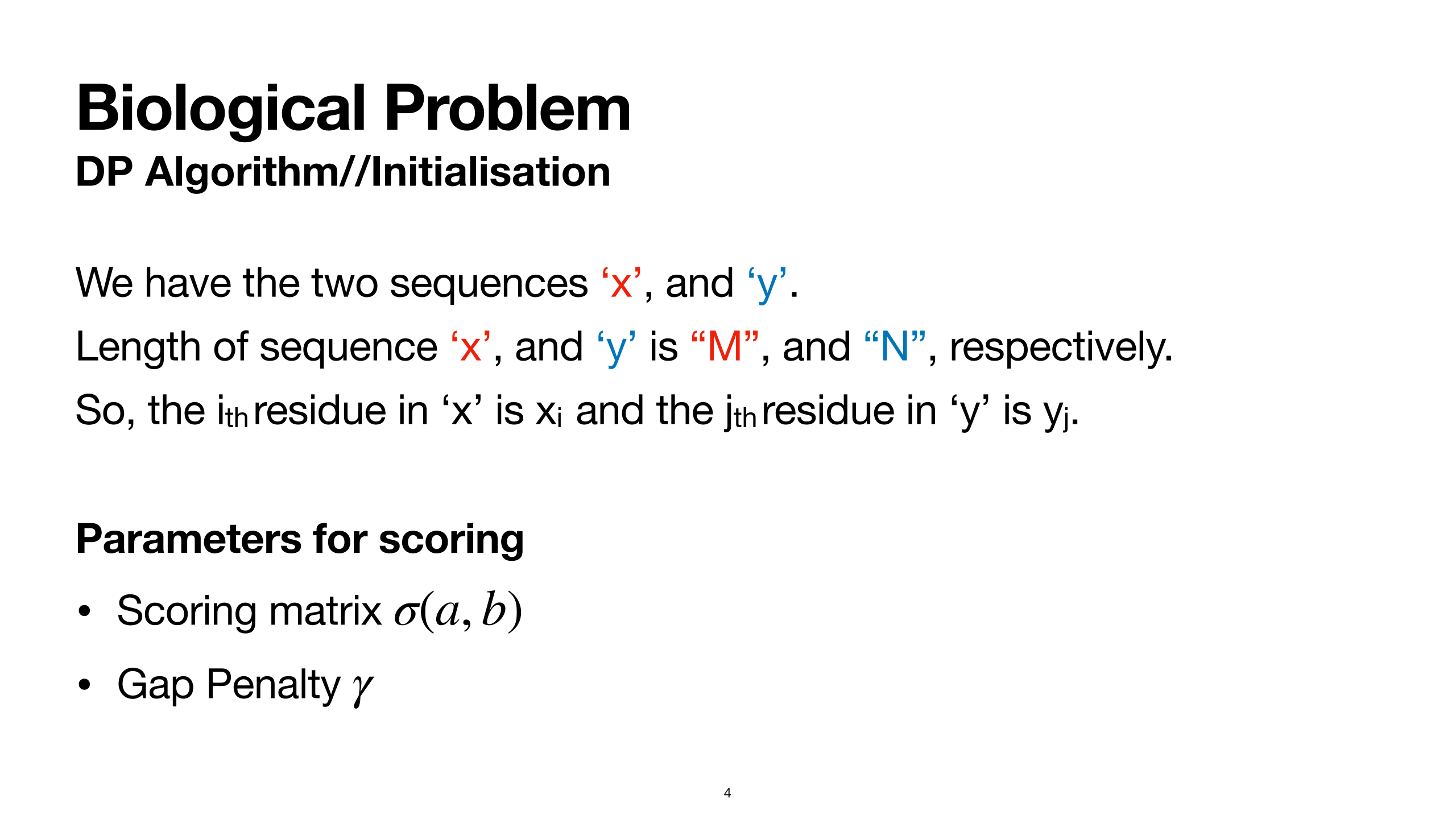
Biological Problem DP Algorithm//Initialisation We have the two sequences ‘x’, and ‘y’. Length of sequence ‘x’, and ‘y’ is “M”, and “N”, respectively. So, the ith residue in ‘x’ is xi and the jth residue in ‘y’ is yj. Parameters for scoring • Scoring matrix σ(a, b) • Gap Penalty γ
Biological Problem
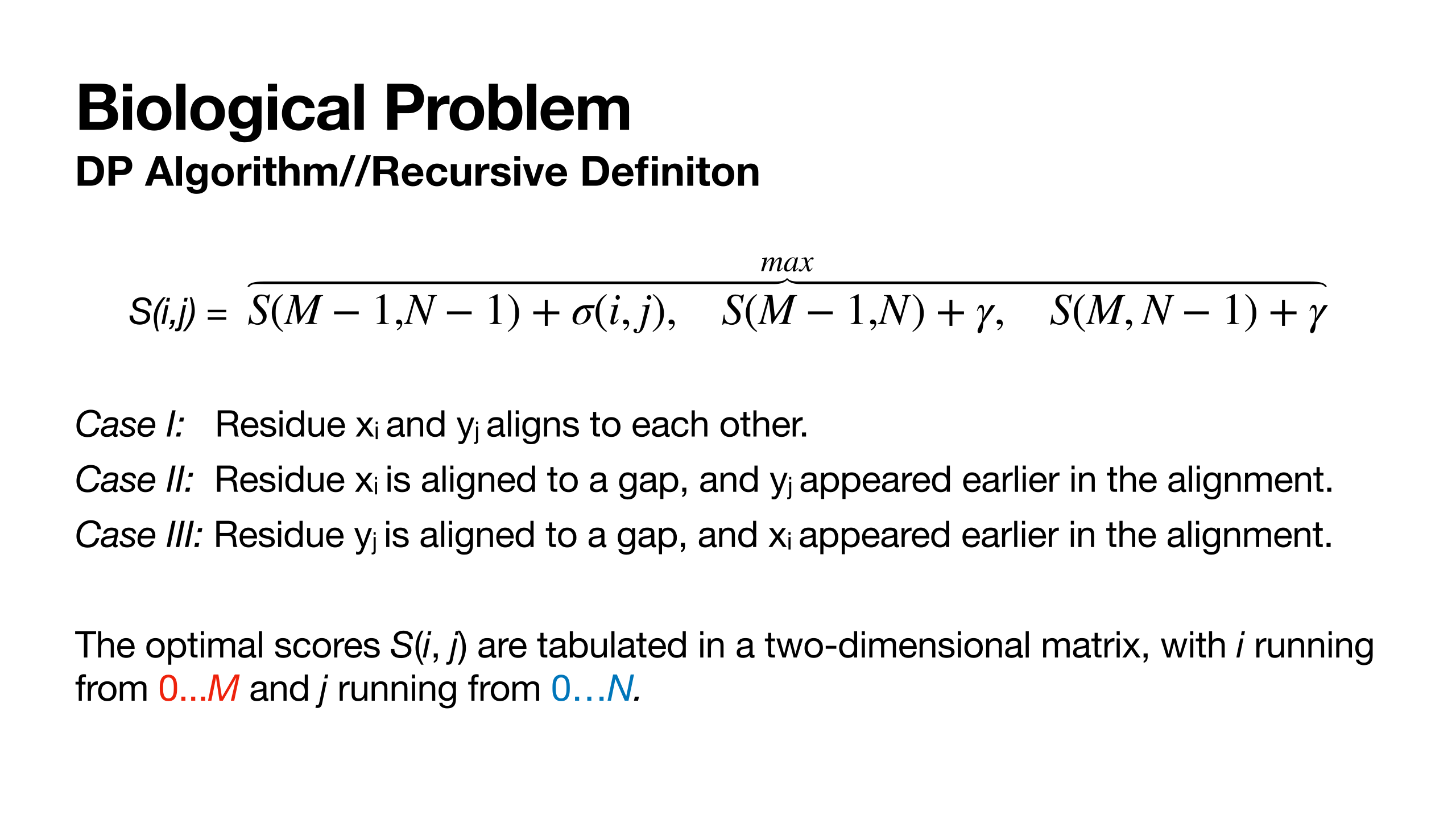
Biological Problem DP Algorithm//Recursive Definiton S(i,j) = S(M − 1,N − 1) + σ(i, j), max S(M − 1,N) + γ, S(M, N − 1) + γ Case I: Residue xi and yj aligns to each other. Case II: Residue xi is aligned to a gap, and yj appeared earlier in the alignment. Case III: Residue yj is aligned to a gap, and xi appeared earlier in the alignment. The optimal scores S(i, j) are tabulated in a two-dimensional matrix, with i running from 0...M and j running from 0…N.
Biological Problem Iterate two nested loops for(i = 0....M) for(i = 0....N)
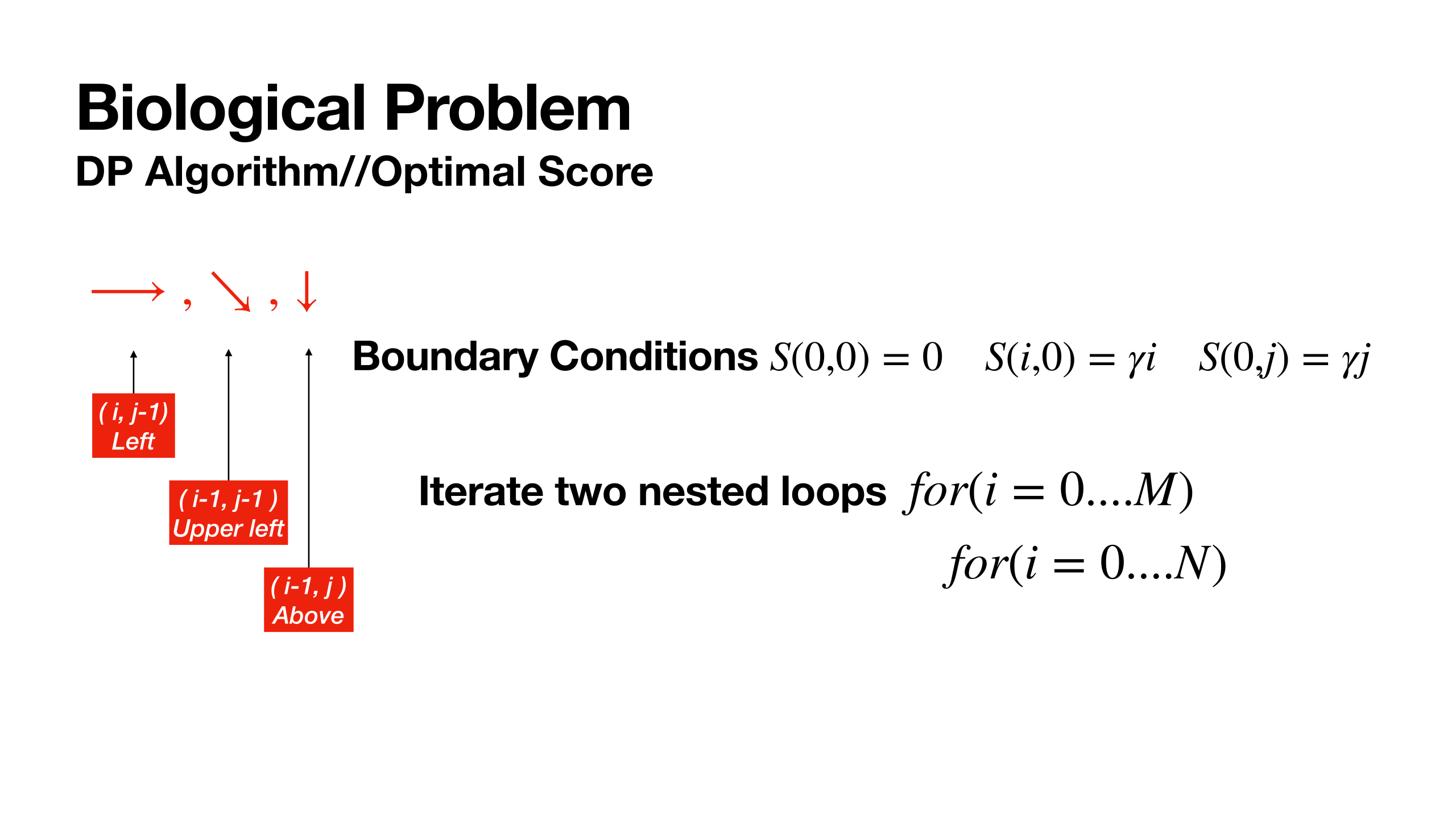
Biological Problem DP Algorithm//Optimal Score ( i, j-1) Left ( i-1, j-1 ) Upper left ( i-1, j ) Above Boundary Conditions S(0,0) = 0 S(i,0) = γi Iterate two nested loops for(i = 0....M) S(0,j) = γj for(i = 0....N)
Biological Problem 2. Determine, and record which of the three cases ( ⟶ , ↘ , ↓ ) led to
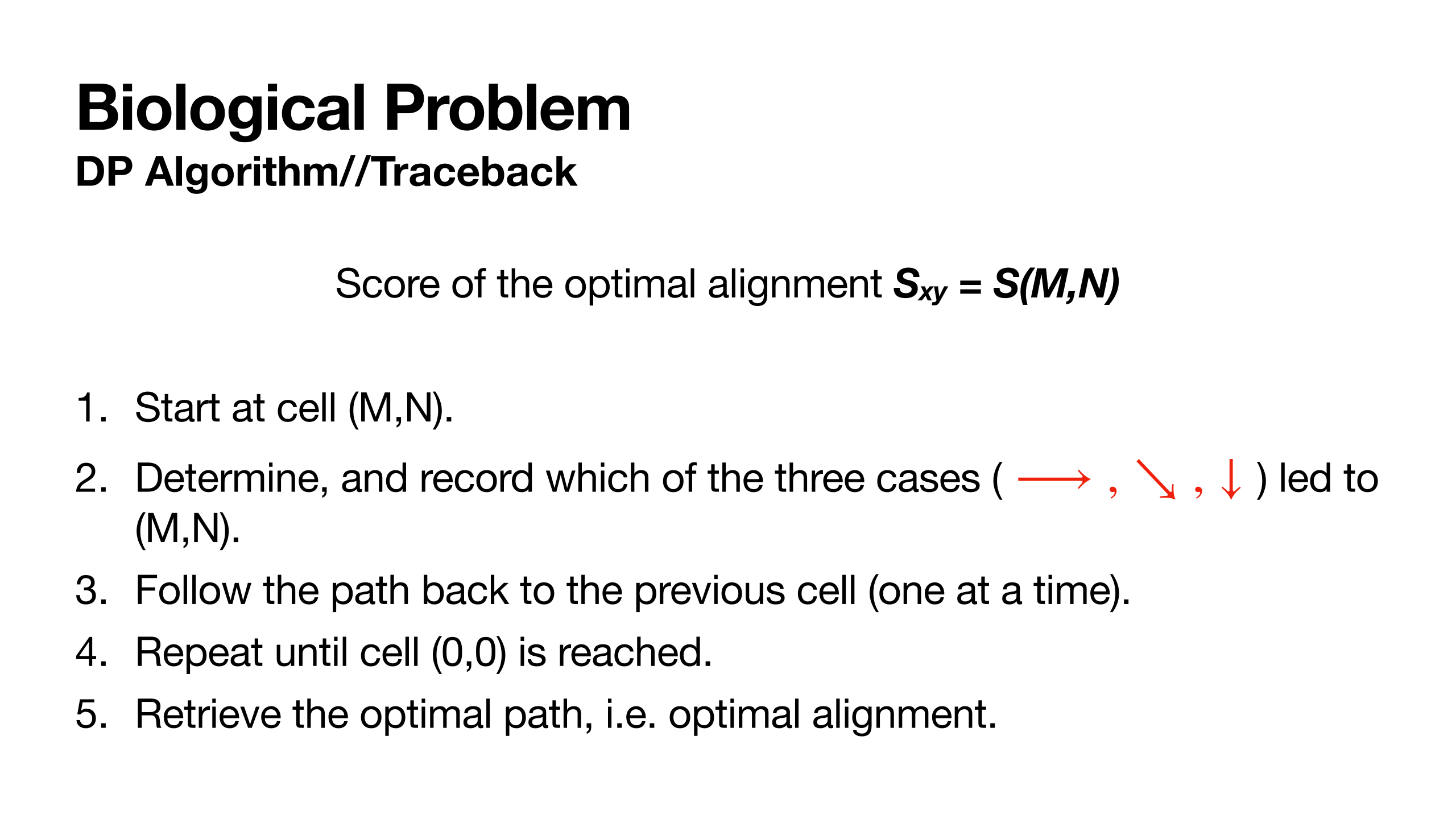
Biological Problem DP Algorithm//Traceback Score of the optimal alignment Sxy = S(M,N) 1. Start at cell (M,N). 2. Determine, and record which of the three cases ( ⟶ , ↘ , ↓ ) led to (M,N). 3. Follow the path back to the previous cell (one at a time). 4. Repeat until cell (0,0) is reached. 5. Retrieve the optimal path, i.e. optimal alignment.
Question 6.
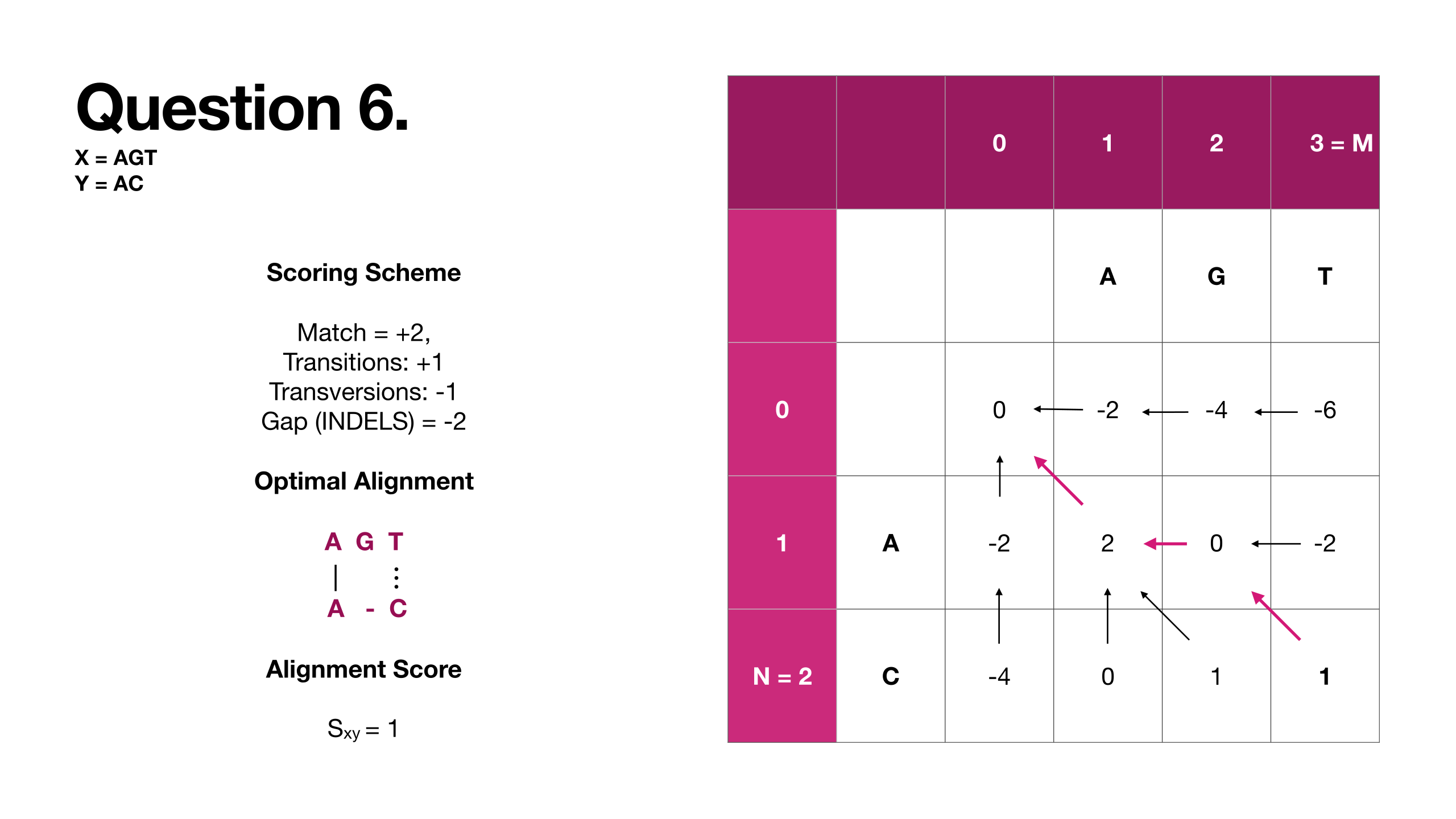
Question 6. X = AGT Y = AC 3=M A G T Scoring Scheme Match = +2, Transitions: +1 Transversions: -1 Gap (INDELS) = -2 Optimal Alignment A G T A N=2 C A - C Alignment Score Sxy = 1
“Mathematical Induction proves that we can climb as high as we like on a ladder, by proving that we can climb onto the b
“Mathematical Induction proves that we can climb as high as we like on a ladder, by proving that we can climb onto the bottom rung (the basis) and that from each rung we can climb up to the next one (the step).” pg. 3, Concrete Mathematics, 1989
Reference
Reference & Credit Eddy, Sean R. "What is dynamic programming?." Nature biotechnology 22, no. 7 (2004): 909-910. “Mandel zoom 00 mandelbrot set.jpg”, Created by Wolfgang Beyer with the program Ultra Fractal 3. / CC BY-SA (http://creativecommons.org/ licenses/by-sa/3.0/).
Thank you for the opportunity!