Castor Oil
Castor Oil Industrial Crops and Products Abhinav Mishra 8th Semester Abhinav Mishra 8th Semester Industrial Crops and Products | 15B1WBT841
Ricinus communis
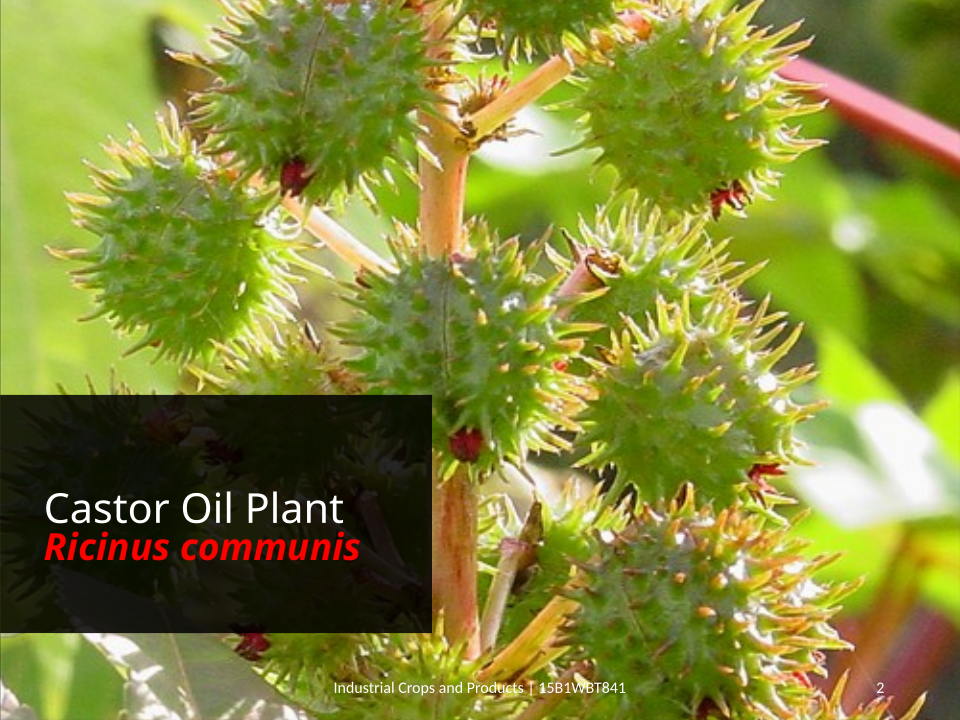
Castor Oil Plant Ricinus communis Industrial Crops and Products | 15B1WBT841
Post-bloom, with developing seed capsules

Post-bloom, with developing seed capsules Industrial Crops and Products | 15B1WBT841
The green capsule dries up.

The green capsule dries up. Industrial Crops and Products | 15B1WBT841
Capsule splits into three sections, forcibly ejecting seeds
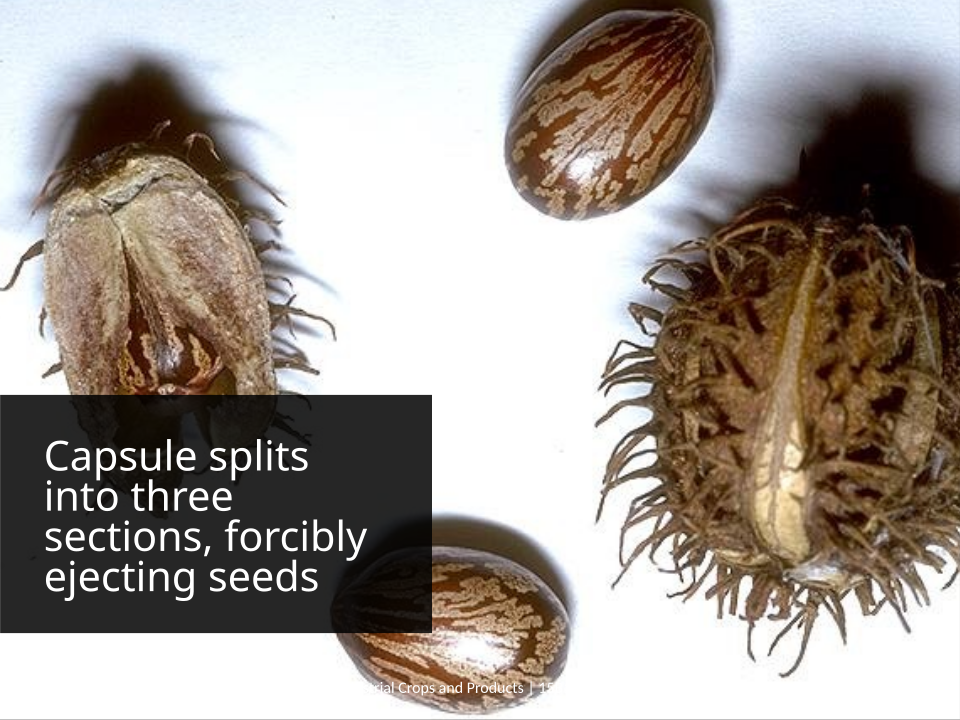
Capsule splits into three sections, forcibly ejecting seeds Industrial Crops and Products | 15B1WBT841
Seeds

Seeds Industrial Crops and Products | 15B1WBT841
Introduction
Introduction Castor oil is derived from the bean of the castor plant, Ricinus communis, belonging to the family Euphorbiaceae. The seeds of the castor plant are produced in racemes, or clusters of capsules. The capsules each contain three seeds protected by a hull that is removed prior to processing. The seeds are mottled to varying extents, most often with shades of dark brown overlaying shades of light brown. Seeds of commercial varieties range from 250 to 1800/kg. Industrial Crops and Products | 15B1WBT841
Properties
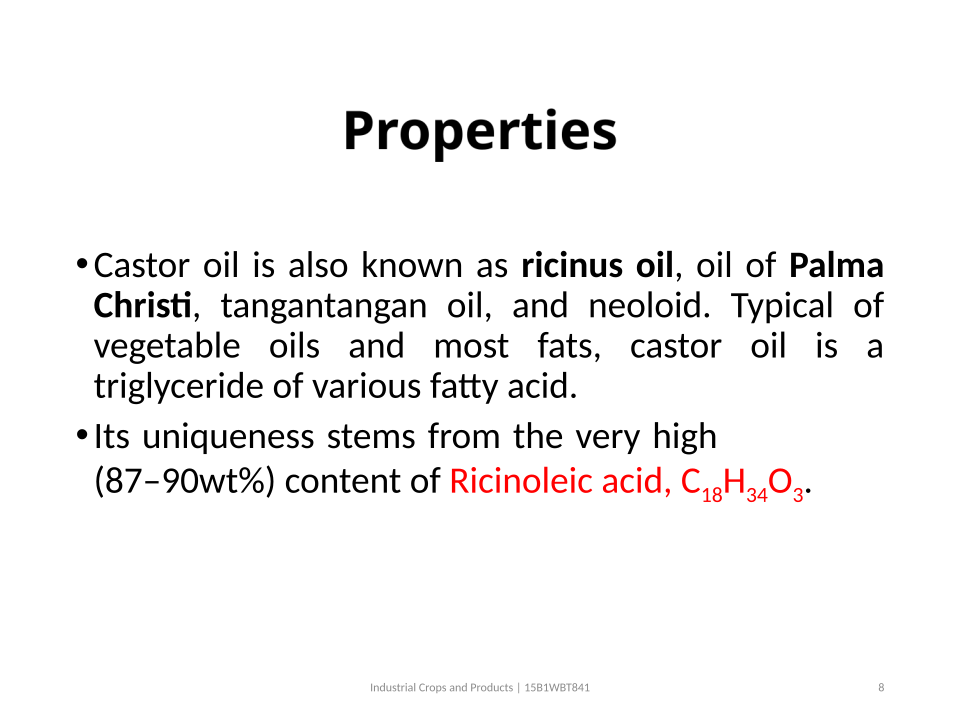
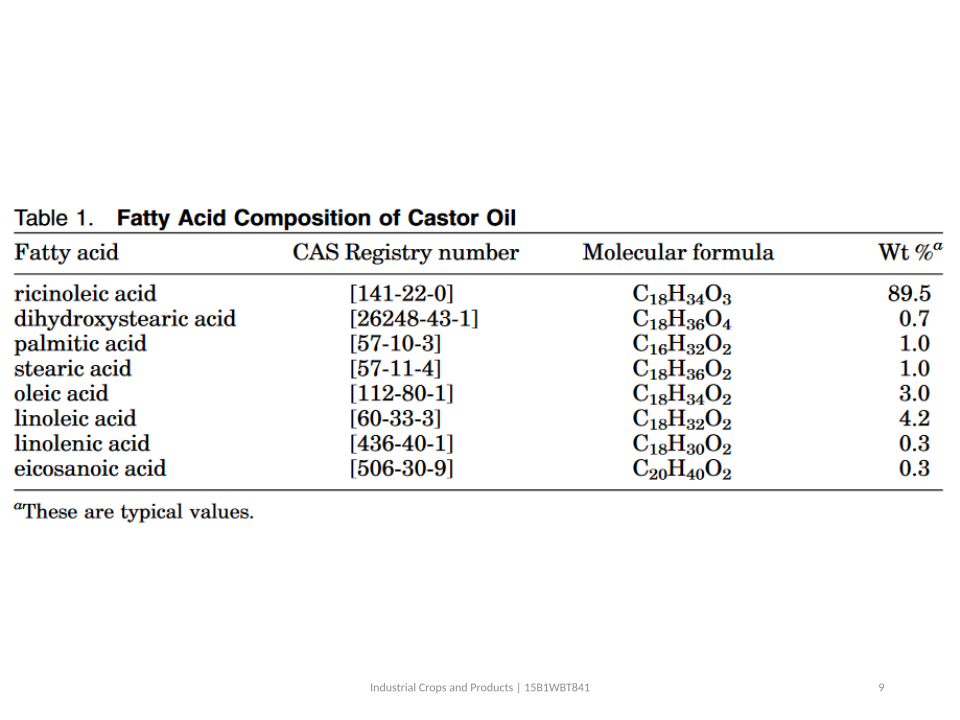
Properties • Castor oil is also known as ricinus oil, oil of Palma Christi, tangantangan oil, and neoloid. Typical of vegetable oils and most fats, castor oil is a triglyceride of various fatty acid. • Its uniqueness stems from the very high (87–90wt%) content of Ricinoleic acid, C18H34O3. Industrial Crops and Products | 15B1WBT841
Industrial Crops and Products | 15B1WBT841
Industrial Crops and Products | 15B1WBT841
Industrial Crops and Products | 15B1WBT841
Commercial Processes
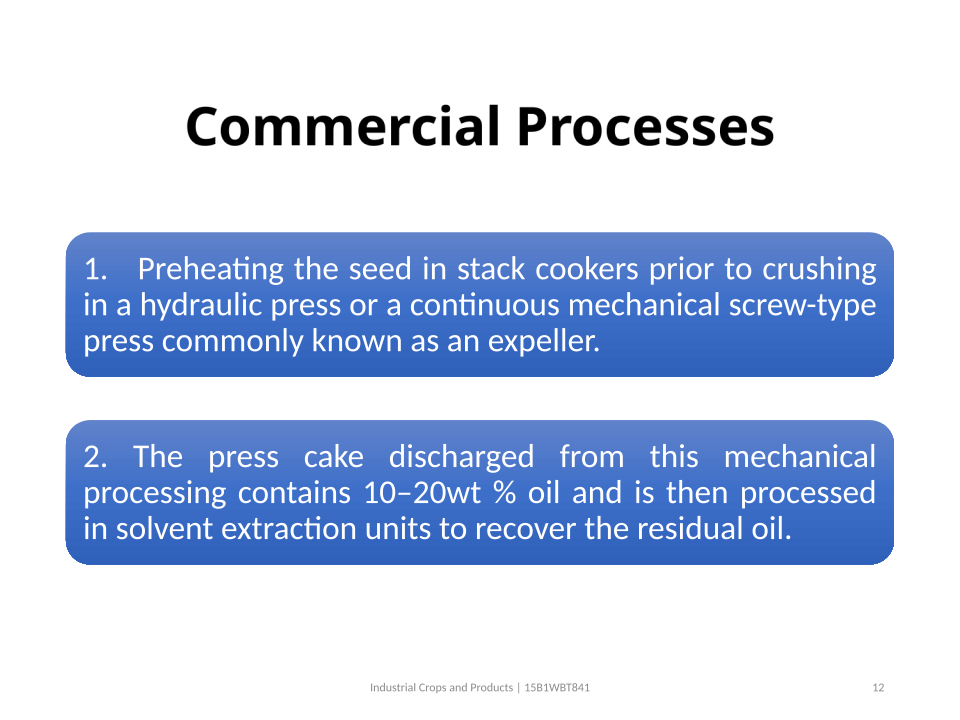
Commercial Processes 1. Preheating the seed in stack cookers prior to crushing in a hydraulic press or a continuous mechanical screw-type press commonly known as an expeller. 2. The press cake discharged from this mechanical processing contains 10–20wt % oil and is then processed in solvent extraction units to recover the residual oil. Industrial Crops and Products | 15B1WBT841
A light colored, high quality medicinal type oil is recovered. Castor oil recovered from hydraulic or continuous mechani
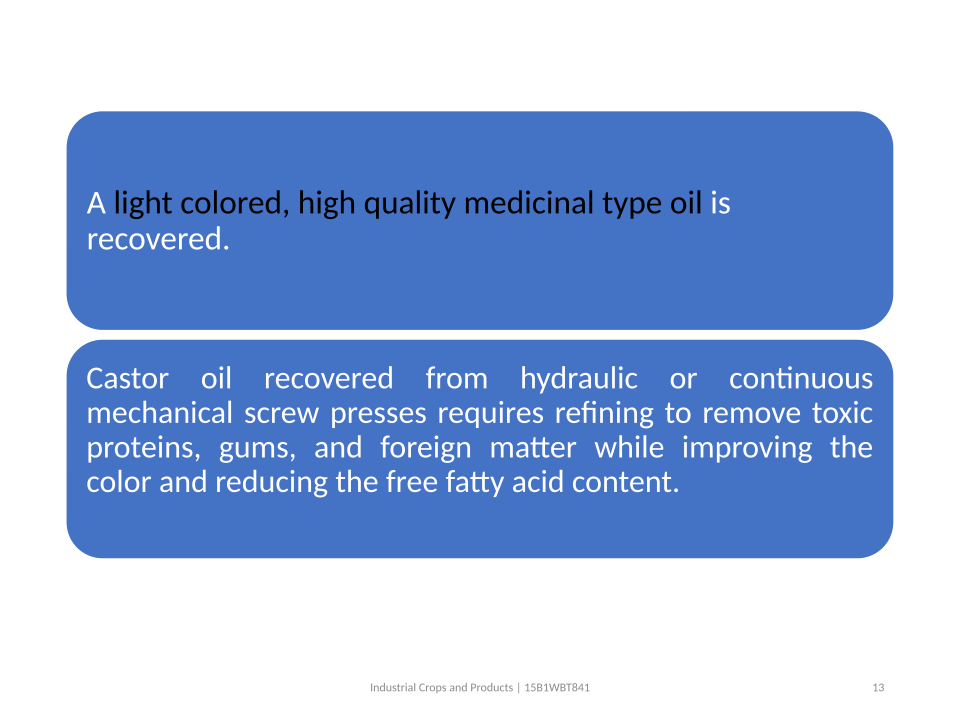
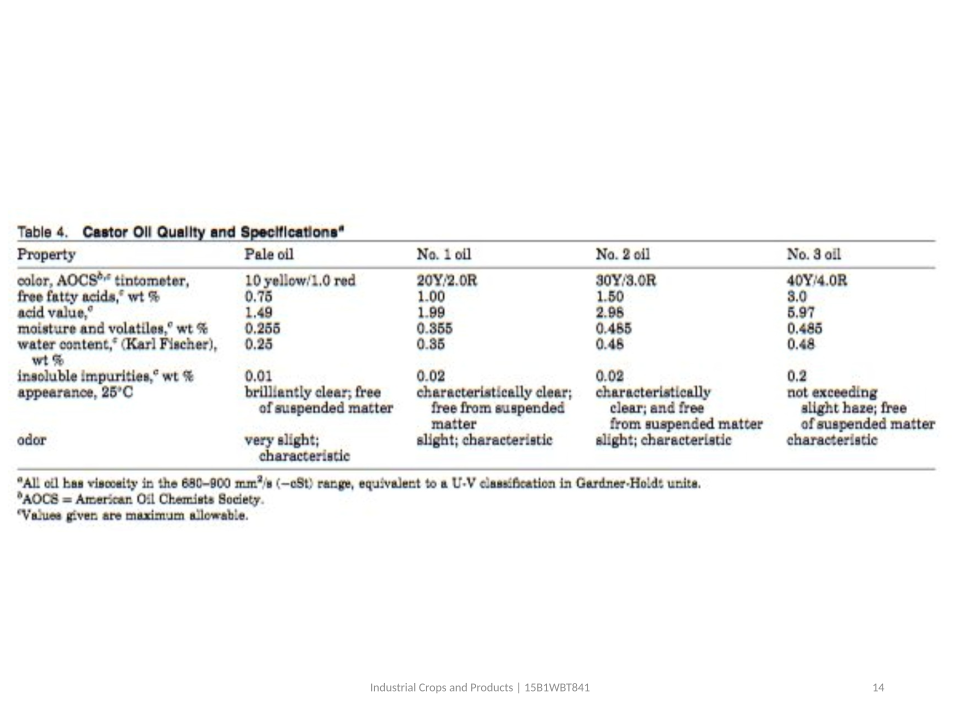
A light colored, high quality medicinal type oil is recovered. Castor oil recovered from hydraulic or continuous mechanical screw presses requires refining to remove toxic proteins, gums, and foreign matter while improving the color and reducing the free fatty acid content. Industrial Crops and Products | 15B1WBT841
Industrial Crops and Products | 15B1WBT841
Industrial Crops and Products | 15B1WBT841
Oil Recovery
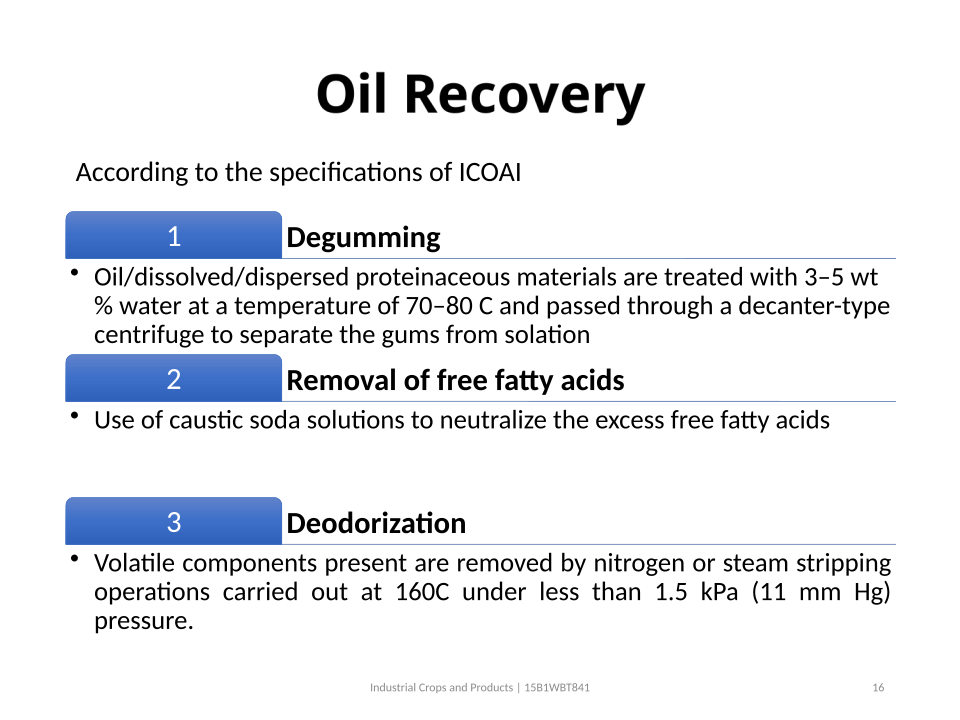
Oil Recovery According to the specifications of ICOAI Degumming • Oil/dissolved/dispersed proteinaceous materials are treated with 3–5 wt % water at a temperature of 70–80 C and passed through a decanter-type centrifuge to separate the gums from solation Removal of free fatty acids • Use of caustic soda solutions to neutralize the excess free fatty acids Deodorization • Volatile components present are removed by nitrogen or steam stripping operations carried out at 160C under less than 1.5 kPa (11 mm Hg) pressure. Industrial Crops and Products | 15B1WBT841
Economic Aspects
Economic Aspects • India is the largest producer of castor seeds in the world. China and Brazil follow. • Historically India, Brazil, and China have been the key producing countries meeting global requirements. • India production ranges between 250,000-350,000 t/year. Industrial Crops and Products | 15B1WBT841
Health and Safety Factors
Health and Safety Factors The toxicological properties of this castor oil have not been fully investigated : Castor oil may cause eye and skin irritation and irritation of the digestive tract. Castor oil is not listed as a carcinogen by ACGIH, IARC, NTP or Ca Prop 65 During fire, irritating and highly toxic gases may be generated by thermal decomposition or combustion. Runoff from fire control or dilution may cause pollution. Use water spray, dry chemical, carbon dioxide, or chemical foam to extinguish fire. • Store in a tightly closed container. • Store in a cool, dry well-ventilated area away from incompatible substances Industrial Crops and Products | 15B1WBT841
Uses
Uses 1. Castor oil is unique among all fatty oils. It is the only renewable vegetable oil resource having a hydroxyl group structure. 2. Many years ago, castor oil was primarily used for medicinal purposes and as a general industrial lubricant. 3. Later derivatives of castor oil were produced and the many more uses were found for the oil. Castor oil and its derivatives are important commodities to the chemical industry. Industrial Crops and Products | 15B1WBT841
• Polyamides (Nylon – 11) [Air brakes/Powder Metal Coatings] VESTAMID Terra DS and HS - both polymers derived from casto
• Polyamides (Nylon – 11) [Air brakes/Powder Metal Coatings] VESTAMID Terra DS and HS - both polymers derived from castor oil • Urethanes Foams (Thermal insulations and structural support) • Coatings (High abrasion resistance on steel plates and flexibility on aluminum plates and PVC cloth) • Lubricants (Non - volatile, high temperature lubricants for jet engines) Castrol B353 is a blended SAE 40 formulation employing castor oil avoids combustion chamber deposits and sludge build-up • Textiles Enhance fiber finish, Uniform Shade Levels Industrial Crops and Products | 15B1WBT841
• Cosmetics Basic lipstick contains 20–44wt % castor oil, which also acts as an ideal dispersant for pigments [nonirri
• Cosmetics Basic lipstick contains 20–44wt % castor oil, which also acts as an ideal dispersant for pigments [nonirritating and noncomedogenic] Haircare [Foam enhancement and conditioning] Antiperspirant sticks • Surfactants and Detergents PEG-40 castor oil , a surfactant that has co-solvent properties and is utilized as a fragrance solubilizer Pearlescence in Shampoos Sulfated castor oil is also used in dishwashing compounds as a hand softener • Biofuels Evogene Ltd announced that biosynthetic paraffin kerosene (bio jet fuel) produced from the company’s castor varieties meets key international standards for alternative fuels (in collaboration with NASA and U.S. Air Force). ASTMD7566 is written for Fischer Tropsch process fuel Industrial Crops and Products | 15B1WBT841
References
References Naughton, F. C. (1974). Production, chemistry, and commercial applications of various chemicals from castor oil. Journal of the American Oil Chemists Society, 51(3), 65-71. doi:10.1007/bf00000015 Naughton, F. C. (2011). Castor Oil Kirk-Othmer Encyclopedia of Chemical Technology: John Wiley & Sons, Inc., 1-20. doi:10.1002/0471238961.0301192014012107.a01.pub2 Industrial Crops and Products | 15B1WBT841
Thank you !

Thank you ! Industrial Crops and Products | 15B1WBT841